AQA · GCSE · Chemistry
Course version: 8462 · Version from Sept 2018
Students should be able to identify formulations given appropriate…
Full specification wording
Formulations: Students should be able to identify formulations given appropriate information.
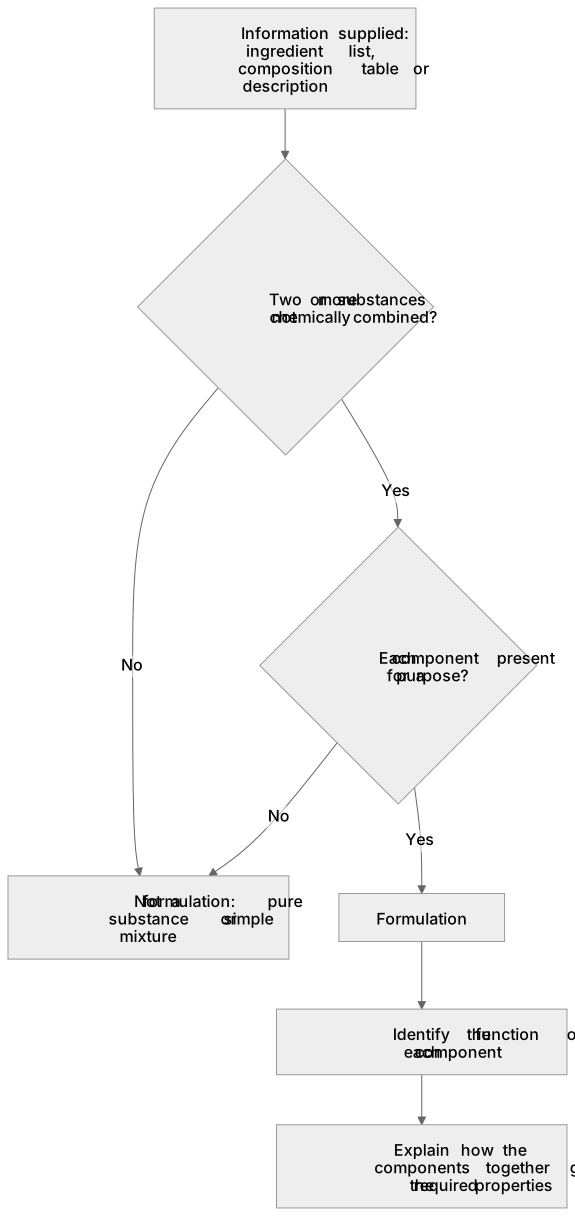
To identify a formulation, examine the information provided and decide whether the product is a mixture of two or more substances combined for a purpose.
Checked against the AQA 8462 specification (opens in a new tab) on .
- Point 5 of 5
- 4 key terms
Study notes
From the checked teaching notes for this specification point.
The idea
To identify a formulation, examine the information provided and decide whether the product is a mixture of two or more substances combined for a purpose. Look for a list of ingredients, a composition table or a description of properties that depend on several components. A single substance with a fixed melting point is not a formulation, whereas a product whose ingredients each have a stated role is one. For example, a data table showing a medicine contains an active ingredient, a filler and a coating indicates a formulation. You may also be asked to suggest why a component is included or how changing its amount would alter the product. Use the evidence given rather than assumptions, and justify your identification by referring to the components and their functions.
What earns the marks
- Use the information supplied, such as an ingredient list or composition table, to decide whether the product is a formulation.
- A formulation contains two or more substances that are not chemically combined and that are present for a purpose.
- Identify the function of each listed component, such as solvent, active ingredient, pigment or preservative.
- Explain how the combination of components gives the product its required properties.
- Distinguish a formulation from a pure substance or a simple mixture by referring to the evidence provided.
Common mistakes and how to put them right
Guessing from the product name alone.
Put it right: Base the identification on the components and evidence given.
Calling every mixture a formulation.
Put it right: Check that the components are present in measured amounts for a designed purpose.
Ignoring the function of components and listing them only.
Put it right: Link each component to the property it provides.
Exam tips
- Underline the components and their stated purposes in the information before answering.
- Write a short justification that names at least two components and explains their roles.
- If asked whether a substance is a formulation, state your decision first and then support it with evidence.
Try the lesson
The start of the Formulations: Students should be able to identify formulations given appropriate information. lesson, made from checked teaching notes for this specification point.
Have a go first
A label states that a product is a mixture of three substances blended in set proportions for a particular use. What type of substance is the product?
Listen
To identify a formulation, examine the information provided and decide whether the product is a mixture of two or more substances combined for a purpose. Look for a list of ingredients, a composition table or a description of properties that depend on several components. A single substance with a fixed melting point is not a formulation, whereas a product whose ingredients each have a stated role is one. For example, a data table showing a medicine contains an active ingredient, a filler and a coating indicates a formulation. You may also be asked to suggest why a component is included or how changing its amount would alter the product. Use the evidence given rather than assumptions, and justify your identification by referring to the components and their functions. A strong answer earns marks for these points. Use the information supplied, such as an ingredient list or composition table, to decide whether the product is a formulation. A formulation contains two or more substances that are not chemically combined and that are present for a purpose. Identify the function of each listed component, such as solvent, active ingredient, pigment or preservative. Explain how the combination of components gives the product its required properties. A common slip: Guessing from the product name alone. Instead, base the identification on the components and evidence given. Exam tip: Underline the components and their stated purposes in the information before answering.
See it
Key words
Say what each word means before you turn the card.
Evidence-based identification
Try answering aloud or in your head before turning the card.
Composition and function
Try answering aloud or in your head before turning the card.
Designed mixtures
Try answering aloud or in your head before turning the card.
Applying knowledge to unfamiliar products
Try answering aloud or in your head before turning the card.
See every definition
- Evidence-based identification
- Using the information supplied, such as an ingredient list or composition table, to decide whether the product is a formulation.
- Composition and function
- Identifying the function of each listed component and explaining how the combination of components gives the product its required properties.
- Designed mixtures
- Products containing two or more substances that are not chemically combined and that are present for a purpose.
- Applying knowledge to unfamiliar products
- Suggesting why a component is included or how changing its amount would alter the product, using the evidence given rather than assumptions.
There is more to this lesson
The full lesson goes on to check your understanding and help you earn the marks. Create a free account to carry on, with your progress saved.
A week of Premium from your first lesson · Then the free plan continues · No card, no charge
Test your understanding of Formulations: Students should be able to identify formulations given appropriate information.
Active recall beats re-reading. Take an instant quiz now to test what you’ve learned and lock it into long-term memory.
A week of Premium from your first lesson · Then the free plan continues · No card, no charge