AQA · GCSE · Chemistry
Course version: 8462 · Version from Sept 2018
Students should be able to explain how fractional distillation works in…
Full specification wording
Fractional distillation and petrochemicals: Students should be able to explain how fractional distillation works in terms of evaporation and condensation.
Crude oil is a mixture of hydrocarbons with different boiling points.
Checked against the AQA 8462 specification (opens in a new tab) on .
- Point 6 of 6
- 4 key terms
Study notes
From the checked teaching notes for this specification point.
The idea
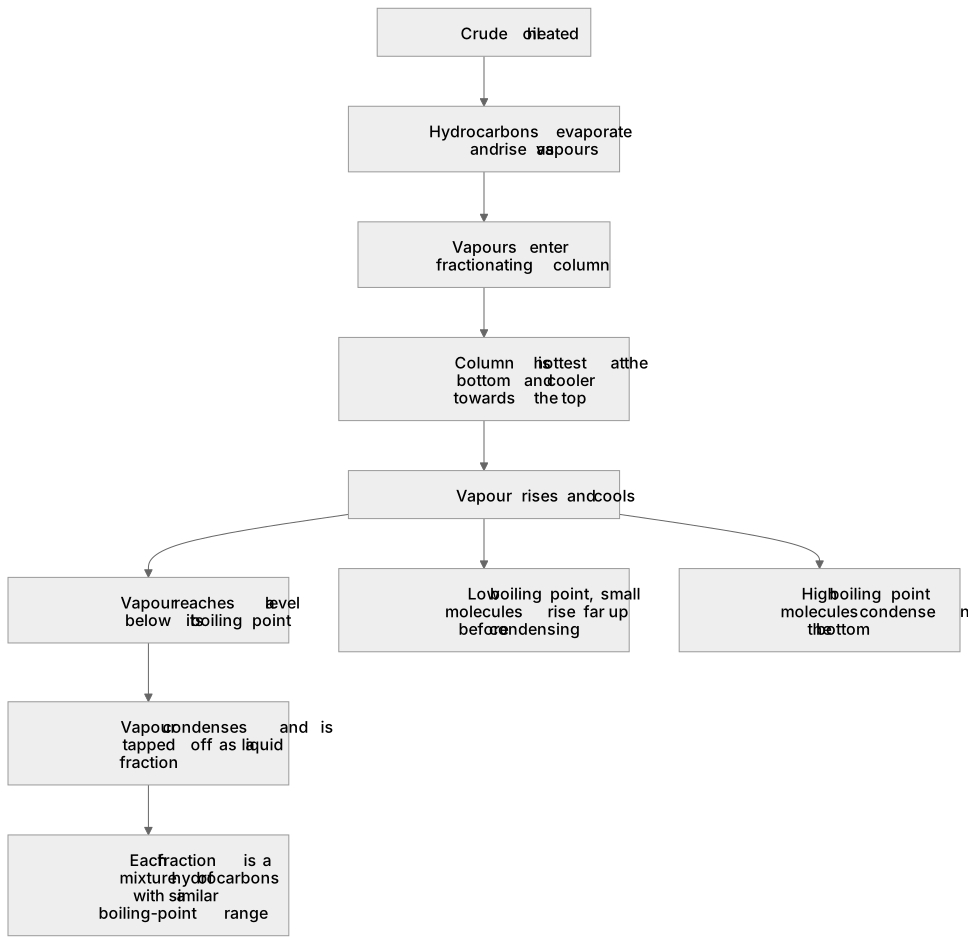
Crude oil is a mixture of hydrocarbons with different boiling points. It is heated until most fractions evaporate, and the vapours enter a fractionating column that is hot at the bottom and cooler towards the top. As a vapour rises it cools; when it reaches a region below its boiling point it condenses and is tapped off as a liquid. Fractions with low boiling points, made of small molecules, rise far up the column before condensing, while fractions with high boiling points condense near the bottom. Each fraction is a mixture of hydrocarbons with a similar boiling-point range, not a single pure compound. The process separates the mixture because evaporation and condensation occur repeatedly at different temperatures.
What earns the marks
- Crude oil is heated so that the hydrocarbons evaporate and rise as vapours into the fractionating column.
- The column has a temperature gradient, hottest at the bottom and coolest at the top.
- A vapour condenses when it reaches a level where the temperature is below its boiling point, and the liquid fraction is collected.
- Hydrocarbons with low boiling points, typically small molecules, travel further up the column before condensing.
- Hydrocarbons with high boiling points condense nearer the bottom of the column.
- Each collected fraction is a mixture of hydrocarbons with a similar boiling-point range rather than a pure substance.
Common mistakes and how to put them right
Saying fractions are separated by boiling point alone.
Put it right: Both evaporation and condensation are needed, with condensation occurring at a level where the temperature falls below the boiling point.
Stating that larger molecules rise to the top.
Put it right: Larger molecules have higher boiling points and condense lower down.
Describing each fraction as a pure compound.
Put it right: A fraction is a mixture of hydrocarbons with a similar boiling-point range.
Exam tips
- Refer to the temperature gradient of the column and link it to where each fraction condenses.
- Use the terms evaporate and condense explicitly, since the question asks for an explanation in terms of both processes.
- Compare small and large molecules in one sentence to show the link between boiling point and position in the column.
Try the lesson
The start of the Fractional distillation and petrochemicals: Students should be able to explain how fractional distillation works in terms of evaporation and condensation. lesson, made from checked teaching notes for this specification point.
Have a go first
In fractional distillation, what happens to the crude oil before it enters the fractionating column?
Listen
Crude oil is a mixture of hydrocarbons with different boiling points. It is heated until most fractions evaporate, and the vapours enter a fractionating column that is hot at the bottom and cooler towards the top. As a vapour rises it cools; when it reaches a region below its boiling point it condenses and is tapped off as a liquid. Fractions with low boiling points, made of small molecules, rise far up the column before condensing, while fractions with high boiling points condense near the bottom. Each fraction is a mixture of hydrocarbons with a similar boiling-point range, not a single pure compound. The process separates the mixture because evaporation and condensation occur repeatedly at different temperatures. A strong answer earns marks for these points. Crude oil is heated so that the hydrocarbons evaporate and rise as vapours into the fractionating column. The column has a temperature gradient, hottest at the bottom and coolest at the top. A vapour condenses when it reaches a level where the temperature is below its boiling point, and the liquid fraction is collected. Hydrocarbons with low boiling points, typically small molecules, travel further up the column before condensing. A common slip: Saying fractions are separated by boiling point alone. Instead, both evaporation and condensation are needed, with condensation occurring at a level where the temperature falls below the boiling point. Exam tip: Refer to the temperature gradient of the column and link it to where each fraction condenses.
See it
Key words
Say what each word means before you turn the card.
Evaporation and condensation
Try answering aloud or in your head before turning the card.
Boiling point and molecular size
Try answering aloud or in your head before turning the card.
Fractions as mixtures with boiling-point ranges
Try answering aloud or in your head before turning the card.
Separation of mixtures by physical processes
Try answering aloud or in your head before turning the card.
See every definition
- Evaporation and condensation
- Crude oil is heated so that hydrocarbons evaporate and rise as vapours, and a vapour condenses when it reaches a level where the temperature is below its boiling point.
- Boiling point and molecular size
- Hydrocarbons with low boiling points are typically small molecules and travel further up the column before condensing, while those with high boiling points condense nearer the bottom.
- Fractions as mixtures with boiling-point ranges
- Each collected fraction is a mixture of hydrocarbons with a similar boiling-point range rather than a pure substance.
- Separation of mixtures by physical processes
- The process separates the mixture because evaporation and condensation occur repeatedly at different temperatures.
Label the diagram
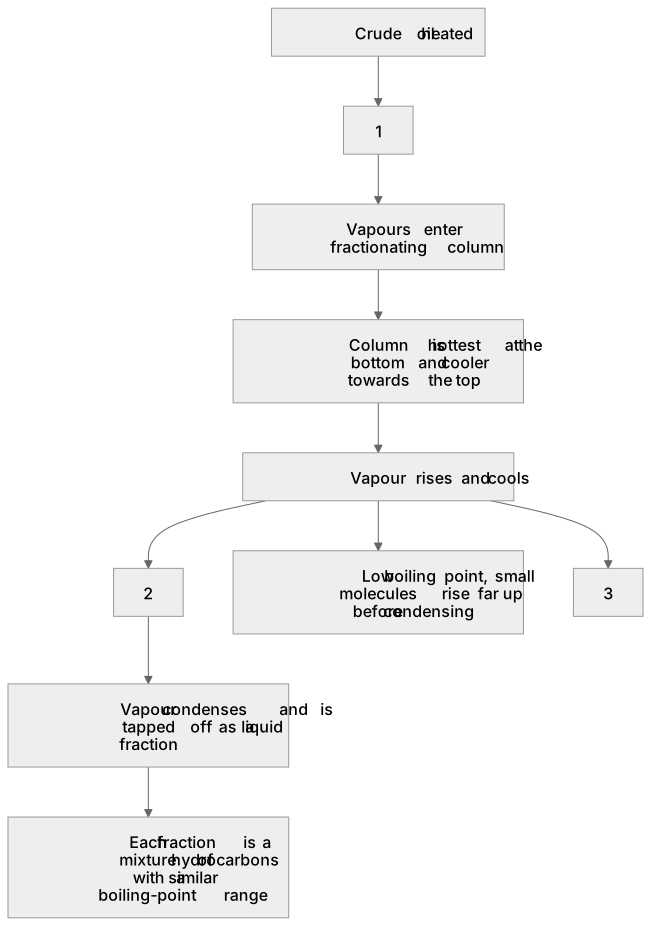
Some boxes have lost their names. Pick the right name for each number.
1Box 1
2Box 2
3Box 3
There is more to this lesson
The full lesson goes on to check your understanding and help you earn the marks. Create a free account to carry on, with your progress saved.
A week of Premium from your first lesson · Then the free plan continues · No card, no charge
Test your understanding of Fractional distillation and petrochemicals: Students should be able to explain how fractional distillation works in terms of evaporation and condensation.
Active recall beats re-reading. Take an instant quiz now to test what you’ve learned and lock it into long-term memory.
A week of Premium from your first lesson · Then the free plan continues · No card, no charge