AQA · GCSE · Chemistry
Course version: 8462 · Version from Sept 2018
These bonds must be overcome to melt or boil these substances.
Full specification wording
Giant covalent structures: These bonds must be overcome to melt or boil these substances.
Melting or boiling a giant covalent substance requires the covalent bonds in the network to be broken, not just weakened or separated.
Checked against the AQA 8462 specification (opens in a new tab) on .
- Point 3 of 5
- 4 key terms
Study notes
From the checked teaching notes for this specification point.
The idea
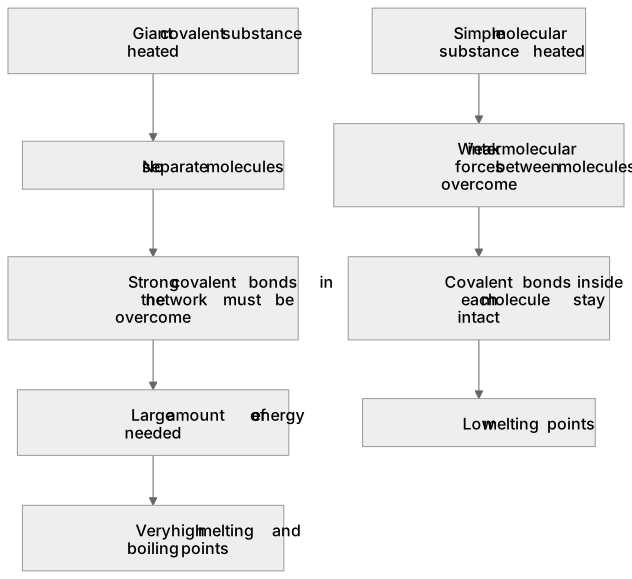
Melting or boiling a giant covalent substance requires the covalent bonds in the network to be broken, not just weakened or separated. In a simple molecular substance, intermolecular forces between molecules are overcome and the covalent bonds inside each molecule stay intact, so melting points are low. In a giant covalent structure there are no separate molecules, so the strong covalent bonds themselves must be overcome throughout the lattice. This needs a large amount of energy, which is why diamond melts at over 3500 °C, silicon dioxide melts at about 1700 °C and graphite sublimes at very high temperature. The number and strength of covalent bonds broken per atom, and the rigidity of the network, determine how much energy is needed.
What earns the marks
- Melting or boiling a giant covalent substance involves breaking strong covalent bonds within the continuous network.
- There are no intermolecular forces between separate molecules to overcome because the structure is one giant network.
- A large amount of energy is required, so giant covalent substances have very high melting and boiling points.
- The energy needed depends on the number and strength of the covalent bonds that must be broken per atom in the lattice.
- Graphite can slide between layers because layers are held by weaker forces, but the covalent bonds within each layer still must be overcome for melting or boiling.
Common mistakes and how to put them right
Saying that intermolecular forces between molecules are overcome when a giant covalent substance melts.
Put it right by stating that covalent bonds in the network must be broken because there are no separate molecules.
Claiming that all the covalent bonds in the structure break at once at a single temperature.
Put it right by explaining that energy is needed to overcome many strong bonds, giving a very high melting point rather than an instantaneous change.
Confusing the weak forces between graphite layers with the strong covalent bonds within each layer.
Put it right by stating that the layers can slide but the covalent bonds within layers must still be overcome for melting.
Exam tips
- Compare giant covalent and simple molecular substances directly, naming the bonds or forces that must be overcome in each case.
- Use the phrase many strong covalent bonds must be broken to justify a very high melting point.
- If graphite is mentioned, distinguish clearly between the weak forces between layers and the strong covalent bonds within each layer.
Try the lesson
The start of the Giant covalent structures: These bonds must be overcome to melt or boil these substances. lesson, made from checked teaching notes for this specification point.
Have a go first
Which bonds must be overcome for a giant covalent substance to melt or boil?
Listen
Melting or boiling a giant covalent substance requires the covalent bonds in the network to be broken, not just weakened or separated. In a simple molecular substance, intermolecular forces between molecules are overcome and the covalent bonds inside each molecule stay intact, so melting points are low. In a giant covalent structure there are no separate molecules, so the strong covalent bonds themselves must be overcome throughout the lattice. This needs a large amount of energy, which is why diamond melts at over 3500 °C, silicon dioxide melts at about 1700 °C and graphite sublimes at very high temperature. The number and strength of covalent bonds broken per atom, and the rigidity of the network, determine how much energy is needed. A strong answer earns marks for these points. Melting or boiling a giant covalent substance involves breaking strong covalent bonds within the continuous network. There are no intermolecular forces between separate molecules to overcome because the structure is one giant network. A large amount of energy is required, so giant covalent substances have very high melting and boiling points. The energy needed depends on the number and strength of the covalent bonds that must be broken per atom in the lattice. A common slip: Saying that intermolecular forces between molecules are overcome when a giant covalent substance melts. Instead, stating that covalent bonds in the network must be broken because there are no separate molecules. Exam tip: Compare giant covalent and simple molecular substances directly, naming the bonds or forces that must be overcome in each case.
See it
Key words
Say what each word means before you turn the card.
Giant covalent structure
Try answering aloud or in your head before turning the card.
Simple molecular substance
Try answering aloud or in your head before turning the card.
Covalent bonds in the network
Try answering aloud or in your head before turning the card.
Intermolecular forces
Try answering aloud or in your head before turning the card.
See every definition
- Giant covalent structure
- A structure with no separate molecules, so the strong covalent bonds themselves must be overcome throughout the lattice to melt or boil it.
- Simple molecular substance
- A substance where intermolecular forces between molecules are overcome and the covalent bonds inside each molecule stay intact, so melting points are low.
- Covalent bonds in the network
- These must be overcome to melt or boil a giant covalent substance, and the energy needed depends on their number and strength per atom.
- Intermolecular forces
- Weak forces between molecules that are overcome in a simple molecular substance, but are not present between separate molecules in a giant covalent structure.
Label the diagram
Some boxes have lost their names. Pick the right name for each number.
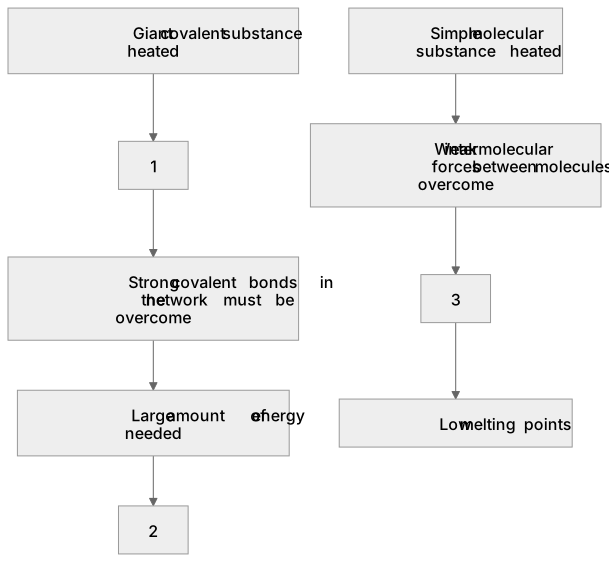
1Box 1
2Box 2
3Box 3
There is more to this lesson
The full lesson goes on to check your understanding and help you earn the marks. Create a free account to carry on, with your progress saved.
A week of Premium from your first lesson · Then the free plan continues · No card, no charge
Test your understanding of Giant covalent structures: These bonds must be overcome to melt or boil these substances.
Active recall beats re-reading. Take an instant quiz now to test what you’ve learned and lock it into long-term memory.
A week of Premium from your first lesson · Then the free plan continues · No card, no charge