AQA · GCSE · Chemistry
Course version: 8462 · Version from Sept 2018
Their properties make them useful for nanotechnology, electronics and…
Full specification wording
Graphene and fullerenes: Their properties make them useful for nanotechnology, electronics and materials.
The distinctive structures of fullerenes, including carbon nanotubes, give them properties that are exploited in three broad areas.
Checked against the AQA 8462 specification (opens in a new tab) on .
- Point 6 of 7
- 2 key terms
Study notes
From the checked teaching notes for this specification point.
The idea
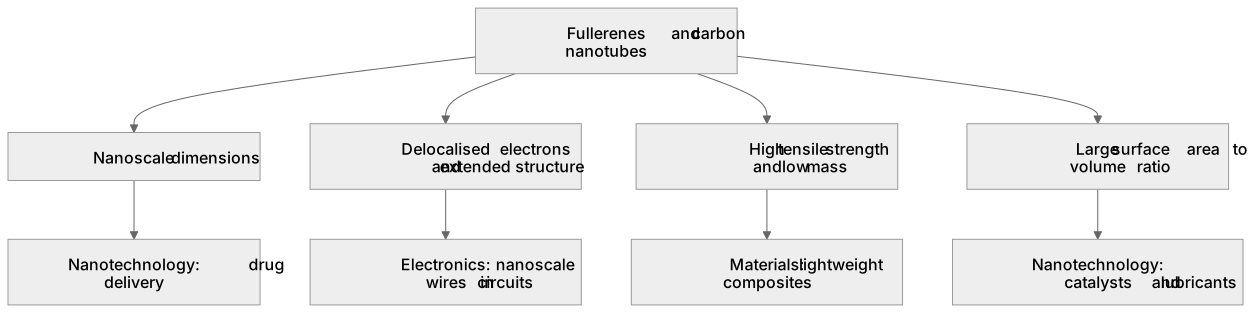
The distinctive structures of fullerenes, including carbon nanotubes, give them properties that are exploited in three broad areas. In nanotechnology, the nanometre-scale dimensions of spherical fullerenes allow them to be used as delivery vessels for drugs, as catalysts and as lubricants. In electronics, carbon nanotubes are excellent conductors of electricity because of their delocalised electrons and extended structure, allowing them to act as tiny wires or components in circuits. In materials, the great tensile strength and low mass of carbon nanotubes make them valuable in lightweight composites for sports equipment, vehicles and construction. The key exam skill is to link a named property, such as high tensile strength or electrical conductivity, to a specific use rather than listing uses without justification.
What earns the marks
- Fullerenes and nanotubes have nanoscale dimensions, making them suitable for nanotechnology applications such as drug delivery.
- Carbon nanotubes have delocalised electrons and an extended structure, giving them electrical conductivity useful for nanoscale wires in electronics.
- The high tensile strength and stiffness of carbon nanotubes, combined with low mass, make them useful in composite materials.
- The large surface area to volume ratio of fullerenes makes them effective catalysts or catalyst supports.
- Uses must be justified by linking a specific property to the application, for example high tensile strength to reinforcing materials.
Common mistakes and how to put them right
Listing uses without linking them to properties.
Put it right by naming the property, such as electrical conductivity or high tensile strength, before giving the use.
Stating that all fullerenes conduct electricity.
Put it right by specifying that carbon nanotubes are the fullerenes used as conductors in electronics.
Confusing nanotechnology with electronics or materials as if they were the same field.
Put it right by giving a distinct example for each area, such as drug delivery for nanotechnology and composite reinforcement for materials.
Exam tips
- Structure answers as property first, then use, for example 'carbon nanotubes conduct electricity, so they are used as nanoscale wires in circuits'.
- Give one clear example for each of nanotechnology, electronics and materials if the question asks for a range of uses.
- Specify 'carbon nanotubes' when discussing electrical conductivity or high tensile strength, rather than just 'fullerenes'.
Try the lesson
The start of the Graphene and fullerenes: Their properties make them useful for nanotechnology, electronics and materials. lesson, made from checked teaching notes for this specification point.
Have a go first
Fullerenes are used in nanotechnology, electronics and materials. Which property helps to explain their use in electronics?
Listen
The distinctive structures of fullerenes, including carbon nanotubes, give them properties that are exploited in three broad areas. In nanotechnology, the nanometre-scale dimensions of spherical fullerenes allow them to be used as delivery vessels for drugs, as catalysts and as lubricants. In electronics, carbon nanotubes are excellent conductors of electricity because of their delocalised electrons and extended structure, allowing them to act as tiny wires or components in circuits. In materials, the great tensile strength and low mass of carbon nanotubes make them valuable in lightweight composites for sports equipment, vehicles and construction. The key exam skill is to link a named property, such as high tensile strength or electrical conductivity, to a specific use rather than listing uses without justification. A strong answer earns marks for these points. Fullerenes and nanotubes have nanoscale dimensions, making them suitable for nanotechnology applications such as drug delivery. Carbon nanotubes have delocalised electrons and an extended structure, giving them electrical conductivity useful for nanoscale wires in electronics. The high tensile strength and stiffness of carbon nanotubes, combined with low mass, make them useful in composite materials. The large surface area to volume ratio of fullerenes makes them effective catalysts or catalyst supports. A common slip: Listing uses without linking them to properties. Instead, naming the property, such as electrical conductivity or high tensile strength, before giving the use. Exam tip: Structure answers as property first, then use, for example 'carbon nanotubes conduct electricity, so they are used as nanoscale wires in circuits'.
See it
Key words
Say what each word means before you turn the card.
Electrical conductivity in carbon nanotubes
Try answering aloud or in your head before turning the card.
Structure-property-application links
Try answering aloud or in your head before turning the card.
See every definition
- Electrical conductivity in carbon nanotubes
- The ability of carbon nanotubes to conduct electricity because of their delocalised electrons and extended structure, allowing them to act as tiny wires or components in circuits.
- Structure-property-application links
- Linking a named property, such as high tensile strength or electrical conductivity, to a specific use rather than listing uses without justification.
Label the diagram
Some boxes have lost their names. Pick the right name for each number.
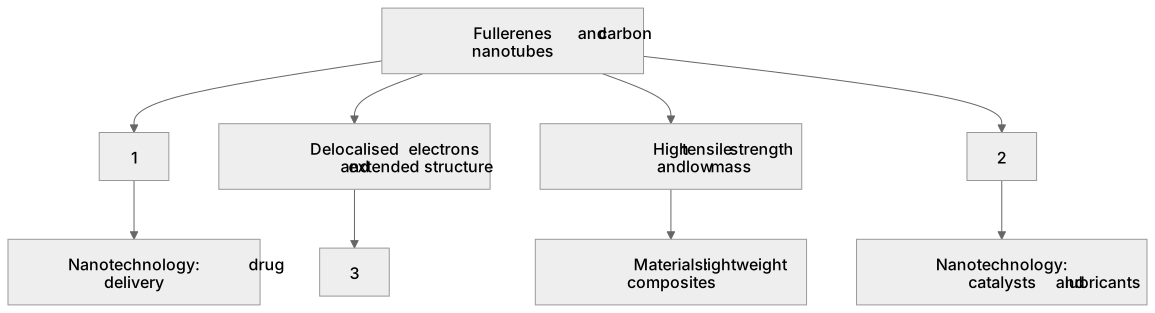
1Box 1
2Box 2
3Box 3
There is more to this lesson
The full lesson goes on to check your understanding and help you earn the marks. Create a free account to carry on, with your progress saved.
A week of Premium from your first lesson · Then the free plan continues · No card, no charge
Test your understanding of Graphene and fullerenes: Their properties make them useful for nanotechnology, electronics and materials.
Active recall beats re-reading. Take an instant quiz now to test what you’ve learned and lock it into long-term memory.
A week of Premium from your first lesson · Then the free plan continues · No card, no charge