AQA · GCSE · Chemistry
Course version: 8462 · Version from Sept 2018
Students should know that graphite is similar to metals in that it has…
Full specification wording
Graphite: Students should know that graphite is similar to metals in that it has delocalised electrons.
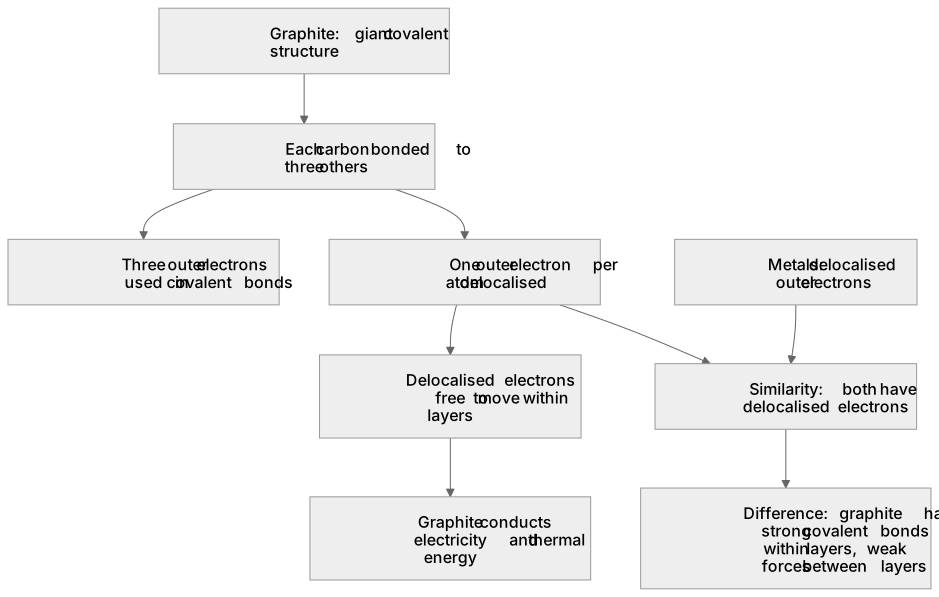
Graphite is a giant covalent structure of carbon atoms, each bonded to three others in flat hexagonal layers.
Checked against the AQA 8462 specification (opens in a new tab) on .
- Point 4 of 4
Study notes
From the checked teaching notes for this specification point.
The idea
Graphite is a giant covalent structure of carbon atoms, each bonded to three others in flat hexagonal layers. Each carbon uses three of its four outer electrons in covalent bonds, so one electron per atom is left free to move throughout the layer. These delocalised electrons are the key similarity to metals, because metals also have delocalised outer electrons that are not tied to a particular atom. In both materials, the mobile electrons can carry charge and transfer energy, so graphite conducts electricity and conducts heat along its layers. Unlike metals, graphite is not malleable in the same way, because its layers are held by weak forces and can slide, and it is a non-metal with covalent bonding within layers. A useful check is to compare graphite with copper: both conduct, but only graphite has strong covalent bonds inside its layers.
What earns the marks
- Graphite is a giant covalent structure in which each carbon atom forms three covalent bonds, leaving one outer electron per atom delocalised.
- Delocalised electrons are free to move within the layers, so graphite can conduct electricity and thermal energy.
- Metals also contain delocalised outer electrons, which is the basis of the stated similarity.
- The delocalised electrons in graphite are not attached to a single atom or to a single covalent bond.
- Graphite differs from metals because its atoms are held by strong covalent bonds in layers, with weak forces between the layers.
- The similarity concerns the presence and mobility of delocalised electrons, not the type of bonding overall.
Common mistakes and how to put them right
Saying that graphite has free ions that carry charge.
Put it right by stating that the mobile charge carriers are delocalised electrons, not ions.
Claiming that all four outer electrons of each carbon are delocalised.
Put it right by explaining that three electrons are used in covalent bonding and one per atom is delocalised.
Describing graphite as a metal because it conducts.
Put it right by saying it is a non-metal giant covalent substance that resembles metals only in having delocalised electrons.
Exam tips
- Link the delocalised electrons directly to a property, such as electrical conductivity, rather than mentioning them in isolation.
- Use the phrase delocalised electrons consistently and avoid switching to free electrons without explaining that they are the same idea.
- When comparing with metals, state one similarity and one difference to show secure understanding of both structures.
Try the lesson
The start of the Graphite: Students should know that graphite is similar to metals in that it has delocalised electrons. lesson, made from checked teaching notes for this specification point.
Have a go first
Which statement explains why graphite is similar to metals?
Listen
Graphite is a giant covalent structure of carbon atoms, each bonded to three others in flat hexagonal layers. Each carbon uses three of its four outer electrons in covalent bonds, so one electron per atom is left free to move throughout the layer. These delocalised electrons are the key similarity to metals, because metals also have delocalised outer electrons that are not tied to a particular atom. In both materials, the mobile electrons can carry charge and transfer energy, so graphite conducts electricity and conducts heat along its layers. Unlike metals, graphite is not malleable in the same way, because its layers are held by weak forces and can slide, and it is a non-metal with covalent bonding within layers. A useful check is to compare graphite with copper: both conduct, but only graphite has strong covalent bonds inside its layers. A strong answer earns marks for these points. Graphite is a giant covalent structure in which each carbon atom forms three covalent bonds, leaving one outer electron per atom delocalised. Delocalised electrons are free to move within the layers, so graphite can conduct electricity and thermal energy. Metals also contain delocalised outer electrons, which is the basis of the stated similarity. The delocalised electrons in graphite are not attached to a single atom or to a single covalent bond. A common slip: Saying that graphite has free ions that carry charge. Instead, stating that the mobile charge carriers are delocalised electrons, not ions. Exam tip: Link the delocalised electrons directly to a property, such as electrical conductivity, rather than mentioning them in isolation.
See it
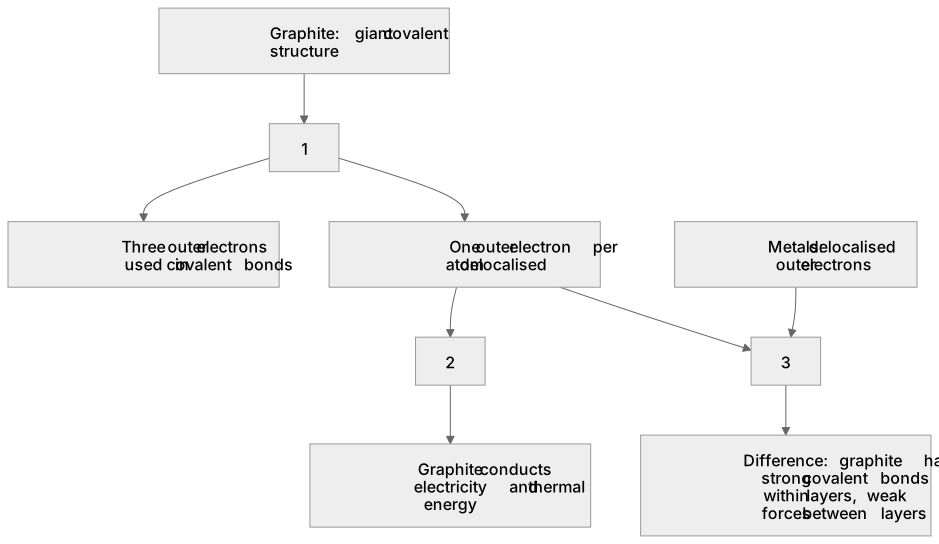
Label the diagram
Some boxes have lost their names. Pick the right name for each number.
1Box 1
2Box 2
3Box 3
There is more to this lesson
The full lesson goes on to check your understanding and help you earn the marks. Create a free account to carry on, with your progress saved.
A week of Premium from your first lesson · Then the free plan continues · No card, no charge
Test your understanding of Graphite: Students should know that graphite is similar to metals in that it has delocalised electrons.
Active recall beats re-reading. Take an instant quiz now to test what you’ve learned and lock it into long-term memory.
A week of Premium from your first lesson · Then the free plan continues · No card, no charge