AQA · GCSE · Chemistry
Course version: 8462 · Version from Sept 2018
Greenhouse gases in the atmosphere maintain temperatures on Earth high…
Full specification wording
Greenhouse gases: Greenhouse gases in the atmosphere maintain temperatures on Earth high enough to support life. Water vapour, carbon dioxide and methane are greenhouse gases.
Energy from the Sun reaches Earth mainly as short wavelength radiation, including visible light and ultraviolet.
Checked against the AQA 8462 specification (opens in a new tab) on .
- Point 1 of 2
- 4 key terms
Study notes
From the checked teaching notes for this specification point.
The idea
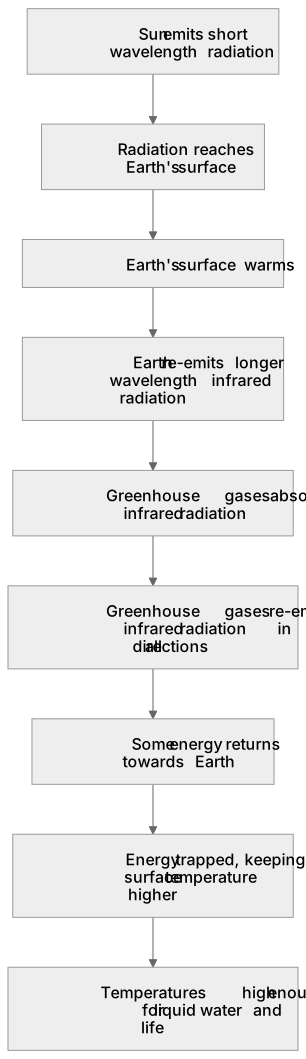
Energy from the Sun reaches Earth mainly as short wavelength radiation, including visible light and ultraviolet. Earth's surface absorbs this energy and warms, then re-emits energy as longer wavelength infrared radiation. Greenhouse gases in the atmosphere absorb some of this outgoing infrared radiation and re-emit it in all directions, including back towards Earth. This traps energy and keeps the average surface temperature higher than it would otherwise be, warm enough for liquid water and life. Water vapour, carbon dioxide and methane are the greenhouse gases named in this specification. Without this natural greenhouse effect, Earth's surface would be far colder.
What earns the marks
- Greenhouse gases absorb and re-emit infrared radiation emitted by Earth's surface, reducing energy lost to space.
- The natural greenhouse effect is essential: it maintains temperatures high enough for liquid water and life.
- Water vapour, carbon dioxide and methane are identified as greenhouse gases.
- Short wavelength radiation from the Sun passes through the atmosphere and warms Earth's surface.
- Earth re-emits longer wavelength infrared radiation, which greenhouse gases absorb.
Common mistakes and how to put them right
Confusing the greenhouse effect with the ozone layer.
Put it right: The ozone layer absorbs ultraviolet radiation, while greenhouse gases absorb infrared radiation.
Thinking greenhouse gases stop all heat leaving Earth.
Put it right: They slow energy loss, and some infrared still escapes to space.
Believing the greenhouse effect is entirely harmful.
Put it right: The natural effect is necessary for life, and the issue is its enhancement by extra greenhouse gases.
Exam tips
- Use the words 'absorb' and 're-emit' when describing what greenhouse gases do to infrared radiation.
- Distinguish incoming short wavelength radiation from outgoing long wavelength infrared radiation.
- State clearly that the natural greenhouse effect keeps Earth warm enough for life before discussing any enhancement.
Try the lesson
The start of the Greenhouse gases: Greenhouse gases in the atmosphere maintain temperatures on Earth high enough to support life. Water vapour, carbon dioxide and methane are greenhouse gases. lesson, made from checked teaching notes for this specification point.
Have a go first
A student lists four gases found in the atmosphere: methane, nitrogen, water vapour and oxygen. Which pair of these gases both act as greenhouse gases?
Listen
Energy from the Sun reaches Earth mainly as short wavelength radiation, including visible light and ultraviolet. Earth's surface absorbs this energy and warms, then re-emits energy as longer wavelength infrared radiation. Greenhouse gases in the atmosphere absorb some of this outgoing infrared radiation and re-emit it in all directions, including back towards Earth. This traps energy and keeps the average surface temperature higher than it would otherwise be, warm enough for liquid water and life. Water vapour, carbon dioxide and methane are the greenhouse gases named in this specification. Without this natural greenhouse effect, Earth's surface would be far colder. A strong answer earns marks for these points. Greenhouse gases absorb and re-emit infrared radiation emitted by Earth's surface, reducing energy lost to space. The natural greenhouse effect is essential: it maintains temperatures high enough for liquid water and life. Water vapour, carbon dioxide and methane are identified as greenhouse gases. Short wavelength radiation from the Sun passes through the atmosphere and warms Earth's surface. Exam tip: Use the words 'absorb' and 're-emit' when describing what greenhouse gases do to infrared radiation.
See it
Key words
Say what each word means before you turn the card.
Greenhouse gases
Try answering aloud or in your head before turning the card.
Absorption of infrared radiation
Try answering aloud or in your head before turning the card.
Natural greenhouse effect
Try answering aloud or in your head before turning the card.
Conditions for life
Try answering aloud or in your head before turning the card.
See every definition
- Greenhouse gases
- Water vapour, carbon dioxide and methane are gases in the atmosphere that absorb and re-emit infrared radiation emitted by Earth's surface.
- Absorption of infrared radiation
- Greenhouse gases take in some of the outgoing longer wavelength infrared radiation that Earth re-emits after its surface warms.
- Natural greenhouse effect
- Trapped energy keeps the average surface temperature higher than it would otherwise be, warm enough for liquid water and life.
- Conditions for life
- The natural greenhouse effect maintains temperatures on Earth high enough to support life.
Label the diagram
Some boxes have lost their names. Pick the right name for each number.
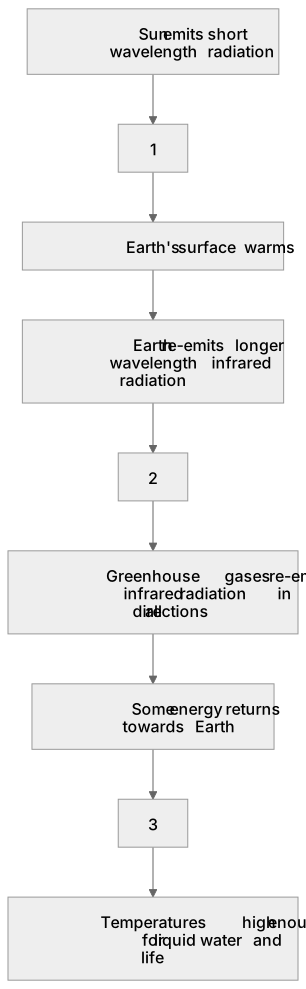
1Box 1
2Box 2
3Box 3
There is more to this lesson
The full lesson goes on to check your understanding and help you earn the marks. Create a free account to carry on, with your progress saved.
A week of Premium from your first lesson · Then the free plan continues · No card, no charge
Test your understanding of Greenhouse gases: Greenhouse gases in the atmosphere maintain temperatures on Earth high enough to support life. Water vapour, carbon dioxide and methane are greenhouse gases.
Active recall beats re-reading. Take an instant quiz now to test what you’ve learned and lock it into long-term memory.
A week of Premium from your first lesson · Then the free plan continues · No card, no charge