AQA · GCSE · Chemistry
Course version: 8462 · Version from Sept 2018
The elements in Group 0 of the periodic table are called the noble gases.
Full specification wording
Group 0: The elements in Group 0 of the periodic table are called the noble gases.
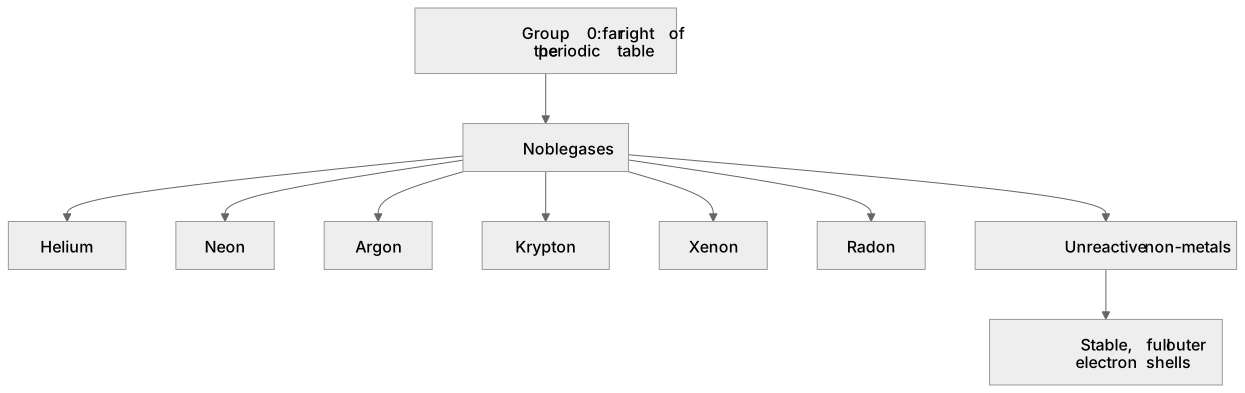
The elements in Group 0, located at the far right of the periodic table, are known as the noble gases.
Checked against the AQA 8462 specification (opens in a new tab) on .
- Point 1 of 5
- 3 key terms
Study notes
From the checked teaching notes for this specification point.
The idea
The elements in Group 0, located at the far right of the periodic table, are known as the noble gases. This group contains helium, neon, argon, krypton, xenon and radon. These elements are remarkably unreactive non-metals because their atoms have stable, full outer electron shells, meaning they do not easily gain, lose or share electrons. For example, argon is used in filament lamps because it does not react with the hot tungsten wire, and helium fills party balloons because it is less dense than air and unreactive. Exam questions frequently ask students to identify a noble gas from its position on the periodic table or to explain their lack of reactivity using electron configuration.
What earns the marks
- Group 0 is the final column on the right of the periodic table and contains the noble gases.
- The noble gases are helium, neon, argon, krypton, xenon and radon.
- The unreactive nature of noble gases is directly linked to their stable electron configuration, featuring full outer electron shells.
- Noble gases are non-metals and exist as single atoms rather than diatomic molecules.
- Group 18 is the modern IUPAC numbering, but Group 0 is the accepted AQA term.
Common mistakes and how to put them right
Writing that Group 18 is an older term.
Put it right: Group 18 is the modern IUPAC standard, though Group 0 is used in this specification.
Confusing noble gases with alkali metals.
Put it right: Alkali metals are Group 1 and are highly reactive, whereas noble gases are unreactive.
Stating that noble gases do not exist in the atmosphere.
Put it right: Argon, neon and helium are present in small amounts in air.
Exam tips
- When asked to name a noble gas, give the element name rather than the group number.
- If a question asks why Group 0 is on the right, refer to full outer shells and stability.
Try the lesson
The start of the Group 0: The elements in Group 0 of the periodic table are called the noble gases. lesson, made from checked teaching notes for this specification point.
Have a go first
A student lists four elements: argon, potassium, bromine and calcium. Which element from this list belongs to Group 0?
Listen
The elements in Group 0, located at the far right of the periodic table, are known as the noble gases. This group contains helium, neon, argon, krypton, xenon and radon. These elements are remarkably unreactive non-metals because their atoms have stable, full outer electron shells, meaning they do not easily gain, lose or share electrons. For example, argon is used in filament lamps because it does not react with the hot tungsten wire, and helium fills party balloons because it is less dense than air and unreactive. Exam questions frequently ask students to identify a noble gas from its position on the periodic table or to explain their lack of reactivity using electron configuration. A strong answer earns marks for these points. Group 0 is the final column on the right of the periodic table and contains the noble gases. The noble gases are helium, neon, argon, krypton, xenon and radon. The unreactive nature of noble gases is directly linked to their stable electron configuration, featuring full outer electron shells. Noble gases are non-metals and exist as single atoms rather than diatomic molecules. A common slip: Writing that Group 18 is an older term. Instead, Group 18 is the modern IUPAC standard, though Group 0 is used in this specification. Exam tip: When asked to name a noble gas, give the element name rather than the group number.
See it
Key words
Say what each word means before you turn the card.
Group 0
Try answering aloud or in your head before turning the card.
Noble gases
Try answering aloud or in your head before turning the card.
Full outer electron shells
Try answering aloud or in your head before turning the card.
See every definition
- Group 0
- The final column on the right of the periodic table, containing the noble gases.
- Noble gases
- The elements in Group 0 of the periodic table, which are unreactive non-metals.
- Full outer electron shells
- A stable electron configuration that means atoms do not easily gain, lose or share electrons.
Label the diagram
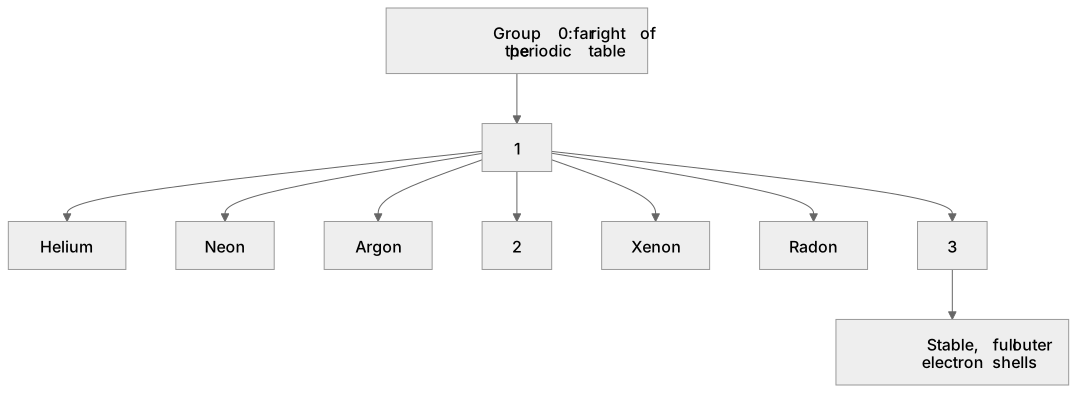
Some boxes have lost their names. Pick the right name for each number.
1Box 1
2Box 2
3Box 3
There is more to this lesson
The full lesson goes on to check your understanding and help you earn the marks. Create a free account to carry on, with your progress saved.
A week of Premium from your first lesson · Then the free plan continues · No card, no charge
Test your understanding of Group 0: The elements in Group 0 of the periodic table are called the noble gases.
Active recall beats re-reading. Take an instant quiz now to test what you’ve learned and lock it into long-term memory.
A week of Premium from your first lesson · Then the free plan continues · No card, no charge