AQA · GCSE · Chemistry
Course version: 8462 · Version from Sept 2018
The elements in Group 1 of the periodic table are known as the alkali…
Full specification wording
Group 1: The elements in Group 1 of the periodic table are known as the alkali metals and have characteristic properties because of the single electron in their outer shell.
Group 1 contains lithium, sodium, potassium, rubidium, caesium and francium.
Checked against the AQA 8462 specification (opens in a new tab) on .
- Point 1 of 4
- 4 key terms
Study notes
From the checked teaching notes for this specification point.
The idea
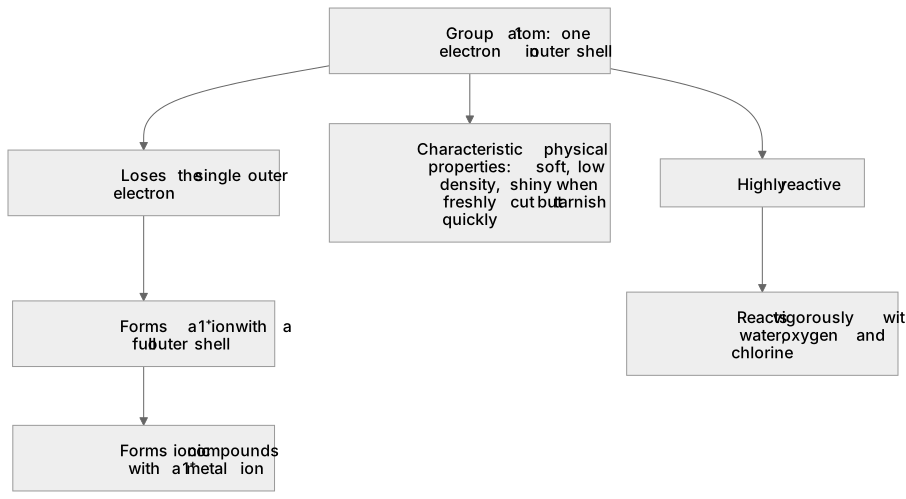
Group 1 contains lithium, sodium, potassium, rubidium, caesium and francium. Each atom has one electron in its outer shell, so it can lose that electron to form a 1⁺ ion with a stable full outer shell. This single outer electron explains the characteristic properties: they are soft, low density, shiny when freshly cut but tarnish quickly, and they react vigorously with water, oxygen and chlorine. Because only one electron must be lost, the metals are highly reactive and form ionic compounds in which the metal ion has a 1⁺ charge. Their reactivity and physical properties are therefore directly linked to their electronic structure.
What earns the marks
- States that Group 1 atoms each have one electron in their outer shell.
- Explains that losing this single outer electron forms a 1⁺ ion with a full outer shell.
- Links the single outer electron to the characteristic reactivity of the alkali metals.
- Describes typical physical properties such as softness, low density and shiny appearance when freshly cut.
- Recalls that alkali metals form ionic compounds in which the metal ion carries a 1⁺ charge.
- Identifies that the vigorous reactions with water, oxygen and chlorine are characteristic of the single outer electron being lost.
Common mistakes and how to put them right
Saying Group 1 atoms gain one electron to fill their outer shell.
Put it right by stating they lose one electron to form a 1⁺ ion.
Writing the ion charge as a postfix number.
Put it right by using the superscript form, for example Na⁺.
Describing alkali metals as hard and dense.
Put it right by stating they are soft and have low density.
Exam tips
- Always link the single outer electron to both the 1⁺ ion formed and the high reactivity.
- When describing physical properties, give at least two observable features such as softness and low density.
- Use the correct superscript notation for ions, for example K⁺, in all written answers.
Try the lesson
The start of the Group 1: The elements in Group 1 of the periodic table are known as the alkali metals and have characteristic properties because of the single electron in their outer shell. lesson, made from checked teaching notes for this specification point.
Have a go first
What name is given to the elements in Group 1 of the periodic table?
Listen
Group 1 contains lithium, sodium, potassium, rubidium, caesium and francium. Each atom has one electron in its outer shell, so it can lose that electron to form a 1⁺ ion with a stable full outer shell. This single outer electron explains the characteristic properties: they are soft, low density, shiny when freshly cut but tarnish quickly, and they react vigorously with water, oxygen and chlorine. Because only one electron must be lost, the metals are highly reactive and form ionic compounds in which the metal ion has a 1⁺ charge. Their reactivity and physical properties are therefore directly linked to their electronic structure. A strong answer earns marks for these points. States that Group 1 atoms each have one electron in their outer shell. Explains that losing this single outer electron forms a 1⁺ ion with a full outer shell. Links the single outer electron to the characteristic reactivity of the alkali metals. Describes typical physical properties such as softness, low density and shiny appearance when freshly cut. A common slip: Saying Group 1 atoms gain one electron to fill their outer shell. Instead, stating they lose one electron to form a 1⁺ ion. Exam tip: Always link the single outer electron to both the 1⁺ ion formed and the high reactivity.
See it
Key words
Say what each word means before you turn the card.
alkali metals
Try answering aloud or in your head before turning the card.
characteristic properties
Try answering aloud or in your head before turning the card.
1⁺ ion
Try answering aloud or in your head before turning the card.
reactivity
Try answering aloud or in your head before turning the card.
See every definition
- alkali metals
- The elements in Group 1 of the periodic table, which have characteristic properties because of the single electron in their outer shell.
- characteristic properties
- Features explained by the single outer electron: soft, low density, shiny when freshly cut but tarnishing quickly, and reacting vigorously with water, oxygen and chlorine.
- 1⁺ ion
- Formed when a Group 1 atom loses its single outer electron, giving a stable full outer shell.
- reactivity
- Being highly reactive because only one electron must be lost, with vigorous reactions with water, oxygen and chlorine.
Label the diagram
Some boxes have lost their names. Pick the right name for each number.
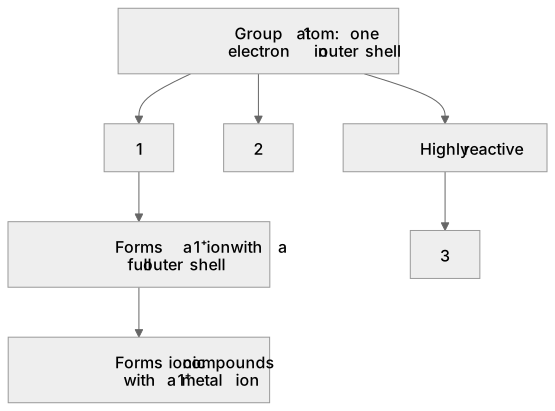
1Box 1
2Box 2
3Box 3
There is more to this lesson
The full lesson goes on to check your understanding and help you earn the marks. Create a free account to carry on, with your progress saved.
A week of Premium from your first lesson · Then the free plan continues · No card, no charge
Test your understanding of Group 1: The elements in Group 1 of the periodic table are known as the alkali metals and have characteristic properties because of the single electron in their outer shell.
Active recall beats re-reading. Take an instant quiz now to test what you’ve learned and lock it into long-term memory.
A week of Premium from your first lesson · Then the free plan continues · No card, no charge