AQA · GCSE · Chemistry
Course version: 8462 · Version from Sept 2018
In Group 7, the reactivity of the elements decreases going down the group.
Full specification wording
Group 7: In Group 7, the reactivity of the elements decreases going down the group.
Halogens form 1⁻ ions in reactions with metals and in displacement reactions with metal halide solutions.
Checked against the AQA 8462 specification (opens in a new tab) on .
- Point 5 of 7
- 3 key terms
Study notes
From the checked teaching notes for this specification point.
The idea
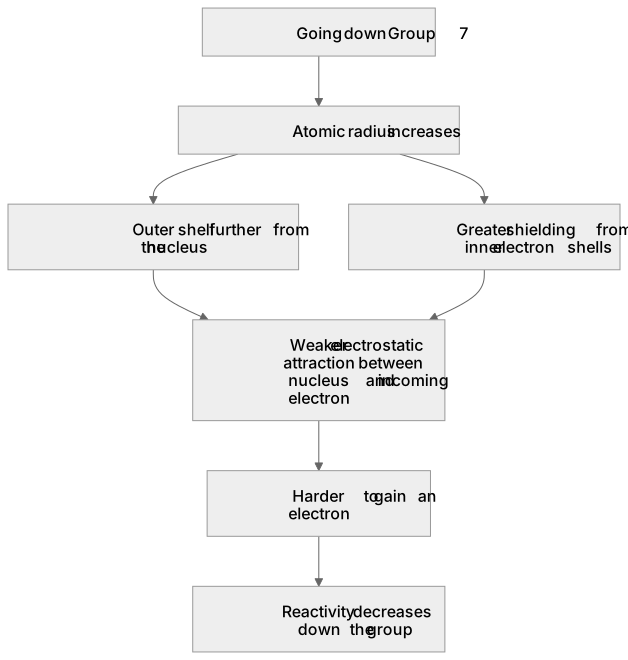
Halogens form 1⁻ ions in reactions with metals and in displacement reactions with metal halide solutions. Reactivity decreases down Group 7 from fluorine to iodine because the atoms become larger. As atomic radius increases, the outer shell is further from the nucleus and experiences greater shielding from inner electron shells. Consequently, the electrostatic attraction between the nucleus and an incoming electron becomes weaker, making it harder to gain an electron.
For example: Chlorine displaces bromine from aqueous potassium bromide (Cl₂ + 2KBr → 2KCl + Br₂) because chlorine is more reactive and gains an electron more easily than bromine.
What earns the marks
- Halogens react by gaining one electron to form a 1⁻ ion in reactions with metals and in displacement reactions.
- Down the group, atomic radius increases and there is more shielding.
- The increased distance and shielding result in a weaker electrostatic attraction between the nucleus and an incoming electron.
- Fluorine is the most reactive halogen and iodine is the least reactive of the commonly studied halogens.
- The reactivity trend is linked to the outer shell electron configuration and the ease of gaining an electron.
Common mistakes and how to put them right
Saying reactivity decreases because the atoms get heavier.
Put it right: Reactivity depends on the attraction for an incoming electron, not on mass.
Claiming that increased nuclear charge always increases reactivity.
Put it right: Increased distance and shielding outweigh the extra nuclear charge down the group.
Stating that halogens only form 1⁻ ions when reacting with metals.
Put it right: They also form 1⁻ ions in displacement reactions with metal halide solutions.
Exam tips
- Explain reactivity using the outer shell electron and the attraction from the nucleus, not just by stating the trend.
- Use comparative terms such as more reactive and less reactive, and name the halogens correctly.
Try the lesson
The start of the Group 7: In Group 7, the reactivity of the elements decreases going down the group. lesson, made from checked teaching notes for this specification point.
Have a go first
Which halogen is the most reactive?
Listen
Halogens form 1⁻ ions in reactions with metals and in displacement reactions with metal halide solutions. Reactivity decreases down Group 7 from fluorine to iodine because the atoms become larger. As atomic radius increases, the outer shell is further from the nucleus and experiences greater shielding from inner electron shells. Consequently, the electrostatic attraction between the nucleus and an incoming electron becomes weaker, making it harder to gain an electron. For example, chlorine displaces bromine from aqueous potassium bromide (Cl₂ + 2KBr → 2KCl + Br₂) because chlorine is more reactive and gains an electron more easily than bromine. A strong answer earns marks for these points. Halogens react by gaining one electron to form a 1⁻ ion in reactions with metals and in displacement reactions. Down the group, atomic radius increases and there is more shielding. The increased distance and shielding result in a weaker electrostatic attraction between the nucleus and an incoming electron. Fluorine is the most reactive halogen and iodine is the least reactive of the commonly studied halogens. A common slip: Saying reactivity decreases because the atoms get heavier. Instead, reactivity depends on the attraction for an incoming electron, not on mass. Exam tip: Explain reactivity using the outer shell electron and the attraction from the nucleus, not just by stating the trend.
See it
Key words
Say what each word means before you turn the card.
Group 7 reactivity
Try answering aloud or in your head before turning the card.
Electron gain
Try answering aloud or in your head before turning the card.
Displacement reactions
Try answering aloud or in your head before turning the card.
See every definition
- Group 7 reactivity
- The reactivity of the elements decreases going down the group, from fluorine to iodine.
- Electron gain
- Halogens react by gaining one electron to form a 1⁻ ion in reactions with metals and in displacement reactions.
- Displacement reactions
- Reactions with metal halide solutions in which halogens form 1⁻ ions, and a more reactive halogen displaces a less reactive one.
Label the diagram
Some boxes have lost their names. Pick the right name for each number.
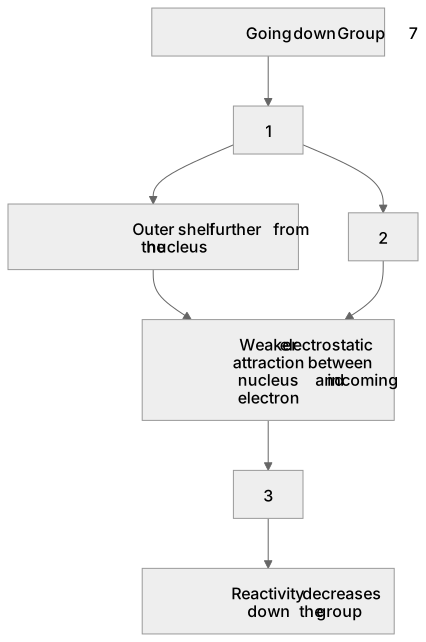
1Box 1
2Box 2
3Box 3
There is more to this lesson
The full lesson goes on to check your understanding and help you earn the marks. Create a free account to carry on, with your progress saved.
A week of Premium from your first lesson · Then the free plan continues · No card, no charge
Test your understanding of Group 7: In Group 7, the reactivity of the elements decreases going down the group.
Active recall beats re-reading. Take an instant quiz now to test what you’ve learned and lock it into long-term memory.
A week of Premium from your first lesson · Then the free plan continues · No card, no charge