AQA · GCSE · Chemistry
Course version: 8462 · Version from Sept 2018
The halogens are non-metals and consist of molecules made of pairs of atoms.
Full specification wording
Group 7: The halogens are non-metals and consist of molecules made of pairs of atoms.
The halogens are non-metals, so they lack the typical properties of metals such as conduction of electricity and malleability.
Checked against the AQA 8462 specification (opens in a new tab) on .
- Point 2 of 7
- 4 key terms
Study notes
From the checked teaching notes for this specification point.
The idea
The halogens are non-metals, so they lack the typical properties of metals such as conduction of electricity and malleability. Their atoms have seven outer-shell electrons and need one more to complete the shell. Two halogen atoms can each contribute one electron to a shared pair, forming a single covalent bond. The result is a diatomic molecule, meaning a molecule made of two atoms, such as F₂, Cl₂, Br₂ and I₂. These small molecules are held together in the element by weak intermolecular forces, which explains why fluorine and chlorine are gases, bromine is a liquid and iodine is a solid at room temperature. The diatomic molecules are a key reason halogens are studied as pairs rather than single atoms.
What earns the marks
- Classify the halogens as non-metals.
- State that halogen molecules are diatomic, containing two atoms joined by a single covalent bond.
- Write the molecular formulae of common halogens as F₂, Cl₂, Br₂ and I₂.
- Explain that each atom contributes one electron to a shared pair, completing the outer shell of both atoms.
- Relate weak intermolecular forces between diatomic molecules to the physical states of the halogens at room temperature.
Common mistakes and how to put them right
Writing halogen molecules as single atoms, for example Cl.
Put it right by writing Cl₂ to show the diatomic molecule.
Describing the bond within a halogen molecule as ionic.
Put it right by describing a single covalent bond formed from a shared pair of electrons.
Confusing intermolecular forces with covalent bonds.
Put it right by stating that weak forces act between molecules while strong covalent bonds act within each molecule.
Using baseline numerals for formulae.
Put it right by using subscript numerals such as F₂ and I₂.
Exam tips
- When naming a halogen molecule, always include the subscript two, for example Br₂.
- If asked why halogens form diatomic molecules, refer to the need to complete the outer shell by sharing one electron pair.
- Link physical state to intermolecular forces rather than to the strength of the covalent bond.
- Check that formulae use subscript numerals, not baseline numerals.
Try the lesson
The start of the Group 7: The halogens are non-metals and consist of molecules made of pairs of atoms. lesson, made from checked teaching notes for this specification point.
Have a go first
Which type of molecule is formed by a halogen such as chlorine?
Listen
The halogens are non-metals, so they lack the typical properties of metals such as conduction of electricity and malleability. Their atoms have seven outer-shell electrons and need one more to complete the shell. Two halogen atoms can each contribute one electron to a shared pair, forming a single covalent bond. The result is a diatomic molecule, meaning a molecule made of two atoms, such as F₂, Cl₂, Br₂ and I₂. These small molecules are held together in the element by weak intermolecular forces, which explains why fluorine and chlorine are gases, bromine is a liquid and iodine is a solid at room temperature. The diatomic molecules are a key reason halogens are studied as pairs rather than single atoms. A strong answer earns marks for these points. Classify the halogens as non-metals. State that halogen molecules are diatomic, containing two atoms joined by a single covalent bond. Write the molecular formulae of common halogens as F₂, Cl₂, Br₂ and I₂. Explain that each atom contributes one electron to a shared pair, completing the outer shell of both atoms. A common slip: Writing halogen molecules as single atoms, for example Cl. Instead, writing Cl₂ to show the diatomic molecule. Exam tip: When naming a halogen molecule, always include the subscript two, for example Br₂.
See it
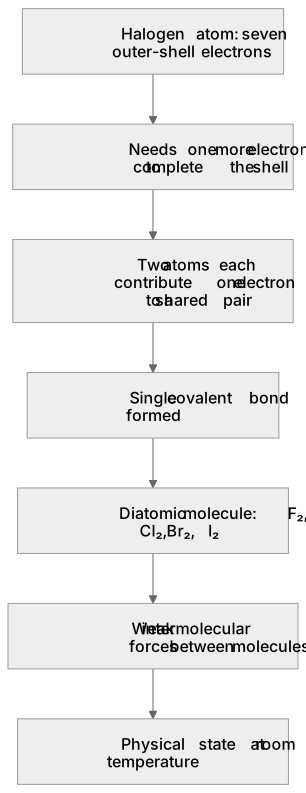
Put it in order
Put these steps in the order they happen.
- 1. Physical state at room temperature
- 2. Weak intermolecular forces between molecules
- 3. Two atoms each contribute one electron to a shared pair
- 4. Diatomic molecule: F₂, Cl₂, Br₂, I₂
- 5. Halogen atom: seven outer-shell electrons
- 6. Needs one more electron to complete the shell
- 7. Single covalent bond formed
Key words
Say what each word means before you turn the card.
Non-metal character of the halogens
Try answering aloud or in your head before turning the card.
Covalent bonding and shared electron pairs
Try answering aloud or in your head before turning the card.
Diatomic molecules
Try answering aloud or in your head before turning the card.
Intermolecular forces and physical states
Try answering aloud or in your head before turning the card.
See every definition
- Non-metal character of the halogens
- The halogens are non-metals, so they lack the typical properties of metals such as conduction of electricity and malleability.
- Covalent bonding and shared electron pairs
- Two halogen atoms can each contribute one electron to a shared pair, forming a single covalent bond.
- Diatomic molecules
- A molecule made of two atoms, such as F₂, Cl₂, Br₂ and I₂.
- Intermolecular forces and physical states
- Weak intermolecular forces hold the small molecules together in the element, which explains why fluorine and chlorine are gases, bromine is a liquid and iodine is a solid at room temperature.
Label the diagram
Some boxes have lost their names. Pick the right name for each number.
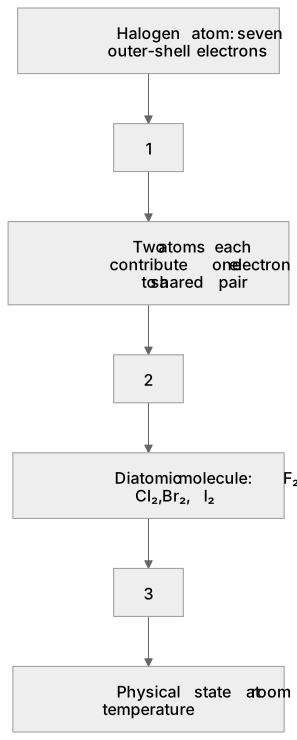
1Box 1
2Box 2
3Box 3
There is more to this lesson
The full lesson goes on to check your understanding and help you earn the marks. Create a free account to carry on, with your progress saved.
A week of Premium from your first lesson · Then the free plan continues · No card, no charge
Test your understanding of Group 7: The halogens are non-metals and consist of molecules made of pairs of atoms.
Active recall beats re-reading. Take an instant quiz now to test what you’ve learned and lock it into long-term memory.
A week of Premium from your first lesson · Then the free plan continues · No card, no charge