AQA · GCSE · Chemistry
Course version: 8462 · Version from Sept 2018
Students should be able to recall two human activities that increase the…
Full specification wording
Human activities which contribute to an increase in greenhouse gases in the: Students should be able to recall two human activities that increase the amounts of each of the greenhouse gases carbon dioxide and methane.
You need to recall two human activities for carbon dioxide and two for methane.
Checked against the AQA 8462 specification (opens in a new tab) on .
- Point 2 of 6
- 4 key terms
Study notes
From the checked teaching notes for this specification point.
The idea
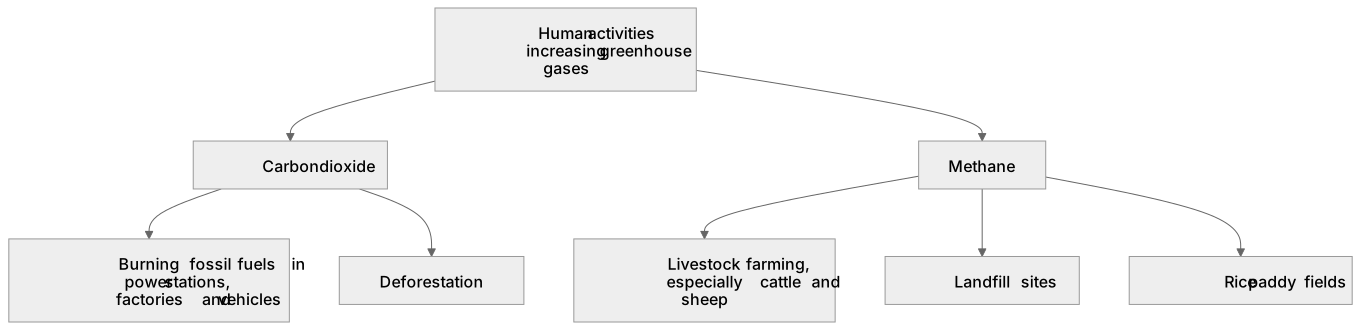
You need to recall two human activities for carbon dioxide and two for methane. For carbon dioxide, burning fossil fuels in power stations, factories and vehicles releases carbon dioxide, and deforestation reduces the removal of carbon dioxide by photosynthesis. For methane, livestock farming, especially cattle and sheep, releases methane during digestion, and landfill sites release methane as organic waste decomposes anaerobically. Rice paddy fields also release methane. A useful method is to group activities by gas: fossil fuels and deforestation for carbon dioxide; livestock and landfill for methane. In an exam, name the activity and the gas it increases.
What earns the marks
- Burning fossil fuels such as coal, oil and natural gas releases carbon dioxide.
- Deforestation reduces carbon dioxide absorption by trees, increasing atmospheric carbon dioxide.
- Livestock farming, especially cattle and sheep, releases methane through digestion and waste.
- Landfill sites release methane as organic waste decomposes without oxygen.
- Rice paddy fields release methane due to anaerobic decomposition in waterlogged soil.
Common mistakes and how to put them right
Giving only one activity for a gas when two are required.
Put it right by learning two distinct examples for each gas.
Mixing up the gases, such as saying landfill releases carbon dioxide.
Put it right by associating landfill with methane.
Using vague terms like farming without specifying livestock.
Put it right by naming cattle or sheep as methane sources.
Exam tips
- Make a two-by-two table in your notes: carbon dioxide activities and methane activities, with two examples each.
- In the exam, write the gas name next to each activity so the examiner can see the link clearly.
- If you cannot recall a second example, use rice paddy fields for methane or deforestation for carbon dioxide.
Try the lesson
The start of the Human activities which contribute to an increase in greenhouse gases in the: Students should be able to recall two human activities that increase the amounts of each of the greenhouse gases carbon dioxide and methane. lesson, made from checked teaching notes for this specification point.
Have a go first
Which human activity increases the amount of carbon dioxide in the atmosphere?
Listen
You need to recall two human activities for carbon dioxide and two for methane. For carbon dioxide, burning fossil fuels in power stations, factories and vehicles releases carbon dioxide, and deforestation reduces the removal of carbon dioxide by photosynthesis. For methane, livestock farming, especially cattle and sheep, releases methane during digestion, and landfill sites release methane as organic waste decomposes anaerobically. Rice paddy fields also release methane. A useful method is to group activities by gas: fossil fuels and deforestation for carbon dioxide; livestock and landfill for methane. In an exam, name the activity and the gas it increases. A strong answer earns marks for these points. Burning fossil fuels such as coal, oil and natural gas releases carbon dioxide. Deforestation reduces carbon dioxide absorption by trees, increasing atmospheric carbon dioxide. Livestock farming, especially cattle and sheep, releases methane through digestion and waste. Landfill sites release methane as organic waste decomposes without oxygen. A common slip: Giving only one activity for a gas when two are required. Instead, learning two distinct examples for each gas. Exam tip: Make a two-by-two table in your notes: carbon dioxide activities and methane activities, with two examples each.
See it
Key words
Say what each word means before you turn the card.
Carbon dioxide sources
Try answering aloud or in your head before turning the card.
Methane sources
Try answering aloud or in your head before turning the card.
Human activities
Try answering aloud or in your head before turning the card.
Recall of examples
Try answering aloud or in your head before turning the card.
See every definition
- Carbon dioxide sources
- Burning fossil fuels such as coal, oil and natural gas releases carbon dioxide, and deforestation reduces carbon dioxide absorption by trees.
- Methane sources
- Livestock farming, especially cattle and sheep, releases methane through digestion and waste, and landfill sites release methane as organic waste decomposes without oxygen.
- Human activities
- Activities such as burning fossil fuels, deforestation, livestock farming and landfill increase the amounts of carbon dioxide and methane.
- Recall of examples
- You need to recall two human activities for carbon dioxide and two for methane, naming the activity and the gas it increases.
Label the diagram
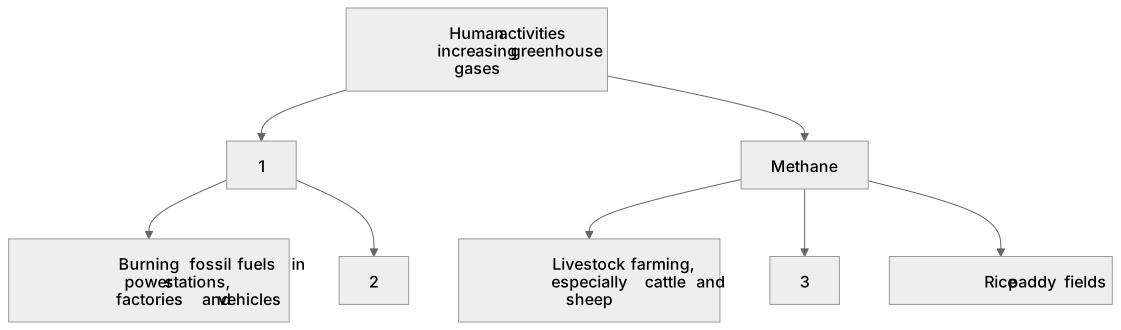
Some boxes have lost their names. Pick the right name for each number.
1Box 1
2Box 2
3Box 3
There is more to this lesson
The full lesson goes on to check your understanding and help you earn the marks. Create a free account to carry on, with your progress saved.
A week of Premium from your first lesson · Then the free plan continues · No card, no charge
Test your understanding of Human activities which contribute to an increase in greenhouse gases in the: Students should be able to recall two human activities that increase the amounts of each of the greenhouse gases carbon dioxide and methane.
Active recall beats re-reading. Take an instant quiz now to test what you’ve learned and lock it into long-term memory.
A week of Premium from your first lesson · Then the free plan continues · No card, no charge