AQA · GCSE · Chemistry
Course version: 8462 · Version from Sept 2018
This leads to simplified models, speculation and opinions presented in the…
Full specification wording
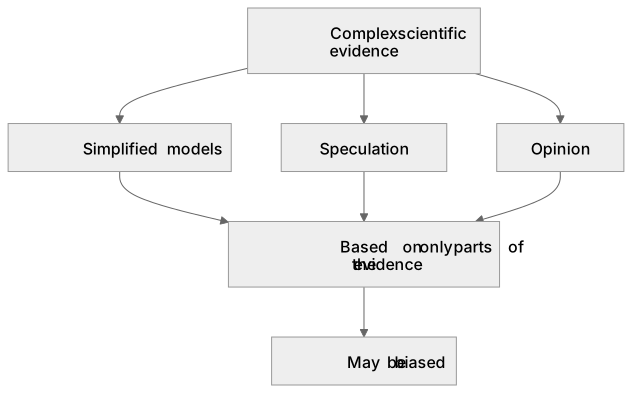
Human activities which contribute to an increase in greenhouse gases in the: This leads to simplified models, speculation and opinions presented in the media that may be based on only parts of the evidence and which may be biased.
Scientific evidence about greenhouse gases and climate is complex, so media reports often simplify it into models, speculation or opinion.
Checked against the AQA 8462 specification (opens in a new tab) on .
- Point 5 of 6
- 4 key terms
Study notes
From the checked teaching notes for this specification point.
The idea
Scientific evidence about greenhouse gases and climate is complex, so media reports often simplify it into models, speculation or opinion. A simplified model, such as a diagram showing only carbon dioxide and temperature, omits methane, water vapour and natural variation. Speculation goes beyond the data, for example claiming a single cold winter disproves warming. Opinion may reflect a group's interests. Bias arises when a report selects only part of the evidence, such as one favourable study, or gives unequal weight to voices. This links to evaluating reports and recognising uncertainty.
What earns the marks
- Identify that media coverage may use simplified models that omit some greenhouse gases, feedbacks or natural factors.
- Explain that speculation is a claim going beyond the available evidence, such as predicting a specific local effect from global data.
- Explain that opinion is a personal or group viewpoint rather than a conclusion drawn from the full evidence base.
- Describe bias as selecting or emphasising only part of the evidence, or presenting one side more strongly.
- Use a specific example, such as a headline based on one study while ignoring several others, to show how bias can arise.
- Suggest how a reader can check a report, for example by finding the original peer-reviewed study and comparing several sources.
Common mistakes and how to put them right
Treating all media reports as equally reliable.
Put it right by checking whether the report cites peer-reviewed evidence and whether other studies agree.
Assuming that a simplified model is wrong.
Put it right by recognising that a model can be useful if its limitations are stated and it fits the purpose.
Confusing speculation with a prediction based on data.
Put it right by asking whether the claim follows from measurements or goes beyond them.
Exam tips
- When asked to evaluate a report, quote or paraphrase a specific part of the supplied information and say what is missing or biased.
- Use the words evidence, uncertainty and peer review accurately; do not simply say the media is wrong.
- Link each criticism to a consequence, such as the public forming an opinion from incomplete evidence.
Try the lesson
The start of the Human activities which contribute to an increase in greenhouse gases in the: This leads to simplified models, speculation and opinions presented in the media that may be based on only parts of the evidence and which may be biased. lesson, made from checked teaching notes for this specification point.
Have a go first
Which of the following explains why media reports about global climate change can sometimes be biased?
Listen
Scientific evidence about greenhouse gases and climate is complex, so media reports often simplify it into models, speculation or opinion. A simplified model, such as a diagram showing only carbon dioxide and temperature, omits methane, water vapour and natural variation. Speculation goes beyond the data, for example claiming a single cold winter disproves warming. Opinion may reflect a group's interests. Bias arises when a report selects only part of the evidence, such as one favourable study, or gives unequal weight to voices. This links to evaluating reports and recognising uncertainty. A strong answer earns marks for these points. Identify that media coverage may use simplified models that omit some greenhouse gases, feedbacks or natural factors. Explain that speculation is a claim going beyond the available evidence, such as predicting a specific local effect from global data. Explain that opinion is a personal or group viewpoint rather than a conclusion drawn from the full evidence base. Describe bias as selecting or emphasising only part of the evidence, or presenting one side more strongly. A common slip: Treating all media reports as equally reliable. Instead, checking whether the report cites peer-reviewed evidence and whether other studies agree. Exam tip: When asked to evaluate a report, quote or paraphrase a specific part of the supplied information and say what is missing or biased.
See it
Key words
Say what each word means before you turn the card.
Speculation
Try answering aloud or in your head before turning the card.
Opinion
Try answering aloud or in your head before turning the card.
Bias
Try answering aloud or in your head before turning the card.
Simplified model
Try answering aloud or in your head before turning the card.
See every definition
- Speculation
- A claim that goes beyond the available evidence, such as predicting a specific local effect from global data.
- Opinion
- A personal or group viewpoint rather than a conclusion drawn from the full evidence base.
- Bias
- Selecting or emphasising only part of the evidence, or presenting one side more strongly.
- Simplified model
- A model that omits some greenhouse gases, feedbacks or natural factors, and can be useful if its limitations are stated and it fits the purpose.
Label the diagram
Some boxes have lost their names. Pick the right name for each number.
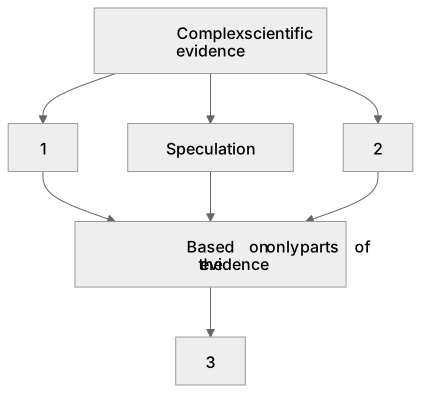
1Box 1
2Box 2
3Box 3
There is more to this lesson
The full lesson goes on to check your understanding and help you earn the marks. Create a free account to carry on, with your progress saved.
A week of Premium from your first lesson · Then the free plan continues · No card, no charge
Test your understanding of Human activities which contribute to an increase in greenhouse gases in the: This leads to simplified models, speculation and opinions presented in the media that may be based on only parts of the evidence and which may be biased.
Active recall beats re-reading. Take an instant quiz now to test what you’ve learned and lock it into long-term memory.
A week of Premium from your first lesson · Then the free plan continues · No card, no charge