AQA · GCSE · Chemistry
Course version: 8462 · Version from Sept 2018
Students should be able to work out the charge on the ions of metals and…
Full specification wording
Ionic bonding: Students should be able to work out the charge on the ions of metals and non-metals from the group number of the element, limited to the metals in Groups 1 and 2, and non-metals in Groups 6 and 7.
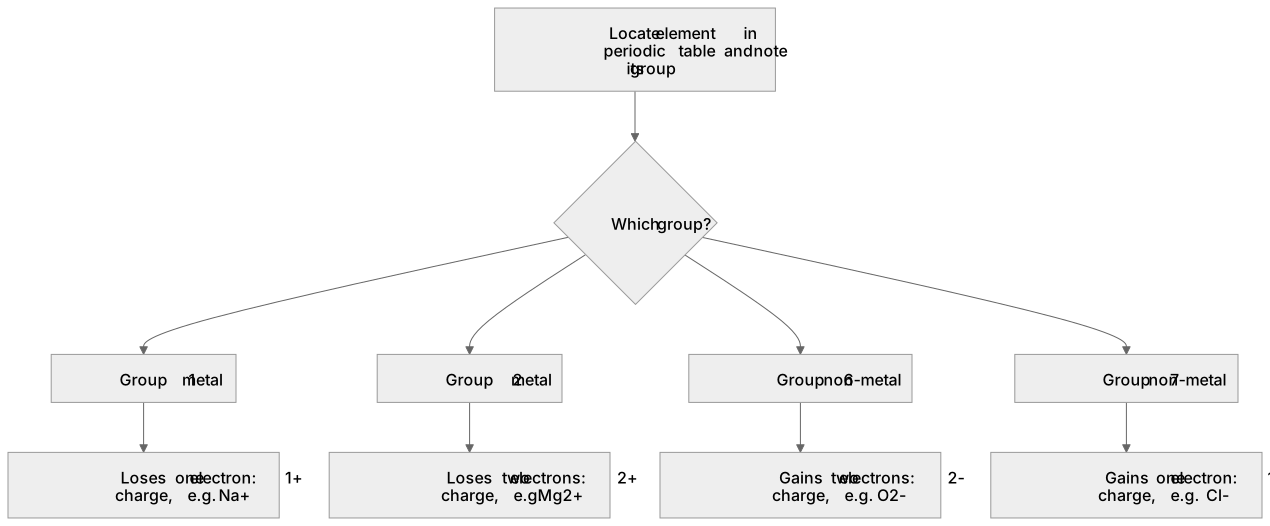
To work out an ion charge, first locate the element in the periodic table and note its group.
Checked against the AQA 8462 specification (opens in a new tab) on .
- Point 7 of 7
- 4 key terms
Study notes
From the checked teaching notes for this specification point.
The idea
To work out an ion charge, first locate the element in the periodic table and note its group. A Group 1 metal loses one electron, so its ion has a 1⁺ charge, as in Na⁺. A Group 2 metal loses two electrons, so its ion has a 2⁺ charge, as in Mg²⁺. A Group 6 non-metal gains two electrons, so its ion has a 2⁻ charge, as in O²⁻. A Group 7 non-metal gains one electron, so its ion has a 1⁻ charge, as in Cl⁻. The number of electrons gained or lost equals the distance from the nearest noble gas group, and the sign shows whether electrons are lost or gained. This method applies only to the groups named in the statement.
What earns the marks
- Identify the group of the element from the periodic table before assigning a charge.
- Group 1 metals form 1⁺ ions by losing one electron, for example Li⁺ and K⁺.
- Group 2 metals form 2⁺ ions by losing two electrons, for example Mg²⁺ and Ca²⁺.
- Group 6 non-metals form 2⁻ ions by gaining two electrons, for example O²⁻ and S²⁻.
- Group 7 non-metals form 1⁻ ions by gaining one electron, for example F⁻ and Br⁻.
- Use the noble gas electron arrangement to justify the number of electrons gained or lost.
Common mistakes and how to put them right
Using the group number directly as the charge for Group 6 elements, giving 6⁻ instead of 2⁻.
Put it right: The correct charge is 2⁻ because two electrons are gained.
Forgetting the sign on the charge, writing Mg² instead of Mg²⁺.
Put it right: The sign shows the direction of electron transfer.
Applying the method to transition metals or Group 4 elements, which do not follow this simple pattern.
Put it right: The rule is limited to Groups 1, 2, 6 and 7.
Exam tips
- Write the electron loss or gain in words before writing the ion symbol.
- For a formula, balance the total positive and negative charges to check the ion charges are consistent.
- Learn one example from each group so you can recall the pattern quickly.
Try the lesson
The start of the Ionic bonding: Students should be able to work out the charge on the ions of metals and non-metals from the group number of the element, limited to the metals in Groups 1 and 2, and non-metals in Groups 6 and 7. lesson, made from checked teaching notes for this specification point.
Have a go first
Sodium is a metal in Group 1. What charge does the sodium ion have?
Listen
To work out an ion charge, first locate the element in the periodic table and note its group. A Group 1 metal loses one electron, so its ion has a 1⁺ charge, as in Na⁺. A Group 2 metal loses two electrons, so its ion has a 2⁺ charge, as in Mg²⁺. A Group 6 non-metal gains two electrons, so its ion has a 2⁻ charge, as in O²⁻. A Group 7 non-metal gains one electron, so its ion has a 1⁻ charge, as in Cl⁻. The number of electrons gained or lost equals the distance from the nearest noble gas group, and the sign shows whether electrons are lost or gained. This method applies only to the groups named in the statement. A strong answer earns marks for these points. Identify the group of the element from the periodic table before assigning a charge. Group 1 metals form 1⁺ ions by losing one electron, for example Li⁺ and K⁺. Group 2 metals form 2⁺ ions by losing two electrons, for example Mg²⁺ and Ca²⁺. Group 6 non-metals form 2⁻ ions by gaining two electrons, for example O²⁻ and S²⁻. Exam tip: Write the electron loss or gain in words before writing the ion symbol.
See it
Key words
Say what each word means before you turn the card.
Periodic table group patterns
Try answering aloud or in your head before turning the card.
Electron gain and loss to form ions
Try answering aloud or in your head before turning the card.
Charge notation for ions
Try answering aloud or in your head before turning the card.
Limiting rules to specified groups
Try answering aloud or in your head before turning the card.
See every definition
- Periodic table group patterns
- The number of electrons gained or lost equals the distance from the nearest noble gas group, and the sign shows whether electrons are lost or gained.
- Electron gain and loss to form ions
- A Group 1 metal loses one electron, a Group 2 metal loses two electrons, a Group 6 non-metal gains two electrons and a Group 7 non-metal gains one electron.
- Charge notation for ions
- The ion symbol carries a superscript charge whose sign shows the direction of electron transfer, as in Mg²⁺ and O²⁻.
- Limiting rules to specified groups
- The method applies only to the metals in Groups 1 and 2 and the non-metals in Groups 6 and 7.
There is more to this lesson
The full lesson goes on to check your understanding and help you earn the marks. Create a free account to carry on, with your progress saved.
A week of Premium from your first lesson · Then the free plan continues · No card, no charge
Test your understanding of Ionic bonding: Students should be able to work out the charge on the ions of metals and non-metals from the group number of the element, limited to the metals in Groups 1 and 2, and non-metals in Groups 6 and 7.
Active recall beats re-reading. Take an instant quiz now to test what you’ve learned and lock it into long-term memory.
A week of Premium from your first lesson · Then the free plan continues · No card, no charge