AQA · GCSE · Chemistry
Course version: 8462 · Version from Sept 2018
Students should be able to: deduce that a compound is ionic from a diagram…
Full specification wording
Ionic compounds: Students should be able to: deduce that a compound is ionic from a diagram of its structure in one of the specified forms describe the limitations of using dot and cross, ball and stick, two and three-dimensional diagrams to represent a giant ionic structure work out the empirical formula of an ionic compound from a given model or diagram that shows the ions in the structure.
This statement combines three skills.
Checked against the AQA 8462 specification (opens in a new tab) on .
- Point 5 of 6
- 4 key terms
Study notes
From the checked teaching notes for this specification point.
The idea
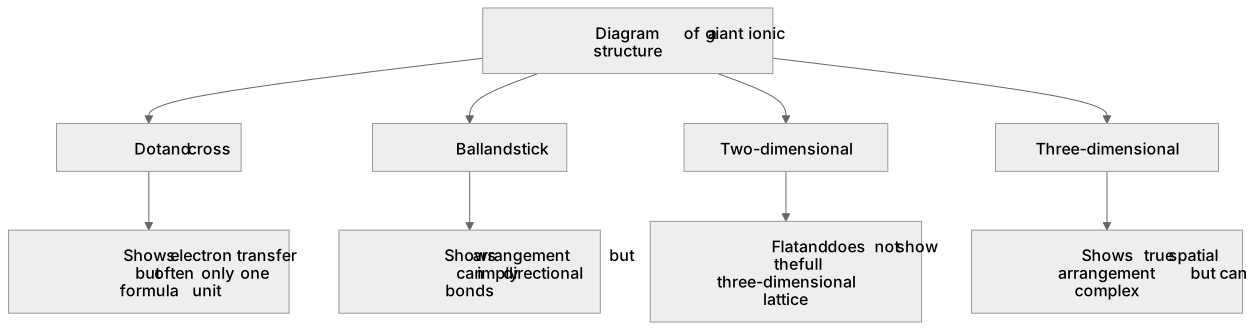
This statement combines three skills. First, you must recognise an ionic compound from a diagram: look for a giant lattice of oppositely charged ions, often shown as spheres or with charges. Second, you must describe the limitations of dot and cross, ball and stick, and two- and three-dimensional diagrams. Dot and cross diagrams show electron transfer but usually only one formula unit; ball and stick models show arrangement but imply directional bonds; two-dimensional diagrams are flat and miss the three-dimensional lattice; three-dimensional models are most accurate but can be complex. Third, you must work out the empirical formula from a model by counting the ratio of cations to anions.
For example: If a diagram shows twice as many Cl⁻ ions as Mg²⁺ ions, the empirical formula is MgCl₂ because the ratio is 1:2.
What earns the marks
- Recognise an ionic compound from a diagram by identifying a giant lattice of oppositely charged ions.
- Describe that dot and cross diagrams show electron transfer but often only one formula unit.
- Describe that ball and stick models show arrangement but can imply directional bonds.
- Describe that two-dimensional diagrams are flat and do not show the full three-dimensional lattice.
- Describe that three-dimensional models show the true spatial arrangement but can be complex.
- Work out the empirical formula by finding the simplest whole-number ratio of cations to anions in the diagram.
Common mistakes and how to put them right
Counting all ions shown in a diagram and using that as the formula.
Put it right by finding the simplest whole-number ratio of cations to anions.
Thinking that a ball and stick model shows covalent bonds in an ionic compound.
Put it right by explaining the sticks represent the arrangement, not shared electrons.
Assuming a two-dimensional diagram shows the complete lattice.
Put it right by stating it is a cross-section and does not show the three-dimensional arrangement.
Exam tips
- When deducing ionic character, look for charged particles arranged in a regular repeating pattern.
- For empirical formula, count the number of each ion in the simplest repeating unit and reduce the ratio.
- When describing limitations, always state what the diagram shows and what it does not show.
Try the lesson
The start of the Ionic compounds: Students should be able to: deduce that a compound is ionic from a diagram of its structure in one of the specified forms describe the limitations of using dot and cross, ball and stick, two and three-dimensional diagrams to represent a giant ionic structure work out the empirical formula of an ionic compound from a given model or diagram that shows the ions in the structure. lesson, made from checked teaching notes for this specification point.
Have a go first
A diagram shows a regular arrangement of positive and negative ions in a giant lattice. What does this diagram show about the compound?
Listen
This statement combines three skills. First, you must recognise an ionic compound from a diagram: look for a giant lattice of oppositely charged ions, often shown as spheres or with charges. Second, you must describe the limitations of dot and cross, ball and stick, and two- and three-dimensional diagrams. Dot and cross diagrams show electron transfer but usually only one formula unit; ball and stick models show arrangement but imply directional bonds; two-dimensional diagrams are flat and miss the three-dimensional lattice; three-dimensional models are most accurate but can be complex. Third, you must work out the empirical formula from a model by counting the ratio of cations to anions. For example, if a diagram shows twice as many Cl⁻ ions as Mg²⁺ ions, the empirical formula is MgCl₂ because the ratio is 1:2. A strong answer earns marks for these points. Recognise an ionic compound from a diagram by identifying a giant lattice of oppositely charged ions. Describe that dot and cross diagrams show electron transfer but often only one formula unit. Describe that ball and stick models show arrangement but can imply directional bonds. Describe that two-dimensional diagrams are flat and do not show the full three-dimensional lattice. A common slip: Counting all ions shown in a diagram and using that as the formula. Instead, finding the simplest whole-number ratio of cations to anions. Exam tip: When deducing ionic character, look for charged particles arranged in a regular repeating pattern.
See it
Key words
Say what each word means before you turn the card.
Ionic lattice recognition
Try answering aloud or in your head before turning the card.
Model limitations
Try answering aloud or in your head before turning the card.
Empirical formula
Try answering aloud or in your head before turning the card.
Ratio of ions
Try answering aloud or in your head before turning the card.
See every definition
- Ionic lattice recognition
- Deducing that a compound is ionic from a diagram by identifying a giant lattice of oppositely charged ions.
- Model limitations
- What dot and cross, ball and stick, and two- and three-dimensional diagrams show and do not show when representing a giant ionic structure.
- Empirical formula
- The simplest whole-number ratio of cations to anions in the diagram, found by counting the ions.
- Ratio of ions
- The proportion of cations to anions in a model, which gives the empirical formula of an ionic compound.
Label the diagram
Some boxes have lost their names. Pick the right name for each number.
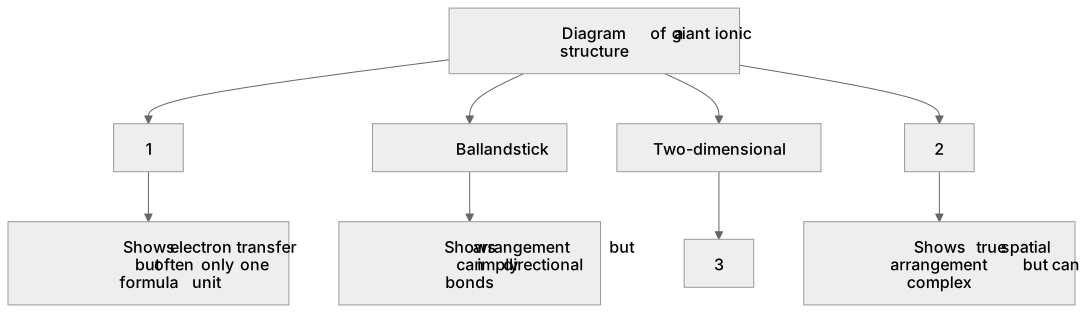
1Box 1
2Box 2
3Box 3
There is more to this lesson
The full lesson goes on to check your understanding and help you earn the marks. Create a free account to carry on, with your progress saved.
A week of Premium from your first lesson · Then the free plan continues · No card, no charge
Test your understanding of Ionic compounds: Students should be able to: deduce that a compound is ionic from a diagram of its structure in one of the specified forms describe the limitations of using dot and cross, ball and stick, two and three-dimensional diagrams to represent a giant ionic structure work out the empirical formula of an ionic compound from a given model or diagram that shows the ions in the structure.
Active recall beats re-reading. Take an instant quiz now to test what you’ve learned and lock it into long-term memory.
A week of Premium from your first lesson · Then the free plan continues · No card, no charge