AQA · GCSE · Chemistry
Course version: 8462 · Version from Sept 2018
Students should be able to explain the effect of a limiting quantity of a…
Full specification wording
Limiting reactants (HT only): Students should be able to explain the effect of a limiting quantity of a reactant on the amount of products it is possible to obtain in terms of amounts in moles or masses in grams.
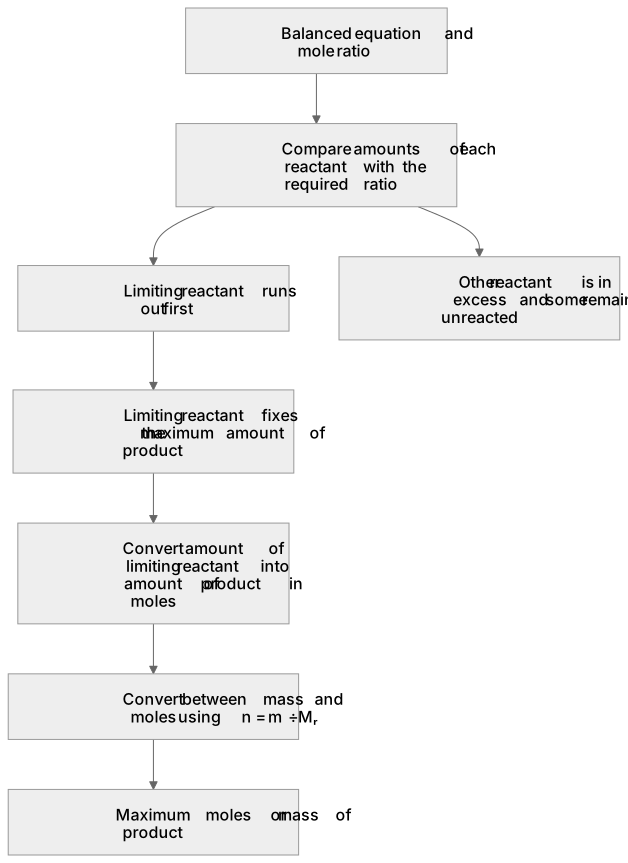
When reactants are not in the exact ratio of the balanced equation, the reactant that runs out first is the limiting reactant; it fixes the maximum amount of product.
Checked against the AQA 8462 specification (opens in a new tab) on .
- Point 3 of 3
- 4 key terms
Study notes
From the checked teaching notes for this specification point.
The idea
When reactants are not in the exact ratio of the balanced equation, the reactant that runs out first is the limiting reactant; it fixes the maximum amount of product. The other reactant is in excess and some remains unreacted. Use the balanced equation to convert the limiting amount into product amount. For example, 2 mol H₂ reacts with 1 mol O₂ to give 2 mol H₂O. If only 1 mol O₂ is available with 3 mol H₂, oxygen is limiting, so at most 2 mol H₂O forms and 1 mol H₂ is left over. The same logic works with masses: convert masses to moles using n = m ÷ Mᵣ, apply the mole ratio, then convert back to mass if required.
What earns the marks
- Identify the limiting reactant by comparing the amounts of each reactant with the ratio required by the balanced equation.
- State that the limiting reactant determines the maximum amount of product that can be formed.
- Use the balanced equation to convert the amount of limiting reactant into the amount of product in moles.
- Convert between mass and moles using n = m ÷ Mᵣ when the question gives masses in grams.
- Explain that the reactant in excess is not fully used up and remains after the reaction.
Common mistakes and how to put them right
Assuming the reactant with the smaller mass is always limiting.
Put it right: The correct approach is to compare mole amounts with the equation ratio.
Using the amount of the excess reactant to calculate product.
Put it right: The correct method uses the limiting reactant only.
Forgetting to convert grams to moles before applying the ratio.
Put it right: The corrected method converts mass to moles first, then uses the ratio.
Exam tips
- Write the balanced equation and label the mole ratio before doing any calculation.
- Show clearly which reactant is limiting and state that it controls the product amount.
- Check units and significant figures at the end, and include the unit with any mass answer.
Try the lesson
The start of the Limiting reactants (HT only): Students should be able to explain the effect of a limiting quantity of a reactant on the amount of products it is possible to obtain in terms of amounts in moles or masses in grams. lesson, made from checked teaching notes for this specification point.
Have a go first
Magnesium reacts with oxygen: 2Mg + O₂ → 2MgO. A student has 4 moles of Mg and 1 mole of O₂. Which reactant is the limiting reactant, and how many moles of MgO can be formed?
Listen
When reactants are not in the exact ratio of the balanced equation, the reactant that runs out first is the limiting reactant; it fixes the maximum amount of product. The other reactant is in excess and some remains unreacted. Use the balanced equation to convert the limiting amount into product amount. For example, 2 mol H₂ reacts with 1 mol O₂ to give 2 mol H₂O. If only 1 mol O₂ is available with 3 mol H₂, oxygen is limiting, so at most 2 mol H₂O forms and 1 mol H₂ is left over. The same logic works with masses: convert masses to moles using n = m ÷ Mᵣ, apply the mole ratio, then convert back to mass if required. A strong answer earns marks for these points. Identify the limiting reactant by comparing the amounts of each reactant with the ratio required by the balanced equation. State that the limiting reactant determines the maximum amount of product that can be formed. Use the balanced equation to convert the amount of limiting reactant into the amount of product in moles. Convert between mass and moles using n = m ÷ Mᵣ when the question gives masses in grams. Exam tip: Write the balanced equation and label the mole ratio before doing any calculation.
See it
Key words
Say what each word means before you turn the card.
Limiting reactant
Try answering aloud or in your head before turning the card.
Excess reactant
Try answering aloud or in your head before turning the card.
Mole ratio
Try answering aloud or in your head before turning the card.
n = m ÷ Mᵣ
Try answering aloud or in your head before turning the card.
See every definition
- Limiting reactant
- The reactant that runs out first when reactants are not in the exact ratio of the balanced equation, fixing the maximum amount of product.
- Excess reactant
- The reactant that is not fully used up and some of which remains unreacted after the reaction.
- Mole ratio
- The ratio required by the balanced equation, used to convert the amount of limiting reactant into the amount of product in moles.
- n = m ÷ Mᵣ
- The relationship used to convert between mass and moles when the question gives masses in grams.
Label the diagram
Some boxes have lost their names. Pick the right name for each number.
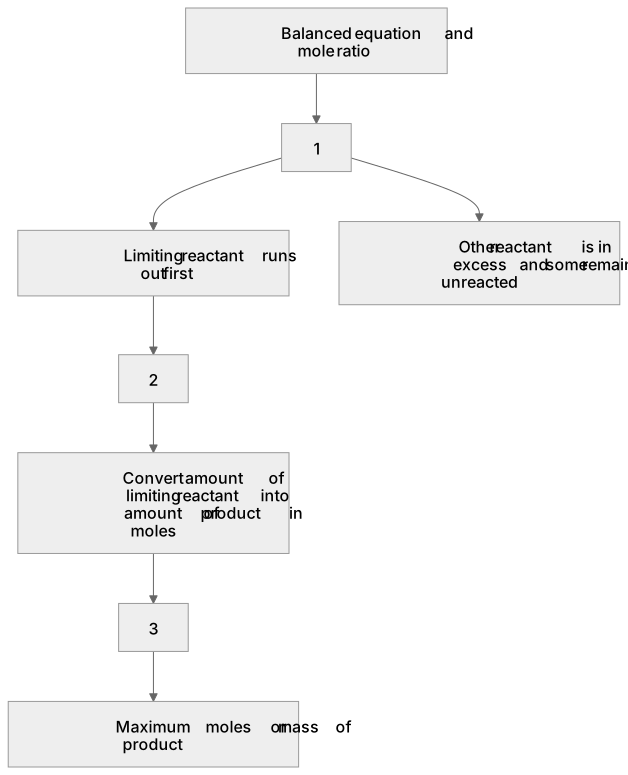
1Box 1
2Box 2
3Box 3
There is more to this lesson
The full lesson goes on to check your understanding and help you earn the marks. Create a free account to carry on, with your progress saved.
A week of Premium from your first lesson · Then the free plan continues · No card, no charge
Test your understanding of Limiting reactants (HT only): Students should be able to explain the effect of a limiting quantity of a reactant on the amount of products it is possible to obtain in terms of amounts in moles or masses in grams.
Active recall beats re-reading. Take an instant quiz now to test what you’ve learned and lock it into long-term memory.
A week of Premium from your first lesson · Then the free plan continues · No card, no charge