AQA · GCSE · Chemistry
Course version: 8462 · Version from Sept 2018
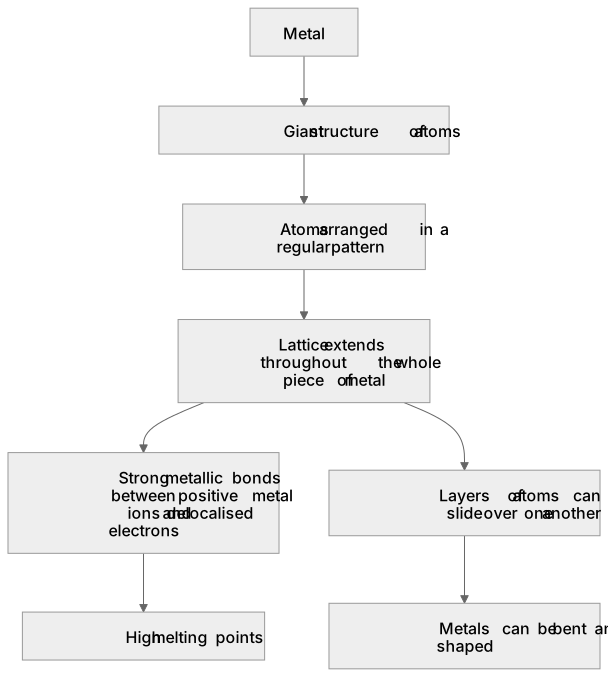
Metals consist of giant structures of atoms arranged in a regular pattern.
Full specification wording
Metallic bonding: Metals consist of giant structures of atoms arranged in a regular pattern.
Metals are not made of separate molecules but of one enormous lattice of atoms.
Checked against the AQA 8462 specification (opens in a new tab) on .
- 4 key terms
Study notes
From the checked teaching notes for this specification point.
The idea
Metals are not made of separate molecules but of one enormous lattice of atoms. In a pure metal, identical atoms pack together in a repeating three-dimensional arrangement, so the structure is described as giant and regular. Because the lattice continues throughout the piece of metal, melting requires overcoming the strong metallic bonds between positive metal ions and delocalised electrons, explaining the high melting points of most metals. The regular packing also allows layers of atoms to slide over one another when a force is applied, so metals can be bent and shaped. For example, in a copper wire the copper atoms form a continuous regular lattice rather than a collection of Cu₂ molecules. When you describe a metal, state that it is a giant structure, that the atoms are arranged in a regular pattern, and that this arrangement extends throughout the material.
What earns the marks
- States that a metal is a giant structure rather than a simple molecule.
- Describes the atoms as arranged in a regular, repeating pattern.
- Explains that the regular lattice extends throughout the whole piece of metal.
- Links the giant regular structure and strong metallic bonds to a property such as high melting point or malleability.
- Uses the term lattice correctly to mean a repeating three-dimensional arrangement of atoms.
Common mistakes and how to put them right
Saying that metals are made of molecules.
Put it right by describing a giant lattice of atoms.
Describing the arrangement as random.
Put it right by stating that the atoms are in a regular pattern.
Confusing giant structures with simple molecular structures.
Put it right by noting that the lattice has no fixed small number of atoms.
Exam tips
- Sketch a small section of the regular lattice and label the repeating pattern.
- Use the words giant, regular and lattice in your answer to show precise vocabulary.
- When asked to explain a property, begin from the structure and strong metallic bonds, then link to the behaviour.
Try the lesson
The start of the Metallic bonding: Metals consist of giant structures of atoms arranged in a regular pattern. lesson, made from checked teaching notes for this specification point.
Have a go first
Which phrase best describes the arrangement of atoms in a piece of solid copper metal?
Listen
Metals are not made of separate molecules but of one enormous lattice of atoms. In a pure metal, identical atoms pack together in a repeating three-dimensional arrangement, so the structure is described as giant and regular. Because the lattice continues throughout the piece of metal, melting requires overcoming the strong metallic bonds between positive metal ions and delocalised electrons, explaining the high melting points of most metals. The regular packing also allows layers of atoms to slide over one another when a force is applied, so metals can be bent and shaped. For example, in a copper wire the copper atoms form a continuous regular lattice rather than a collection of Cu₂ molecules. When you describe a metal, state that it is a giant structure, that the atoms are arranged in a regular pattern, and that this arrangement extends throughout the material. A strong answer earns marks for these points. States that a metal is a giant structure rather than a simple molecule. Describes the atoms as arranged in a regular, repeating pattern. Explains that the regular lattice extends throughout the whole piece of metal. Links the giant regular structure and strong metallic bonds to a property such as high melting point or malleability. A common slip: Saying that metals are made of molecules. Instead, describing a giant lattice of atoms. Exam tip: Sketch a small section of the regular lattice and label the repeating pattern.
See it
Key words
Say what each word means before you turn the card.
Giant structure
Try answering aloud or in your head before turning the card.
Regular pattern
Try answering aloud or in your head before turning the card.
Lattice
Try answering aloud or in your head before turning the card.
Malleability
Try answering aloud or in your head before turning the card.
See every definition
- Giant structure
- A metal is a giant structure of atoms rather than a simple molecule, with no fixed small number of atoms.
- Regular pattern
- The atoms in a metal are arranged in a regular, repeating pattern, not a random arrangement.
- Lattice
- A repeating three-dimensional arrangement of atoms that extends throughout the whole piece of metal.
- Malleability
- The regular packing allows layers of atoms to slide over one another when a force is applied, so metals can be bent and shaped.
Label the diagram
Some boxes have lost their names. Pick the right name for each number.
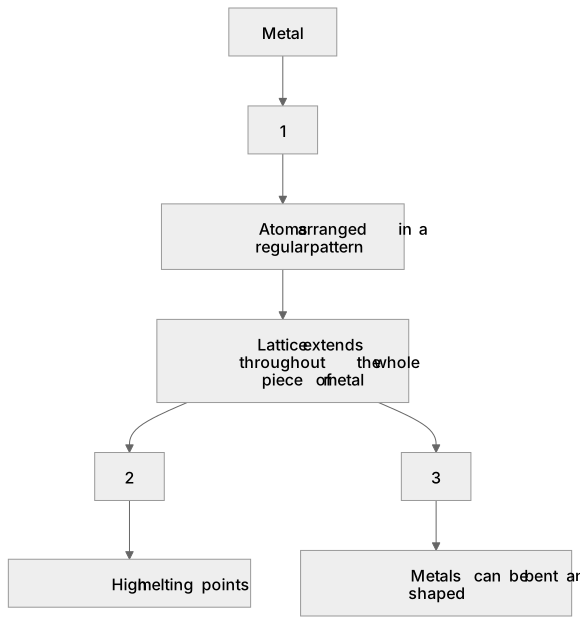
1Box 1
2Box 2
3Box 3
There is more to this lesson
The full lesson goes on to check your understanding and help you earn the marks. Create a free account to carry on, with your progress saved.
A week of Premium from your first lesson · Then the free plan continues · No card, no charge
Test your understanding of Metallic bonding: Metals consist of giant structures of atoms arranged in a regular pattern.
Active recall beats re-reading. Take an instant quiz now to test what you’ve learned and lock it into long-term memory.
A week of Premium from your first lesson · Then the free plan continues · No card, no charge