AQA · GCSE · Chemistry
Course version: 8462 · Version from Sept 2018
Metals are good conductors of electricity because the delocalised…
Full specification wording
Metals as conductors: Metals are good conductors of electricity because the delocalised electrons in the metal carry electrical charge through the metal.
Metallic bonding produces a giant lattice of positive metal ions surrounded by delocalised electrons.
Checked against the AQA 8462 specification (opens in a new tab) on .
- Point 1 of 2
- 3 key terms
Study notes
From the checked teaching notes for this specification point.
The idea
Metallic bonding produces a giant lattice of positive metal ions surrounded by delocalised electrons. These delocalised electrons are not attached to any particular ion and are free to move throughout the structure. When a potential difference is applied across a metal, for example by connecting it to a battery in a circuit, the delocalised electrons drift towards the positive terminal. Because electrons carry negative charge, this movement of charge is an electric current. The more freely the electrons can move, the better the metal conducts. This explains why metals such as copper are used for electrical wiring, while materials without delocalised electrons, such as plastics, do not conduct. The same model also helps explain why metals conduct thermal energy.
What earns the marks
- Metals contain delocalised electrons that are free to move through the giant metallic lattice.
- The delocalised electrons carry electrical charge through the metal.
- When a potential difference is applied, the electrons move and constitute an electric current.
- The presence of mobile charge carriers explains why metals are good conductors of electricity.
- A named example, such as copper used in electrical wiring, can illustrate the property.
Common mistakes and how to put them right
Saying that the positive metal ions carry the current.
Put it right: In metallic conduction it is the delocalised electrons that move and carry charge.
Stating that electrons are transferred from atom to atom as whole atoms move.
Put it right: The electrons are delocalised and move through the lattice.
Confusing electrical conduction with thermal conduction.
Put it right: Both involve delocalised electrons, but the statement here is specifically about carrying electrical charge.
Exam tips
- Name the charge carriers explicitly: delocalised electrons.
- Explain that the electrons are free to move through the whole structure, not fixed to one ion.
- Link the movement of electrons to the idea of charge being carried through the metal.
Try the lesson
The start of the Metals as conductors: Metals are good conductors of electricity because the delocalised electrons in the metal carry electrical charge through the metal. lesson, made from checked teaching notes for this specification point.
Have a go first
Which statement explains why a copper wire conducts electricity?
Listen
Metallic bonding produces a giant lattice of positive metal ions surrounded by delocalised electrons. These delocalised electrons are not attached to any particular ion and are free to move throughout the structure. When a potential difference is applied across a metal, for example by connecting it to a battery in a circuit, the delocalised electrons drift towards the positive terminal. Because electrons carry negative charge, this movement of charge is an electric current. The more freely the electrons can move, the better the metal conducts. This explains why metals such as copper are used for electrical wiring, while materials without delocalised electrons, such as plastics, do not conduct. The same model also helps explain why metals conduct thermal energy. A strong answer earns marks for these points. Metals contain delocalised electrons that are free to move through the giant metallic lattice. The delocalised electrons carry electrical charge through the metal. When a potential difference is applied, the electrons move and constitute an electric current. The presence of mobile charge carriers explains why metals are good conductors of electricity. Exam tip: Name the charge carriers explicitly: delocalised electrons.
See it
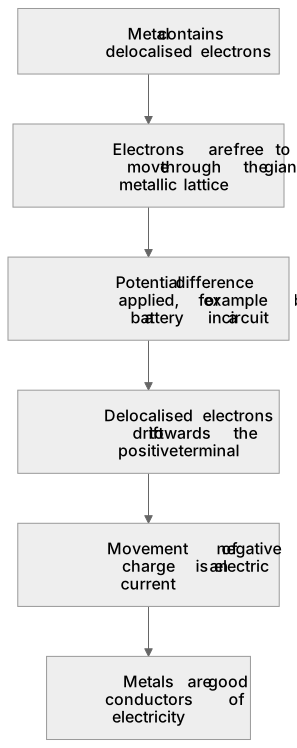
Put it in order
Put these steps in the order they happen.
- 1. Potential difference applied, for example by a battery in a circuit
- 2. Electrons are free to move through the giant metallic lattice
- 3. Metal contains delocalised electrons
- 4. Metals are good conductors of electricity
- 5. Movement of negative charge is an electric current
- 6. Delocalised electrons drift towards the positive terminal
Key words
Say what each word means before you turn the card.
Delocalised electrons
Try answering aloud or in your head before turning the card.
Mobile charge carriers
Try answering aloud or in your head before turning the card.
Electric current
Try answering aloud or in your head before turning the card.
See every definition
- Delocalised electrons
- Electrons in a metal that are not attached to any particular ion and are free to move throughout the structure.
- Mobile charge carriers
- The delocalised electrons in a metal, which are free to move through the giant metallic lattice.
- Electric current
- The movement of charge that occurs when delocalised electrons drift towards the positive terminal after a potential difference is applied.
Label the diagram
Some boxes have lost their names. Pick the right name for each number.
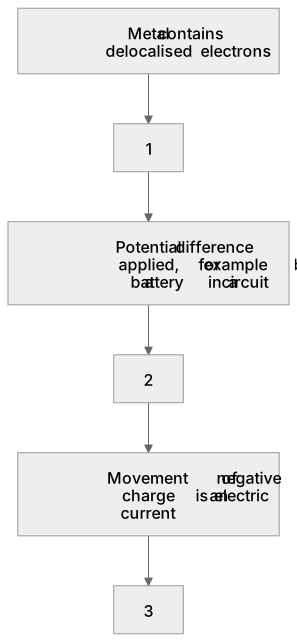
1Box 1
2Box 2
3Box 3
There is more to this lesson
The full lesson goes on to check your understanding and help you earn the marks. Create a free account to carry on, with your progress saved.
A week of Premium from your first lesson · Then the free plan continues · No card, no charge
Test your understanding of Metals as conductors: Metals are good conductors of electricity because the delocalised electrons in the metal carry electrical charge through the metal.
Active recall beats re-reading. Take an instant quiz now to test what you’ve learned and lock it into long-term memory.
A week of Premium from your first lesson · Then the free plan continues · No card, no charge