AQA · GCSE · Chemistry
Course version: 8462 · Version from Sept 2018
A mixture consists of two or more elements or compounds not chemically…
Full specification wording
Mixtures: A mixture consists of two or more elements or compounds not chemically combined together.
A mixture contains two or more substances that are together in the same space but are not joined by chemical bonds.
Checked against the AQA 8462 specification (opens in a new tab) on .
- Point 1 of 5
- 3 key terms
Study notes
From the checked teaching notes for this specification point.
The idea
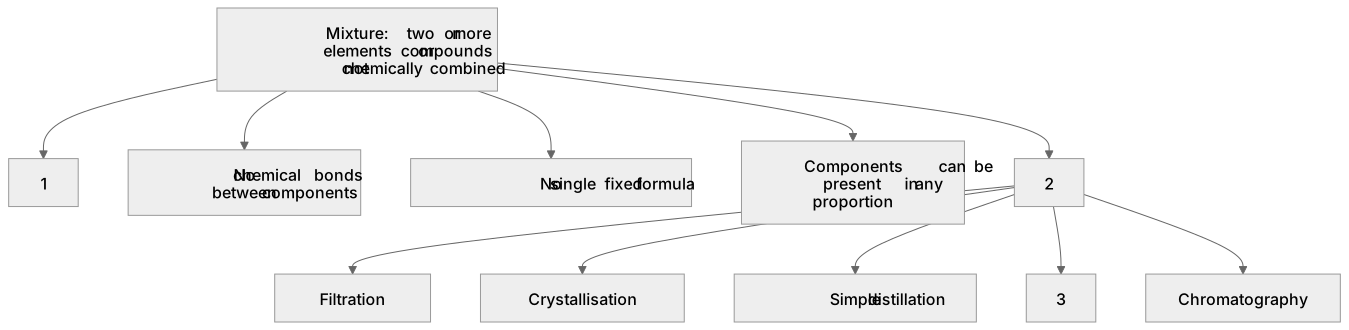
A mixture contains two or more substances that are together in the same space but are not joined by chemical bonds. The substances keep their own identities, so a mixture can usually be separated by physical methods such as filtration, crystallisation, simple distillation, fractional distillation or chromatography. Air is a mixture of nitrogen, oxygen, argon, carbon dioxide and other gases; seawater is a mixture of water and dissolved salts. In a mixture the components can be present in any proportion, unlike a compound which has a fixed composition by mass. No new chemical bonds form between the components, so the mixture does not have a single fixed formula.
What earns the marks
- Defines a mixture as two or more elements or compounds that are not chemically combined together.
- Distinguishes mixtures from compounds: mixtures have variable composition, no chemical bonds between components and can be separated by physical means.
- Gives examples of mixtures such as air, seawater, alloys and crude oil, and identifies the elements or compounds present.
- Explains that the components of a mixture retain their individual identities and can be separated using techniques matched to their physical properties.
- Recognises that no new substance is formed when a mixture is made, so the process is not a chemical reaction.
- Uses particle diagrams or descriptions to show different types of particles mixed but not bonded together.
Common mistakes and how to put them right
Describing a mixture as a compound because the substances are together.
Put it right: State that a compound involves chemical bonding and fixed composition, whereas a mixture does not.
Assuming a mixture always has a fixed ratio of components.
Put it right: Note that mixtures can be made in any proportion.
Thinking that a mixture cannot be separated because it looks uniform.
Put it right: Recall that physical separation methods can separate even apparently uniform mixtures such as salt solution.
Exam tips
- When asked to classify a substance, look for a fixed formula and chemical bonding to identify a compound, and variable composition with no bonding to identify a mixture.
- Name the components of a named mixture and state the physical property that allows separation, such as boiling point or solubility.
- Use particle diagrams to support your answer; show different particles close together but not joined.
Try the lesson
The start of the Mixtures: A mixture consists of two or more elements or compounds not chemically combined together. lesson, made from checked teaching notes for this specification point.
Have a go first
Which statement best describes a mixture?
Listen
A mixture contains two or more substances that are together in the same space but are not joined by chemical bonds. The substances keep their own identities, so a mixture can usually be separated by physical methods such as filtration, crystallisation, simple distillation, fractional distillation or chromatography. Air is a mixture of nitrogen, oxygen, argon, carbon dioxide and other gases; seawater is a mixture of water and dissolved salts. In a mixture the components can be present in any proportion, unlike a compound which has a fixed composition by mass. No new chemical bonds form between the components, so the mixture does not have a single fixed formula. A strong answer earns marks for these points. Defines a mixture as two or more elements or compounds that are not chemically combined together. Distinguishes mixtures from compounds: mixtures have variable composition, no chemical bonds between components and can be separated by physical means. Gives examples of mixtures such as air, seawater, alloys and crude oil, and identifies the elements or compounds present. Explains that the components of a mixture retain their individual identities and can be separated using techniques matched to their physical properties. A common slip: Describing a mixture as a compound because the substances are together. Instead, state that a compound involves chemical bonding and fixed composition, whereas a mixture does not. Exam tip: When asked to classify a substance, look for a fixed formula and chemical bonding to identify a compound, and variable composition with no bonding to identify a mixture.
See it

Key words
Say what each word means before you turn the card.
Mixture
Try answering aloud or in your head before turning the card.
Variable composition
Try answering aloud or in your head before turning the card.
Particle diagram
Try answering aloud or in your head before turning the card.
See every definition
- Mixture
- Two or more elements or compounds that are not chemically combined together, so the substances keep their own identities.
- Variable composition
- The components of a mixture can be present in any proportion, unlike a compound which has a fixed composition by mass.
- Particle diagram
- A representation showing different types of particles mixed but not bonded together.
Label the diagram
Some boxes have lost their names. Pick the right name for each number.
1Box 1
2Box 2
3Box 3
There is more to this lesson
The full lesson goes on to check your understanding and help you earn the marks. Create a free account to carry on, with your progress saved.
A week of Premium from your first lesson · Then the free plan continues · No card, no charge
Test your understanding of Mixtures: A mixture consists of two or more elements or compounds not chemically combined together.
Active recall beats re-reading. Take an instant quiz now to test what you’ve learned and lock it into long-term memory.
A week of Premium from your first lesson · Then the free plan continues · No card, no charge