AQA · GCSE · Chemistry
Course version: 8462 · Version from Sept 2018
Students should understand that the measurement of amounts in moles can…
Full specification wording
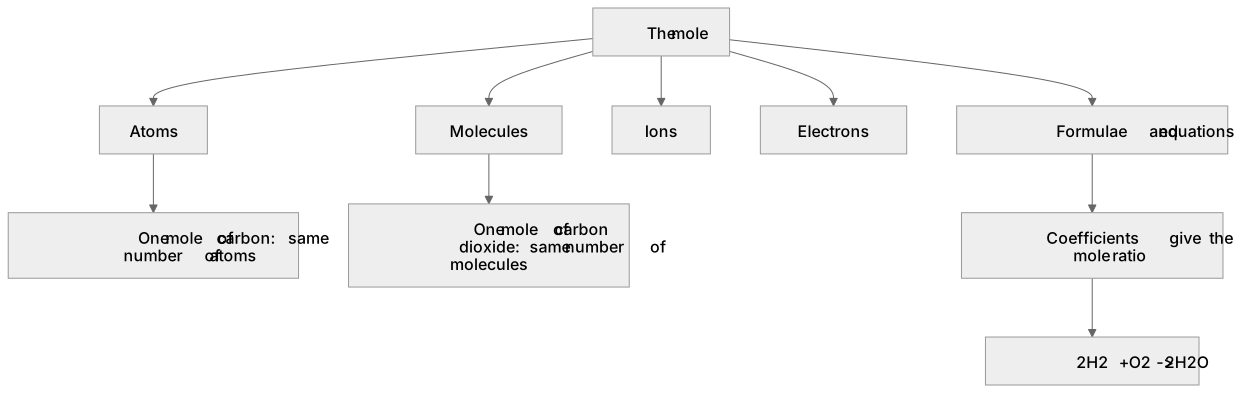
Moles (HT only): Students should understand that the measurement of amounts in moles can apply to atoms, molecules, ions, electrons, formulae and equations, for example that in one mole of carbon (C) the number of atoms is the same as the number of molecules in one mole of carbon dioxide (CO ).
The mole is a general unit for counting any specified particle.
Checked against the AQA 8462 specification (opens in a new tab) on .
- Point 5 of 6
- 4 key terms
Study notes
From the checked teaching notes for this specification point.
The idea
The mole is a general unit for counting any specified particle. It can be used for atoms, molecules, ions, electrons, formula units and the substances in equations. For example, one mole of carbon contains 6.02 × 10²³ carbon atoms, and one mole of carbon dioxide contains 6.02 × 10²³ carbon dioxide molecules. The number of particles is the same, but the particles are different. In equations, coefficients show the ratio of moles of each substance. For example, in 2H₂ + O₂ → 2H₂O, two moles of hydrogen molecules react with one mole of oxygen molecules to form two moles of water molecules. The mole can also count electrons, such as in electrolysis or redox reactions, where one mole of electrons is 6.02 × 10²³ electrons.
What earns the marks
- Explain that the mole can be applied to any stated particle, including atoms, molecules, ions and electrons.
- Compare equal amounts in moles of different substances and state that they contain the same number of stated particles.
- Use coefficients in a balanced equation to give the ratio of amounts in moles of reactants and products.
- Apply the mole concept to electrons, for example in electrolysis or redox, stating the particle as electrons.
Common mistakes and how to put them right
Treating one mole of carbon dioxide as containing one mole of atoms.
Put it right by stating it contains one mole of CO₂ molecules, which contain three moles of atoms in total.
Ignoring the coefficients in an equation when comparing moles.
Put it right by using the balanced coefficients as the mole ratio.
Using the mole only for molecules and not for atoms, ions or electrons.
Put it right by applying it to any stated particle.
Exam tips
- Always state which particle the mole refers to in your answer.
- When using an equation, write the mole ratio underneath the balanced equation before calculating.
- For electron calculations, remember that one mole of electrons is 6.02 × 10²³ electrons.
Try the lesson
The start of the Moles (HT only): Students should understand that the measurement of amounts in moles can apply to atoms, molecules, ions, electrons, formulae and equations, for example that in one mole of carbon (C) the number of atoms is the same as the number of molecules in one mole of carbon dioxide (CO ). lesson, made from checked teaching notes for this specification point.
Have a go first
In one mole of carbon, C, how does the number of atoms compare with the number of molecules in one mole of carbon dioxide, CO₂?
Listen
The mole is a general unit for counting any specified particle. It can be used for atoms, molecules, ions, electrons, formula units and the substances in equations. For example, one mole of carbon contains 6.02 × 10²³ carbon atoms, and one mole of carbon dioxide contains 6.02 × 10²³ carbon dioxide molecules. The number of particles is the same, but the particles are different. In equations, coefficients show the ratio of moles of each substance. For example, in 2H₂ + O₂ → 2H₂O, two moles of hydrogen molecules react with one mole of oxygen molecules to form two moles of water molecules. The mole can also count electrons, such as in electrolysis or redox reactions, where one mole of electrons is 6.02 × 10²³ electrons. A strong answer earns marks for these points. Explain that the mole can be applied to any stated particle, including atoms, molecules, ions and electrons. Compare equal amounts in moles of different substances and state that they contain the same number of stated particles. Use coefficients in a balanced equation to give the ratio of amounts in moles of reactants and products. Apply the mole concept to electrons, for example in electrolysis or redox, stating the particle as electrons. A common slip: Treating one mole of carbon dioxide as containing one mole of atoms. Instead, stating it contains one mole of CO₂ molecules, which contain three moles of atoms in total. Exam tip: Always state which particle the mole refers to in your answer.
See it
Key words
Say what each word means before you turn the card.
Mole concept
Try answering aloud or in your head before turning the card.
Particle types
Try answering aloud or in your head before turning the card.
Balanced equations
Try answering aloud or in your head before turning the card.
Electron counting
Try answering aloud or in your head before turning the card.
See every definition
- Mole concept
- The measurement of amounts in moles can apply to atoms, molecules, ions, electrons, formulae and equations.
- Particle types
- The mole can be applied to any stated particle, including atoms, molecules, ions and electrons.
- Balanced equations
- Coefficients in a balanced equation give the ratio of amounts in moles of reactants and products.
- Electron counting
- The mole can also count electrons, such as in electrolysis or redox reactions, where one mole of electrons is 6.02 × 10²³ electrons.
Label the diagram
Some boxes have lost their names. Pick the right name for each number.
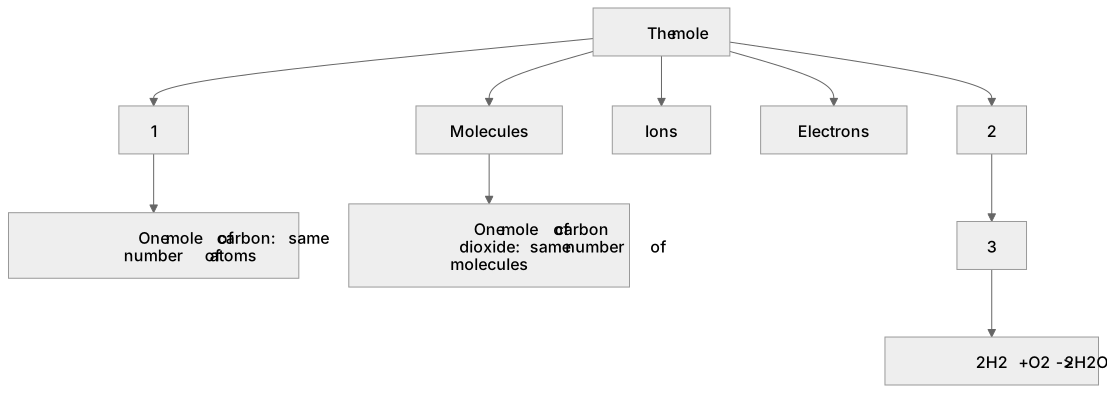
1Box 1
2Box 2
3Box 3
There is more to this lesson
The full lesson goes on to check your understanding and help you earn the marks. Create a free account to carry on, with your progress saved.
A week of Premium from your first lesson · Then the free plan continues · No card, no charge
Test your understanding of Moles (HT only): Students should understand that the measurement of amounts in moles can apply to atoms, molecules, ions, electrons, formulae and equations, for example that in one mole of carbon (C) the number of atoms is the same as the number of molecules in one mole of carbon dioxide (CO ).
Active recall beats re-reading. Take an instant quiz now to test what you’ve learned and lock it into long-term memory.
A week of Premium from your first lesson · Then the free plan continues · No card, no charge