AQA · GCSE · Chemistry
Course version: 8462 · Version from Sept 2018
The amount of a product obtained is known as the yield. When compared with…
Full specification wording
Percentage yield: The amount of a product obtained is known as the yield. When compared with the maximum theoretical amount as a percentage, it is called the percentage yield.
Yield is the actual quantity of a named product formed in a reaction, usually measured in grams.
Checked against the AQA 8462 specification (opens in a new tab) on .
- Point 2 of 2
- 3 key terms
Study notes
From the checked teaching notes for this specification point.
The idea
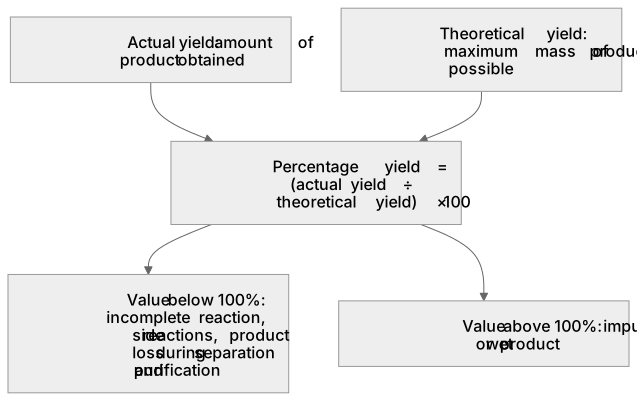
Yield is the actual quantity of a named product formed in a reaction, usually measured in grams. The theoretical maximum is the maximum mass of product that could possibly be created from the given reactants. Percentage yield compares the two: percentage yield = (actual yield ÷ theoretical yield) × 100. For example, if a reaction should theoretically make 8.0 g of copper sulfate but only 6.0 g is obtained, the percentage yield is (6.0 ÷ 8.0) × 100 = 75%. Losses arise from incomplete reaction, side reactions, transferring and filtering, evaporation and purification. Percentage yield is always less than 100% in practice, though a calculated value above 100% signals impure or wet product.
What earns the marks
- State that yield is the actual amount of product obtained, and identify the product and unit in a given context.
- Calculate percentage yield when given the actual yield and the maximum theoretical yield.
- Apply percentage yield = (actual yield ÷ theoretical yield) × 100, rearranging to find an unknown actual or theoretical yield.
- Interpret a percentage yield value, explaining that values below 100% arise from incomplete reaction, side reactions or product loss during separation and purification.
- Recognise that a value above 100% indicates impurities or residual solvent rather than a genuine extra amount of product.
Common mistakes and how to put them right
Dividing theoretical yield by actual yield instead of actual by theoretical.
Put it right by writing the fraction as actual yield over theoretical yield before multiplying by 100.
Forgetting to multiply by 100 and reporting a decimal such as 0.75.
Put it right by checking that a percentage yield is expressed on a 0 to 100 scale.
Confusing the mass of the starting reactant with the theoretical yield of the product.
Put it right: Carefully reading the question to identify the stated theoretical maximum mass of the product.
Exam tips
- Underline the actual yield and the theoretical yield in the question before substituting, so the fraction is set up the right way round.
- Show all working when substituting values into the percentage yield equation, as method marks are often available even if the final arithmetic slips.
- Check whether the question asks for a mass, a percentage or a reason for a low yield, and answer in that form with units where appropriate.
Try the lesson
The start of the Percentage yield: The amount of a product obtained is known as the yield. When compared with the maximum theoretical amount as a percentage, it is called the percentage yield. lesson, made from checked teaching notes for this specification point.
Have a go first
A reaction should make 20 g of product but only 15 g is collected. What is the percentage yield?
Listen
Yield is the actual quantity of a named product formed in a reaction, usually measured in grams. The theoretical maximum is the maximum mass of product that could possibly be created from the given reactants. Percentage yield compares the two: percentage yield = (actual yield ÷ theoretical yield) × 100. For example, if a reaction should theoretically make 8.0 g of copper sulfate but only 6.0 g is obtained, the percentage yield is (6.0 ÷ 8.0) × 100 = 75%. Losses arise from incomplete reaction, side reactions, transferring and filtering, evaporation and purification. Percentage yield is always less than 100% in practice, though a calculated value above 100% signals impure or wet product. A strong answer earns marks for these points. State that yield is the actual amount of product obtained, and identify the product and unit in a given context. Calculate percentage yield when given the actual yield and the maximum theoretical yield. Apply percentage yield = (actual yield ÷ theoretical yield) × 100, rearranging to find an unknown actual or theoretical yield. Interpret a percentage yield value, explaining that values below 100% arise from incomplete reaction, side reactions or product loss during separation and purification. A common slip: Dividing theoretical yield by actual yield instead of actual by theoretical. Instead, writing the fraction as actual yield over theoretical yield before multiplying by 100. Exam tip: Underline the actual yield and the theoretical yield in the question before substituting, so the fraction is set up the right way round.
See it
Key words
Say what each word means before you turn the card.
Yield
Try answering aloud or in your head before turning the card.
Theoretical maximum
Try answering aloud or in your head before turning the card.
Percentage yield
Try answering aloud or in your head before turning the card.
See every definition
- Yield
- The amount of a product obtained in a reaction, usually measured in grams.
- Theoretical maximum
- The maximum mass of product that could possibly be created from the given reactants.
- Percentage yield
- The actual yield compared with the maximum theoretical amount as a percentage, calculated as (actual yield ÷ theoretical yield) × 100.
Label the diagram
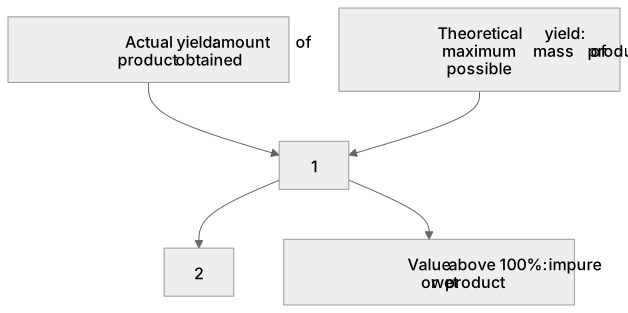
Some boxes have lost their names. Pick the right name for each number.
1Box 1
2Box 2
There is more to this lesson
The full lesson goes on to check your understanding and help you earn the marks. Create a free account to carry on, with your progress saved.
A week of Premium from your first lesson · Then the free plan continues · No card, no charge
Test your understanding of Percentage yield: The amount of a product obtained is known as the yield. When compared with the maximum theoretical amount as a percentage, it is called the percentage yield.
Active recall beats re-reading. Take an instant quiz now to test what you’ve learned and lock it into long-term memory.
A week of Premium from your first lesson · Then the free plan continues · No card, no charge