AQA · GCSE · Chemistry
Course version: 8462 · Version from Sept 2018
For humans, drinking water should have sufficiently low levels of…
Full specification wording
Potable water: For humans, drinking water should have sufficiently low levels of dissolved salts and microbes.
Drinking water must be safe for humans, which means keeping dissolved salts and microbes at sufficiently low levels.
Checked against the AQA 8462 specification (opens in a new tab) on .
- Point 2 of 12
- 4 key terms
Study notes
From the checked teaching notes for this specification point.
The idea
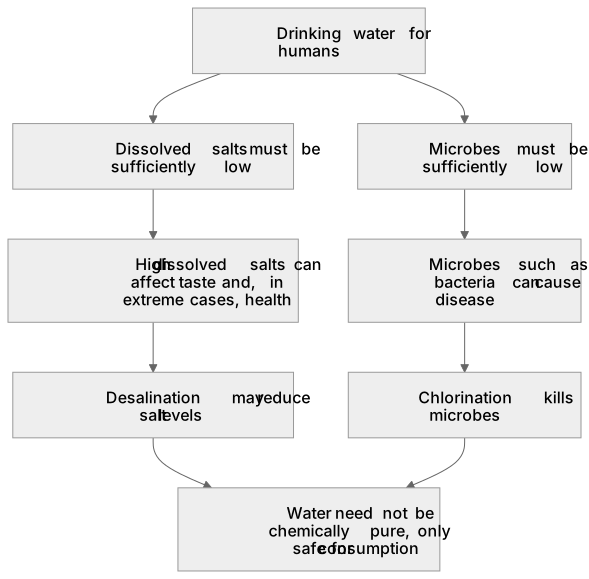
Drinking water must be safe for humans, which means keeping dissolved salts and microbes at sufficiently low levels. High dissolved salts can affect taste and, in extreme cases, health, while microbes such as bacteria can cause disease. Treatment therefore aims to reduce both. For example, water from a river may be filtered to remove solids, then chlorinated to kill microbes; in coastal areas, desalination may reduce salt levels. The phrase 'sufficiently low' shows that water need not be chemically pure, but must meet safety standards.
What earns the marks
- States that drinking water must have low levels of dissolved salts to be safe and palatable.
- States that drinking water must have low levels of microbes to prevent disease.
- Explains that 'sufficiently low' means water need not be chemically pure, only safe for consumption.
- Links specific treatments to the impurity they reduce, such as chlorination for microbes or desalination for salts.
- Recognises that safety standards for potable water are set to protect human health.
Common mistakes and how to put them right
Thinking that drinking water must be 100% pure water with no dissolved substances.
Put it right: Potable water can contain low levels of dissolved salts and must simply be safe.
Confusing the removal of microbes with the removal of salts.
Put it right: Chlorination or UV treatment targets microbes, while desalination or distillation targets dissolved salts.
Assuming all dissolved salts are equally harmful.
Put it right: The requirement is that levels are sufficiently low, not that all salts are absent.
Exam tips
- When asked why water is treated, name the impurity and the risk it poses, such as microbes causing disease.
- Use the phrase 'sufficiently low' to show understanding that potable water is not chemically pure.
- If given a water source, match the treatment to the main impurity present, for example chlorination for river water.
- Avoid saying water is 'pure' unless you mean chemically pure; use 'potable' or 'safe to drink' instead.
Try the lesson
The start of the Potable water: For humans, drinking water should have sufficiently low levels of dissolved salts and microbes. lesson, made from checked teaching notes for this specification point.
Have a go first
To be safe for humans to drink, water must have sufficiently low levels of which two components?
Listen
Drinking water must be safe for humans, which means keeping dissolved salts and microbes at sufficiently low levels. High dissolved salts can affect taste and, in extreme cases, health, while microbes such as bacteria can cause disease. Treatment therefore aims to reduce both. For example, water from a river may be filtered to remove solids, then chlorinated to kill microbes; in coastal areas, desalination may reduce salt levels. The phrase 'sufficiently low' shows that water need not be chemically pure, but must meet safety standards. A strong answer earns marks for these points. States that drinking water must have low levels of dissolved salts to be safe and palatable. States that drinking water must have low levels of microbes to prevent disease. Explains that 'sufficiently low' means water need not be chemically pure, only safe for consumption. Links specific treatments to the impurity they reduce, such as chlorination for microbes or desalination for salts. A common slip: Thinking that drinking water must be 100% pure water with no dissolved substances. Instead, potable water can contain low levels of dissolved salts and must simply be safe. Exam tip: When asked why water is treated, name the impurity and the risk it poses, such as microbes causing disease.
See it
Key words
Say what each word means before you turn the card.
Potable water
Try answering aloud or in your head before turning the card.
Dissolved salts
Try answering aloud or in your head before turning the card.
Microbes
Try answering aloud or in your head before turning the card.
Sufficiently low
Try answering aloud or in your head before turning the card.
See every definition
- Potable water
- Drinking water that is safe for humans, having sufficiently low levels of dissolved salts and microbes.
- Dissolved salts
- Impurities in water that can affect taste and, in extreme cases, health, and may be reduced by desalination.
- Microbes
- Impurities such as bacteria that can cause disease and are reduced by chlorination to kill them.
- Sufficiently low
- The phrase showing that water need not be chemically pure, but must meet safety standards for consumption.
Label the diagram
Some boxes have lost their names. Pick the right name for each number.
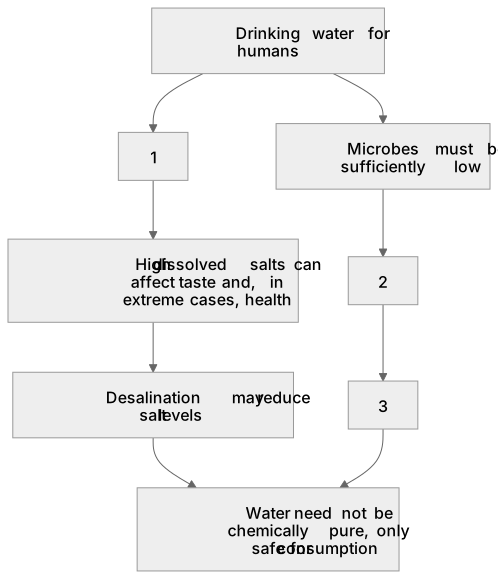
1Box 1
2Box 2
3Box 3
There is more to this lesson
The full lesson goes on to check your understanding and help you earn the marks. Create a free account to carry on, with your progress saved.
A week of Premium from your first lesson · Then the free plan continues · No card, no charge
Test your understanding of Potable water: For humans, drinking water should have sufficiently low levels of dissolved salts and microbes.
Active recall beats re-reading. Take an instant quiz now to test what you’ve learned and lock it into long-term memory.
A week of Premium from your first lesson · Then the free plan continues · No card, no charge