AQA · GCSE · Chemistry
Course version: 8462 · Version from Sept 2018
Students should be able to: recall the names of the salts produced when…
Full specification wording
Production and uses of NPK fertilisers: Students should be able to: recall the names of the salts produced when phosphate rock is treated with nitric acid, sulfuric acid and phosphoric acid compare the industrial production of fertilisers with laboratory preparations of the same compounds, given appropriate information.
Treating phosphate rock with different acids gives different soluble salts.
Checked against the AQA 8462 specification (opens in a new tab) on .
- Point 8 of 8
- 4 key terms
Study notes
From the checked teaching notes for this specification point.
The idea
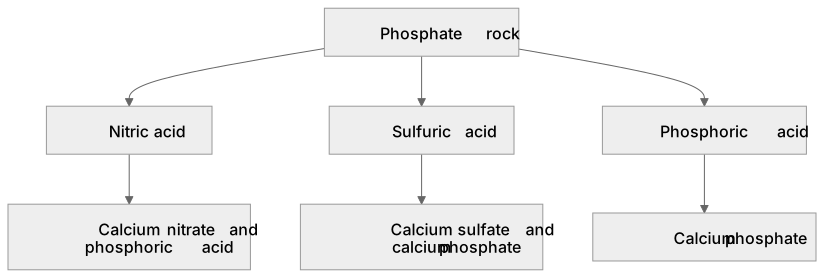
Treating phosphate rock with different acids gives different soluble salts. Nitric acid produces calcium nitrate and phosphoric acid; sulfuric acid produces calcium sulfate and calcium phosphate; phosphoric acid produces calcium phosphate. These salts supply phosphate and sometimes nitrate or sulfate ions to crops. Industrial fertiliser production differs from laboratory preparation: industry uses large-scale continuous plants, locally mined phosphate rock, concentrated acids, controlled temperatures and recycling of waste heat, and it monitors product purity and nutrient content. Laboratory preparation typically uses small quantities, bench apparatus such as beakers and filter funnels, dilute acids and batch methods. Both routes rely on the same reaction between an acid and the basic phosphate rock, but scale, equipment, safety controls and product specification differ.
What earns the marks
- Nitric acid and phosphate rock produce calcium nitrate and phosphoric acid.
- Sulfuric acid and phosphate rock produce calcium sulfate and calcium phosphate.
- Phosphoric acid and phosphate rock produce calcium phosphate.
- Industrial production uses large-scale continuous processes, concentrated reagents and strict quality control.
- Laboratory preparation uses small-scale batch apparatus and is mainly for identification or testing rather than bulk supply.
Common mistakes and how to put them right
Naming calcium phosphate as the only product of every acid reaction.
Put it right: Nitric acid also gives calcium nitrate and phosphoric acid, and sulfuric acid also gives calcium sulfate.
Assuming laboratory and industrial methods use completely different chemistry.
Put it right: The underlying acid-base reaction is the same, but scale and conditions differ.
Describing industrial production as simply a larger version of a school experiment without mentioning continuous operation, quality control or reagent concentration.
Exam tips
- Learn the three acid-product sets as a table so you can recall them quickly.
- When comparing, organise your answer into similarities and differences rather than listing one side only.
- Use comparative language such as whereas, while and in contrast to make the comparison explicit.
Try the lesson
The start of the Production and uses of NPK fertilisers: Students should be able to: recall the names of the salts produced when phosphate rock is treated with nitric acid, sulfuric acid and phosphoric acid compare the industrial production of fertilisers with laboratory preparations of the same compounds, given appropriate information. lesson, made from checked teaching notes for this specification point.
Have a go first
Phosphate rock is treated with nitric acid to produce soluble compounds for fertilisers. Which salt is produced by this reaction?
Listen
Treating phosphate rock with different acids gives different soluble salts. Nitric acid produces calcium nitrate and phosphoric acid; sulfuric acid produces calcium sulfate and calcium phosphate; phosphoric acid produces calcium phosphate. These salts supply phosphate and sometimes nitrate or sulfate ions to crops. Industrial fertiliser production differs from laboratory preparation: industry uses large-scale continuous plants, locally mined phosphate rock, concentrated acids, controlled temperatures and recycling of waste heat, and it monitors product purity and nutrient content. Laboratory preparation typically uses small quantities, bench apparatus such as beakers and filter funnels, dilute acids and batch methods. Both routes rely on the same reaction between an acid and the basic phosphate rock, but scale, equipment, safety controls and product specification differ. A strong answer earns marks for these points. Nitric acid and phosphate rock produce calcium nitrate and phosphoric acid. Sulfuric acid and phosphate rock produce calcium sulfate and calcium phosphate. Phosphoric acid and phosphate rock produce calcium phosphate. Industrial production uses large-scale continuous processes, concentrated reagents and strict quality control. Exam tip: Learn the three acid-product sets as a table so you can recall them quickly.
See it
Key words
Say what each word means before you turn the card.
Salt formation from acids
Try answering aloud or in your head before turning the card.
Scale and apparatus in chemistry
Try answering aloud or in your head before turning the card.
Industrial versus laboratory processes
Try answering aloud or in your head before turning the card.
Fertiliser specification and quality control
Try answering aloud or in your head before turning the card.
See every definition
- Salt formation from acids
- Treating phosphate rock with nitric acid, sulfuric acid or phosphoric acid gives different soluble salts that supply phosphate and sometimes nitrate or sulfate ions to crops.
- Scale and apparatus in chemistry
- Industry uses large-scale continuous plants with concentrated acids and controlled temperatures, whereas laboratory preparation uses small quantities and bench apparatus such as beakers and filter funnels.
- Industrial versus laboratory processes
- Both routes rely on the same reaction between an acid and the basic phosphate rock, but scale, equipment, safety controls and product specification differ.
- Fertiliser specification and quality control
- Industry monitors product purity and nutrient content, while laboratory preparation is mainly for identification or testing rather than bulk supply.
Label the diagram
Some boxes have lost their names. Pick the right name for each number.
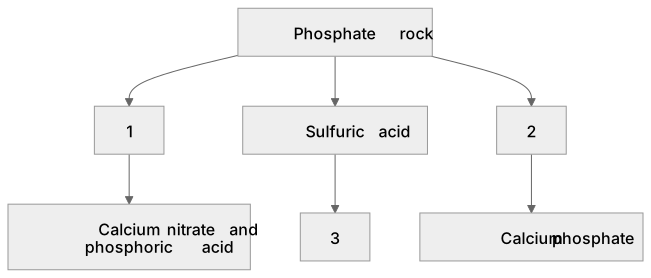
1Box 1
2Box 2
3Box 3
There is more to this lesson
The full lesson goes on to check your understanding and help you earn the marks. Create a free account to carry on, with your progress saved.
A week of Premium from your first lesson · Then the free plan continues · No card, no charge
Test your understanding of Production and uses of NPK fertilisers: Students should be able to: recall the names of the salts produced when phosphate rock is treated with nitric acid, sulfuric acid and phosphoric acid compare the industrial production of fertilisers with laboratory preparations of the same compounds, given appropriate information.
Active recall beats re-reading. Take an instant quiz now to test what you’ve learned and lock it into long-term memory.
A week of Premium from your first lesson · Then the free plan continues · No card, no charge