AQA · GCSE · Chemistry
Course version: 8462 · Version from Sept 2018
Students should be able to describe and explain the problems caused by…
Full specification wording
Properties and effects of atmospheric pollutants: Students should be able to describe and explain the problems caused by increased amounts of these pollutants in the air.
This skill requires linking each atmospheric pollutant to a specific environmental or health problem and explaining the mechanism.
Checked against the AQA 8462 specification (opens in a new tab) on .
- Point 4 of 4
- 4 key terms
Study notes
From the checked teaching notes for this specification point.
The idea
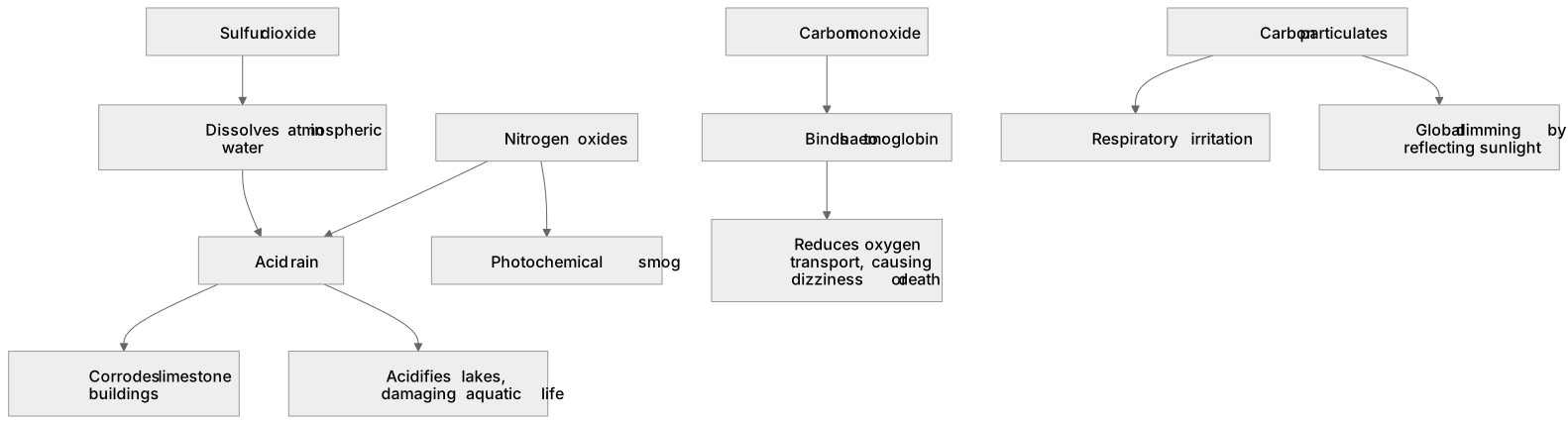
This skill requires linking each atmospheric pollutant to a specific environmental or health problem and explaining the mechanism. Sulfur dioxide, produced by burning fossil fuels containing sulfur impurities, dissolves in atmospheric water to form acid rain, which corrodes limestone buildings and acidifies lakes, damaging aquatic life. Nitrogen oxides, formed when nitrogen and oxygen react in hot engines, also contribute to acid rain and photochemical smog. Carbon monoxide, from incomplete combustion, binds to haemoglobin and reduces oxygen transport, causing dizziness and death. Carbon particulates cause respiratory irritation and global dimming. For each pollutant, name the source, identify the problem and explain the causal chain, using a concrete example such as acid rain eroding a limestone statue.
What earns the marks
- Sulfur dioxide dissolves in rainwater to form acid rain, which damages limestone buildings and acidifies lakes, harming aquatic organisms.
- Nitrogen oxides are produced in hot engines and contribute to acid rain and photochemical smog, which irritates eyes and lungs.
- Carbon monoxide binds to haemoglobin, reducing oxygen transport in the blood, causing dizziness, unconsciousness or death.
- Carbon particulates are inhaled and irritate the lungs, and can cause global dimming by reflecting sunlight.
- A full explanation links pollutant source, the chemical or physical process, and the resulting environmental or health consequence.
Common mistakes and how to put them right
Confusing carbon monoxide with carbon dioxide.
Put it right: Carbon monoxide is toxic because it binds to haemoglobin, whereas carbon dioxide is a greenhouse gas.
Stating that acid rain is caused by carbon dioxide.
Put it right: Sulfur dioxide and nitrogen oxides are the main acidic pollutants.
Describing particulates as greenhouse gases.
Put it right: Particulates are solid particles that irritate lungs and reduce sunlight reaching the surface.
Exam tips
- For each pollutant, write a chain: source, process, effect, so the explanation is complete.
- Use named examples such as limestone erosion or lake acidification to make the consequence concrete.
- Check that the pollutant named matches the problem described, because marks depend on correct pairing.
Try the lesson
The start of the Properties and effects of atmospheric pollutants: Students should be able to describe and explain the problems caused by increased amounts of these pollutants in the air. lesson, made from checked teaching notes for this specification point.
Have a go first
Sulfur dioxide released into the air can cause harm to the environment. Which problem is caused by increased amounts of sulfur dioxide in the air?
Listen
This skill requires linking each atmospheric pollutant to a specific environmental or health problem and explaining the mechanism. Sulfur dioxide, produced by burning fossil fuels containing sulfur impurities, dissolves in atmospheric water to form acid rain, which corrodes limestone buildings and acidifies lakes, damaging aquatic life. Nitrogen oxides, formed when nitrogen and oxygen react in hot engines, also contribute to acid rain and photochemical smog. Carbon monoxide, from incomplete combustion, binds to haemoglobin and reduces oxygen transport, causing dizziness and death. Carbon particulates cause respiratory irritation and global dimming. For each pollutant, name the source, identify the problem and explain the causal chain, using a concrete example such as acid rain eroding a limestone statue. A strong answer earns marks for these points. Sulfur dioxide dissolves in rainwater to form acid rain, which damages limestone buildings and acidifies lakes, harming aquatic organisms. Nitrogen oxides are produced in hot engines and contribute to acid rain and photochemical smog, which irritates eyes and lungs. Carbon monoxide binds to haemoglobin, reducing oxygen transport in the blood, causing dizziness, unconsciousness or death. Carbon particulates are inhaled and irritate the lungs, and can cause global dimming by reflecting sunlight. A common slip: Confusing carbon monoxide with carbon dioxide. Instead, carbon monoxide is toxic because it binds to haemoglobin, whereas carbon dioxide is a greenhouse gas. Exam tip: For each pollutant, write a chain: source, process, effect, so the explanation is complete.
See it
Key words
Say what each word means before you turn the card.
Acid rain formation
Try answering aloud or in your head before turning the card.
Human health effects
Try answering aloud or in your head before turning the card.
Environmental impact
Try answering aloud or in your head before turning the card.
Combustion products
Try answering aloud or in your head before turning the card.
See every definition
- Acid rain formation
- Sulfur dioxide dissolves in atmospheric water to form acid rain, which corrodes limestone buildings and acidifies lakes, damaging aquatic life.
- Human health effects
- Carbon monoxide binds to haemoglobin and reduces oxygen transport, causing dizziness and death, while carbon particulates cause respiratory irritation.
- Environmental impact
- Acid rain acidifies lakes and damages aquatic life, and carbon particulates can cause global dimming by reflecting sunlight.
- Combustion products
- Sulfur dioxide is produced by burning fossil fuels containing sulfur impurities, and carbon monoxide comes from incomplete combustion.
Label the diagram
Some boxes have lost their names. Pick the right name for each number.
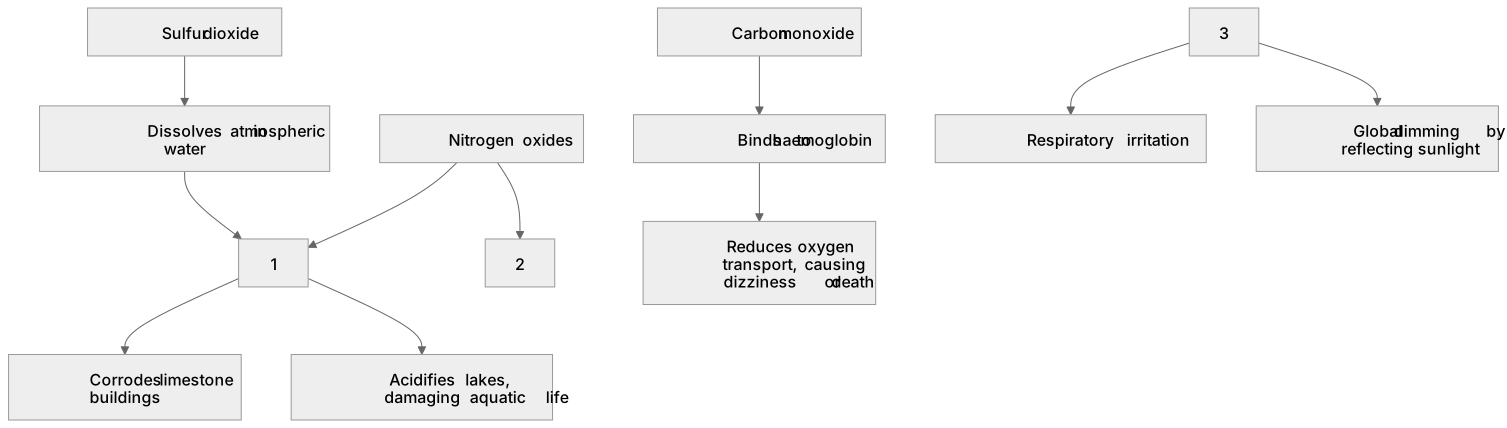
1Box 1
2Box 2
3Box 3
There is more to this lesson
The full lesson goes on to check your understanding and help you earn the marks. Create a free account to carry on, with your progress saved.
A week of Premium from your first lesson · Then the free plan continues · No card, no charge
Test your understanding of Properties and effects of atmospheric pollutants: Students should be able to describe and explain the problems caused by increased amounts of these pollutants in the air.
Active recall beats re-reading. Take an instant quiz now to test what you’ve learned and lock it into long-term memory.
A week of Premium from your first lesson · Then the free plan continues · No card, no charge