AQA · GCSE · Chemistry
Course version: 8462 · Version from Sept 2018
Ionic compounds have regular structures (giant ionic lattices) in which…
Full specification wording
Properties of ionic compounds: Ionic compounds have regular structures (giant ionic lattices) in which there are strong electrostatic forces of attraction in all directions between oppositely charged ions.
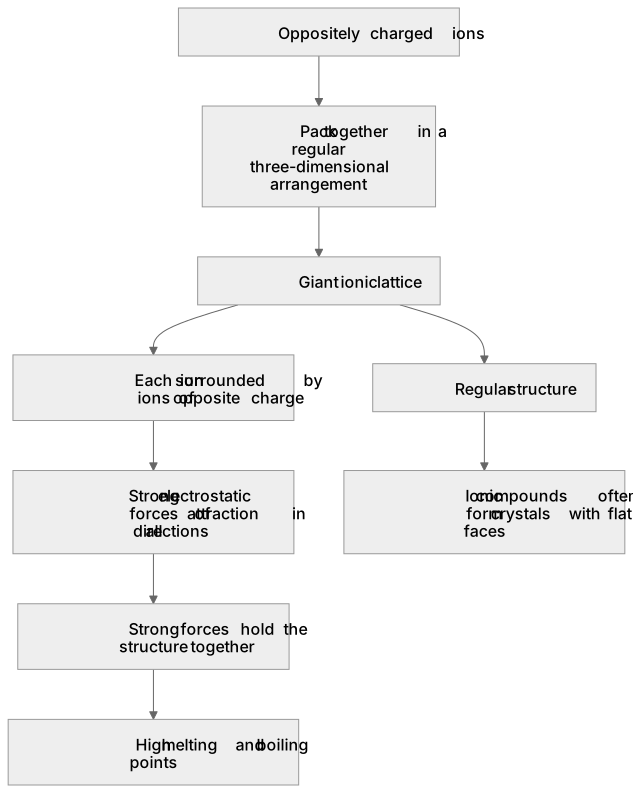
Ionic compounds form when oppositely charged ions pack together in a regular three-dimensional arrangement called a giant ionic lattice.
Checked against the AQA 8462 specification (opens in a new tab) on .
- Point 1 of 3
- 3 key terms
Study notes
From the checked teaching notes for this specification point.
The idea
Ionic compounds form when oppositely charged ions pack together in a regular three-dimensional arrangement called a giant ionic lattice. Each ion is surrounded by ions of opposite charge, and the electrostatic forces of attraction act in all directions, not just between one pair. For example, in sodium chloride, each Na⁺ is surrounded by six Cl⁻ ions and each Cl⁻ by six Na⁺ ions. The lattice is described as giant because it extends throughout the crystal. These strong forces hold the structure together, which explains the high melting and boiling points. The regularity also means ionic compounds often form crystals with flat faces.
What earns the marks
- Describes the structure as a giant ionic lattice with a regular arrangement of alternating positive and negative ions.
- States that electrostatic forces of attraction act in all directions between oppositely charged ions.
- Explains that the forces are strong because of the high charges and close packing of ions.
- Uses a named example such as sodium chloride to illustrate the lattice arrangement.
- Links the regular structure to the crystalline nature of ionic compounds.
Common mistakes and how to put them right
Describing ionic bonding as sharing electrons.
Put it right: Ionic bonding involves transfer of electrons to form ions and electrostatic attraction between them.
Saying forces act only between one pair of ions.
Put it right: Forces act in all directions throughout the lattice.
Confusing a giant ionic lattice with a simple molecule.
Put it right: It is a continuous three-dimensional structure, not discrete molecules.
Exam tips
- Use the phrase 'electrostatic forces of attraction in all directions' when describing ionic lattices.
- Refer to a specific ionic compound to support your description.
- If asked to explain properties, always link back to the strength and direction of the forces.
Try the lesson
The start of the Properties of ionic compounds: Ionic compounds have regular structures (giant ionic lattices) in which there are strong electrostatic forces of attraction in all directions between oppositely charged ions. lesson, made from checked teaching notes for this specification point.
Have a go first
What name is given to the regular structure of an ionic compound such as sodium chloride?
Listen
Ionic compounds form when oppositely charged ions pack together in a regular three-dimensional arrangement called a giant ionic lattice. Each ion is surrounded by ions of opposite charge, and the electrostatic forces of attraction act in all directions, not just between one pair. For example, in sodium chloride, each Na⁺ is surrounded by six Cl⁻ ions and each Cl⁻ by six Na⁺ ions. The lattice is described as giant because it extends throughout the crystal. These strong forces hold the structure together, which explains the high melting and boiling points. The regularity also means ionic compounds often form crystals with flat faces. A strong answer earns marks for these points. Describes the structure as a giant ionic lattice with a regular arrangement of alternating positive and negative ions. States that electrostatic forces of attraction act in all directions between oppositely charged ions. Explains that the forces are strong because of the high charges and close packing of ions. Uses a named example such as sodium chloride to illustrate the lattice arrangement. A common slip: Describing ionic bonding as sharing electrons. Instead, ionic bonding involves transfer of electrons to form ions and electrostatic attraction between them. Exam tip: Use the phrase 'electrostatic forces of attraction in all directions' when describing ionic lattices.
See it
Key words
Say what each word means before you turn the card.
Giant ionic lattice
Try answering aloud or in your head before turning the card.
Electrostatic forces of attraction
Try answering aloud or in your head before turning the card.
Structure-property relationships
Try answering aloud or in your head before turning the card.
See every definition
- Giant ionic lattice
- A regular structure in which oppositely charged ions pack together in a three-dimensional arrangement that extends throughout the crystal.
- Electrostatic forces of attraction
- Strong forces that act in all directions between oppositely charged ions in a giant ionic lattice.
- Structure-property relationships
- The link between the strong forces holding the regular structure together and the high melting and boiling points of ionic compounds.
Label the diagram
Some boxes have lost their names. Pick the right name for each number.
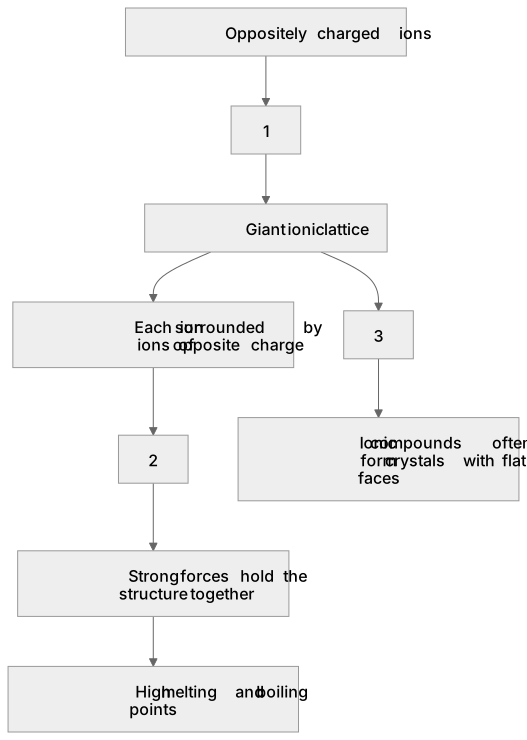
1Box 1
2Box 2
3Box 3
There is more to this lesson
The full lesson goes on to check your understanding and help you earn the marks. Create a free account to carry on, with your progress saved.
A week of Premium from your first lesson · Then the free plan continues · No card, no charge
Test your understanding of Properties of ionic compounds: Ionic compounds have regular structures (giant ionic lattices) in which there are strong electrostatic forces of attraction in all directions between oppositely charged ions.
Active recall beats re-reading. Take an instant quiz now to test what you’ve learned and lock it into long-term memory.
A week of Premium from your first lesson · Then the free plan continues · No card, no charge