AQA · GCSE · Chemistry
Course version: 8462 · Version from Sept 2018
It is these intermolecular forces that are overcome, not the covalent…
Full specification wording
Properties of small molecules: It is these intermolecular forces that are overcome, not the covalent bonds, when the substance melts or boils.
When a simple molecular substance melts or boils, energy is transferred to the substance.
Checked against the AQA 8462 specification (opens in a new tab) on .
- Point 3 of 6
- 4 key terms
Study notes
From the checked teaching notes for this specification point.
The idea
When a simple molecular substance melts or boils, energy is transferred to the substance. That energy is used to overcome the weak intermolecular forces between the molecules, allowing the molecules to move further apart or past one another. The strong covalent bonds within each molecule are not broken, so the molecules themselves stay intact. For example, when ice melts, the water molecules separate from the ordered lattice but each H₂O molecule remains covalently bonded; when water boils, molecules escape into the gas phase without decomposing. This distinction is central to explaining why simple molecular substances have low melting and boiling points despite containing strong covalent bonds. Always state clearly which forces are overcome and which bonds remain intact.
What earns the marks
- State that melting or boiling involves overcoming intermolecular forces between molecules.
- State that covalent bonds within molecules are not broken during melting or boiling.
- Explain that molecules remain intact and only become further apart or move past one another.
- Use a named example, such as water or methane, to show that the molecules survive the state change.
- Link the energy transferred during melting or boiling to overcoming weak intermolecular forces rather than breaking strong covalent bonds.
Common mistakes and how to put them right
Saying that covalent bonds break when a simple molecular substance boils.
Put it right by stating that intermolecular forces are overcome and covalent bonds remain intact.
Stating that molecules decompose on melting.
Put it right by explaining that the molecules separate but keep their covalent bonds.
Confusing the energy needed to overcome intermolecular forces with the much larger energy needed to break covalent bonds.
Put it right by distinguishing the two clearly.
Exam tips
- Use the phrase overcome intermolecular forces and state explicitly that covalent bonds are not broken.
- Name a substance and describe what happens to its molecules during the state change.
- Avoid saying bonds are broken unless you mean covalent bonds, and make clear which type of force or bond you are discussing.
Try the lesson
The start of the Properties of small molecules: It is these intermolecular forces that are overcome, not the covalent bonds, when the substance melts or boils. lesson, made from checked teaching notes for this specification point.
Have a go first
When a simple molecular substance melts, which forces are overcome?
Listen
When a simple molecular substance melts or boils, energy is transferred to the substance. That energy is used to overcome the weak intermolecular forces between the molecules, allowing the molecules to move further apart or past one another. The strong covalent bonds within each molecule are not broken, so the molecules themselves stay intact. For example, when ice melts, the water molecules separate from the ordered lattice but each H₂O molecule remains covalently bonded; when water boils, molecules escape into the gas phase without decomposing. This distinction is central to explaining why simple molecular substances have low melting and boiling points despite containing strong covalent bonds. Always state clearly which forces are overcome and which bonds remain intact. A strong answer earns marks for these points. State that melting or boiling involves overcoming intermolecular forces between molecules. State that covalent bonds within molecules are not broken during melting or boiling. Explain that molecules remain intact and only become further apart or move past one another. Use a named example, such as water or methane, to show that the molecules survive the state change. A common slip: Saying that covalent bonds break when a simple molecular substance boils. Instead, stating that intermolecular forces are overcome and covalent bonds remain intact. Exam tip: Use the phrase overcome intermolecular forces and state explicitly that covalent bonds are not broken.
See it
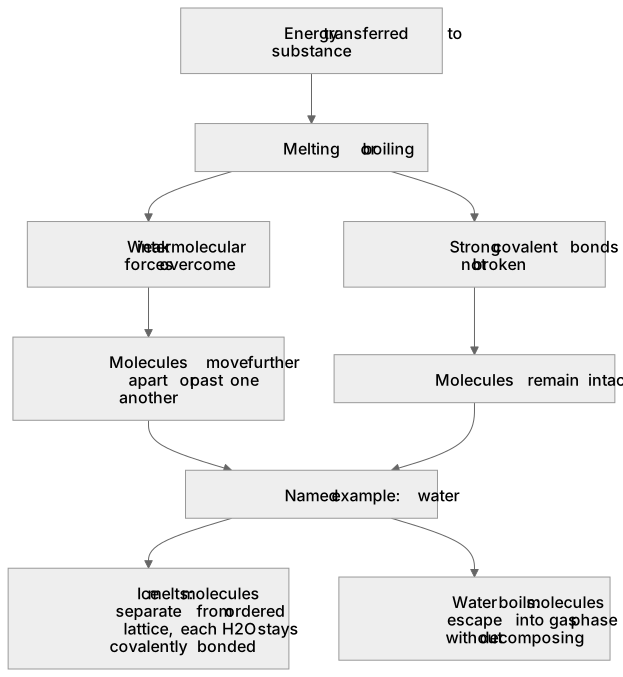
Key words
Say what each word means before you turn the card.
Overcoming intermolecular forces
Try answering aloud or in your head before turning the card.
Covalent bonds remain intact
Try answering aloud or in your head before turning the card.
Melting and boiling of simple molecular substances
Try answering aloud or in your head before turning the card.
Energy transfer during state changes
Try answering aloud or in your head before turning the card.
See every definition
- Overcoming intermolecular forces
- When a substance melts or boils, energy is transferred and used to overcome the weak intermolecular forces between the molecules.
- Covalent bonds remain intact
- The strong covalent bonds within each molecule are not broken during melting or boiling, so the molecules themselves stay intact.
- Melting and boiling of simple molecular substances
- The molecules separate and move further apart or past one another, but each molecule keeps its covalent bonds.
- Energy transfer during state changes
- Energy transferred during melting or boiling is used to overcome weak intermolecular forces rather than to break strong covalent bonds.
Label the diagram
Some boxes have lost their names. Pick the right name for each number.
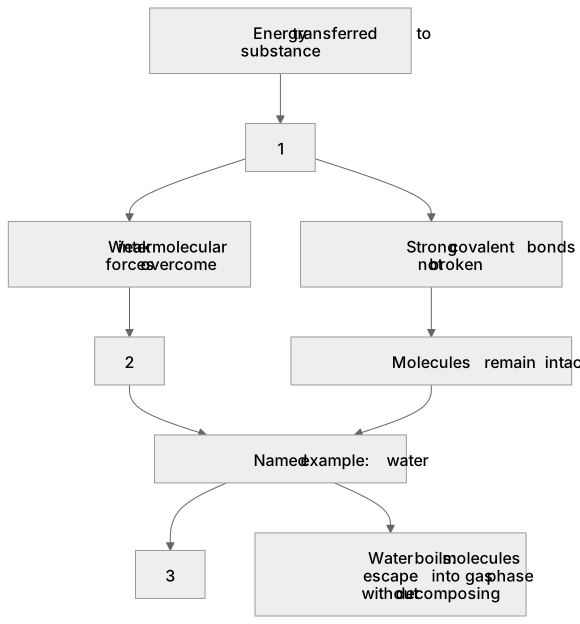
1Box 1
2Box 2
3Box 3
There is more to this lesson
The full lesson goes on to check your understanding and help you earn the marks. Create a free account to carry on, with your progress saved.
A week of Premium from your first lesson · Then the free plan continues · No card, no charge
Test your understanding of Properties of small molecules: It is these intermolecular forces that are overcome, not the covalent bonds, when the substance melts or boils.
Active recall beats re-reading. Take an instant quiz now to test what you’ve learned and lock it into long-term memory.
A week of Premium from your first lesson · Then the free plan continues · No card, no charge