AQA · GCSE · Chemistry
Course version: 8462 · Version from Sept 2018
Pure elements and compounds melt and boil at specific temperatures.
Full specification wording
Pure substances: Pure elements and compounds melt and boil at specific temperatures.
A pure element or compound has a sharp melting point and a sharp boiling point at a given pressure.
Checked against the AQA 8462 specification (opens in a new tab) on .
- Point 2 of 5
- 3 key terms
Study notes
From the checked teaching notes for this specification point.
The idea
A pure element or compound has a sharp melting point and a sharp boiling point at a given pressure. For example, pure water melts at 0 °C and boils at 100 °C at normal atmospheric pressure, while pure iron melts at about 1538 °C. These fixed temperatures occur because all the particles are the same substance and the forces between them are uniform, so the change of state happens at one temperature. In contrast, a mixture usually melts or boils over a range of temperatures because its different components change state at different temperatures. This means melting point and boiling point data can be used to test purity: a substance that melts sharply at the expected temperature is likely to be pure, while a substance that melts over a range is likely to be impure or a mixture.
What earns the marks
- Pure elements and compounds have specific, sharp melting points.
- Pure elements and compounds have specific, sharp boiling points.
- The melting or boiling point of a pure substance is a fixed value at a given pressure.
- Mixtures typically melt or boil over a range of temperatures rather than at one specific temperature.
- Melting point and boiling point data can be used to identify a substance and to test its purity.
Common mistakes and how to put them right
Thinking that a pure substance melts over a range of temperatures.
Put it right: A pure substance melts sharply at one temperature.
Confusing boiling point with melting point.
Put it right: Melting is solid to liquid, boiling is liquid to gas.
Assuming that any liquid that boils is pure.
Put it right: A mixture can boil, but it does so over a range of temperatures.
Exam tips
- Quote the specific melting or boiling point when using it as evidence of purity, for example pure water boils at 100 °C at normal pressure.
- Compare a measured melting point with the known value; a close match to the sharp value suggests purity.
- State that a range of melting or boiling temperatures indicates a mixture or impurity.
Try the lesson
The start of the Pure substances: Pure elements and compounds melt and boil at specific temperatures. lesson, made from checked teaching notes for this specification point.
Have a go first
A sample of pure ice is warmed slowly. At what temperature does the pure ice melt?
Listen
A pure element or compound has a sharp melting point and a sharp boiling point at a given pressure. For example, pure water melts at 0 °C and boils at 100 °C at normal atmospheric pressure, while pure iron melts at about 1538 °C. These fixed temperatures occur because all the particles are the same substance and the forces between them are uniform, so the change of state happens at one temperature. In contrast, a mixture usually melts or boils over a range of temperatures because its different components change state at different temperatures. This means melting point and boiling point data can be used to test purity: a substance that melts sharply at the expected temperature is likely to be pure, while a substance that melts over a range is likely to be impure or a mixture. A strong answer earns marks for these points. Pure elements and compounds have specific, sharp melting points. Pure elements and compounds have specific, sharp boiling points. The melting or boiling point of a pure substance is a fixed value at a given pressure. Mixtures typically melt or boil over a range of temperatures rather than at one specific temperature. Exam tip: Quote the specific melting or boiling point when using it as evidence of purity, for example pure water boils at 100 °C at normal pressure.
See it
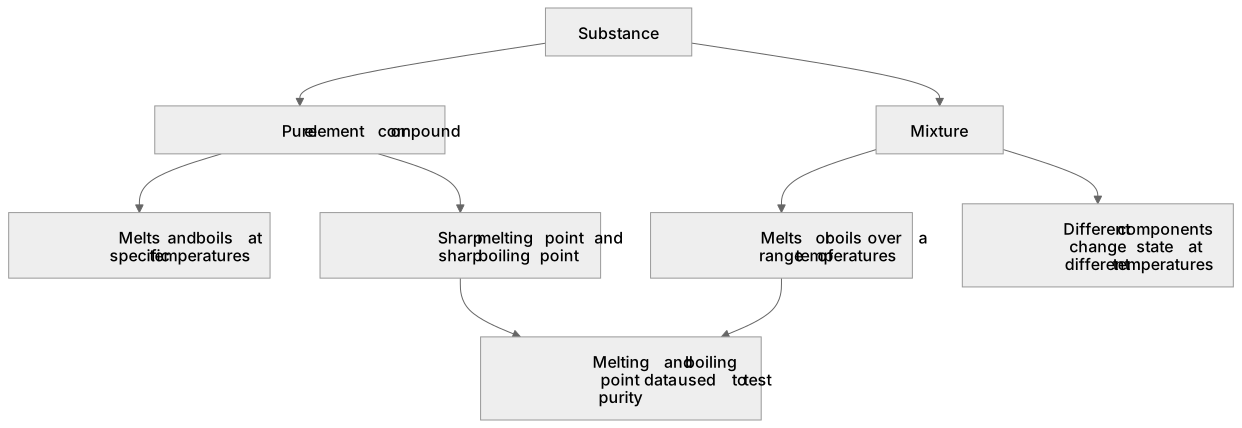
Key words
Say what each word means before you turn the card.
Melting and boiling points
Try answering aloud or in your head before turning the card.
Purity testing
Try answering aloud or in your head before turning the card.
Mixtures versus pure substances
Try answering aloud or in your head before turning the card.
See every definition
- Melting and boiling points
- Pure elements and compounds melt and boil at specific temperatures, which are fixed values at a given pressure.
- Purity testing
- Melting point and boiling point data can be used to test purity, as a substance that melts sharply at the expected temperature is likely to be pure.
- Mixtures versus pure substances
- A mixture usually melts or boils over a range of temperatures because its different components change state at different temperatures, while a pure substance melts sharply at one temperature.
Label the diagram
Some boxes have lost their names. Pick the right name for each number.
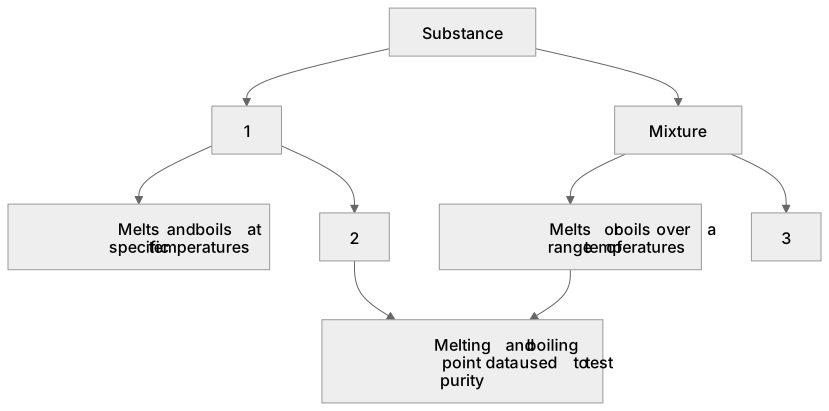
1Box 1
2Box 2
3Box 3
There is more to this lesson
The full lesson goes on to check your understanding and help you earn the marks. Create a free account to carry on, with your progress saved.
A week of Premium from your first lesson · Then the free plan continues · No card, no charge
Test your understanding of Pure substances: Pure elements and compounds melt and boil at specific temperatures.
Active recall beats re-reading. Take an instant quiz now to test what you’ve learned and lock it into long-term memory.
A week of Premium from your first lesson · Then the free plan continues · No card, no charge