AQA · GCSE · Chemistry
Course version: 8462 · Version from Sept 2018
Students should be able to: describe the reactions and conditions for the…
Full specification wording
Reactions of alkenes: Students should be able to: describe the reactions and conditions for the addition of hydrogen, water and halogens to alkenes draw fully displayed structural formulae of the first four members of the alkenes and the products of their addition reactions with hydrogen, water, chlorine, bromine and iodine.
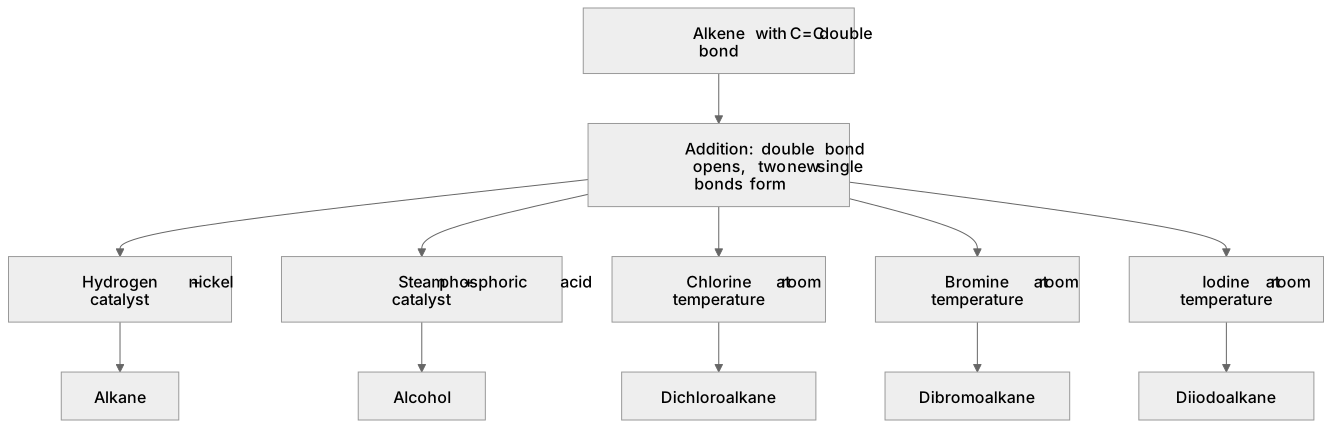
Alkenes contain a C=C double bond and undergo addition reactions in which the double bond opens and two new single bonds form.
Checked against the AQA 8462 specification (opens in a new tab) on .
- Point 5 of 5
- 3 key terms
Study notes
From the checked teaching notes for this specification point.
The idea
Alkenes contain a C=C double bond and undergo addition reactions in which the double bond opens and two new single bonds form. Hydrogen adds with a nickel catalyst, typically around 150 °C, converting ethene to ethane. Steam adds with a phosphoric acid catalyst at about 300 °C and 60 atm, converting ethene to ethanol. Halogens add directly at room temperature: chlorine gives a dichloroalkane, bromine gives a dibromoalkane and iodine gives a diiodoalkane; bromine water decolourises, which tests for a C=C. You must draw fully displayed formulae showing every atom and every bond. The first four alkenes are ethene, propene, butene and pentene, with butene existing as structural isomers. For each addition, draw the alkene, identify the two atoms now bonded to the former double-bond carbons, and complete the product with all C–H and C–X bonds shown.
What earns the marks
- State that addition reactions of alkenes involve the C=C double bond opening so that each of the two carbons forms a new single bond.
- Give the correct reagent and condition for each addition: hydrogen with a nickel catalyst; steam with a phosphoric acid catalyst; chlorine, bromine or iodine at room temperature.
- Name the products correctly: hydrogen gives an alkane, water gives an alcohol, and each halogen gives a dihaloalkane, for example ethene plus bromine gives 1,2-dibromoethane.
- Draw fully displayed formulae in which every atom is shown and every bond is drawn as a line, including all C–H bonds and the new C–H or C–X bonds.
- Recognise the first four alkenes as ethene, propene, butene and pentene, and represent butene as straight-chain and branched structural isomers.
- Use the decolourisation of bromine water as evidence for a C=C double bond and link this observation to the addition of bromine.
Common mistakes and how to put them right
Drawing a condensed formula such as CH₂=CH₂ instead of a fully displayed formula.
Put it right by drawing every atom and every bond explicitly.
Adding only one halogen atom to the product.
Put it right by adding two halogen atoms, one to each carbon of the former double bond.
Omitting the catalyst or temperature condition when describing hydrogenation or hydration.
Put it right by stating nickel for hydrogen and phosphoric acid for steam.
Writing the product of ethene and water as ethane.
Put it right by writing ethanol, because water adds across the double bond to give an alcohol.
Exam tips
- When asked to draw a displayed formula, count the bonds on each carbon and check that every carbon has four bonds before moving on.
- For each addition reaction, write the word equation first, then convert it into displayed structures so no atom is lost.
- If a question mentions bromine water losing its colour, link the observation to the presence of a C=C double bond and to an addition reaction.
Try the lesson
The start of the Reactions of alkenes: Students should be able to: describe the reactions and conditions for the addition of hydrogen, water and halogens to alkenes draw fully displayed structural formulae of the first four members of the alkenes and the products of their addition reactions with hydrogen, water, chlorine, bromine and iodine. lesson, made from checked teaching notes for this specification point.
Have a go first
Which reagent adds to an alkene to produce an alcohol?
Listen
Alkenes contain a C=C double bond and undergo addition reactions in which the double bond opens and two new single bonds form. Hydrogen adds with a nickel catalyst, typically around 150 °C, converting ethene to ethane. Steam adds with a phosphoric acid catalyst at about 300 °C and 60 atm, converting ethene to ethanol. Halogens add directly at room temperature: chlorine gives a dichloroalkane, bromine gives a dibromoalkane and iodine gives a diiodoalkane; bromine water decolourises, which tests for a C=C. You must draw fully displayed formulae showing every atom and every bond. The first four alkenes are ethene, propene, butene and pentene, with butene existing as structural isomers. For each addition, draw the alkene, identify the two atoms now bonded to the former double-bond carbons, and complete the product with all C–H and C–X bonds shown. A strong answer earns marks for these points. State that addition reactions of alkenes involve the C=C double bond opening so that each of the two carbons forms a new single bond. Give the correct reagent and condition for each addition: hydrogen with a nickel catalyst; steam with a phosphoric acid catalyst; chlorine, bromine or iodine at room temperature. Name the products correctly: hydrogen gives an alkane, water gives an alcohol, and each halogen gives a dihaloalkane, for example ethene plus bromine gives 1,2-dibromoethane. Draw fully displayed formulae in which every atom is shown and every bond is drawn as a line, including all C–H bonds and the new C–H or C–X bonds. A common slip: Drawing a condensed formula such as CH₂=CH₂ instead of a fully displayed formula. Instead, drawing every atom and every bond explicitly. Exam tip: When asked to draw a displayed formula, count the bonds on each carbon and check that every carbon has four bonds before moving on.
See it
Key words
Say what each word means before you turn the card.
Addition reactions
Try answering aloud or in your head before turning the card.
Fully displayed formulae
Try answering aloud or in your head before turning the card.
Dihaloalkane
Try answering aloud or in your head before turning the card.
See every definition
- Addition reactions
- Reactions in which the C=C double bond opens and two new single bonds form, so each of the two carbons forms a new single bond.
- Fully displayed formulae
- Structural formulae in which every atom is shown and every bond is drawn as a line, including all C–H bonds and the new C–H or C–X bonds.
- Dihaloalkane
- The product formed when a halogen adds to an alkene, with two halogen atoms added, one to each carbon of the former double bond.
Label the diagram
Some boxes have lost their names. Pick the right name for each number.
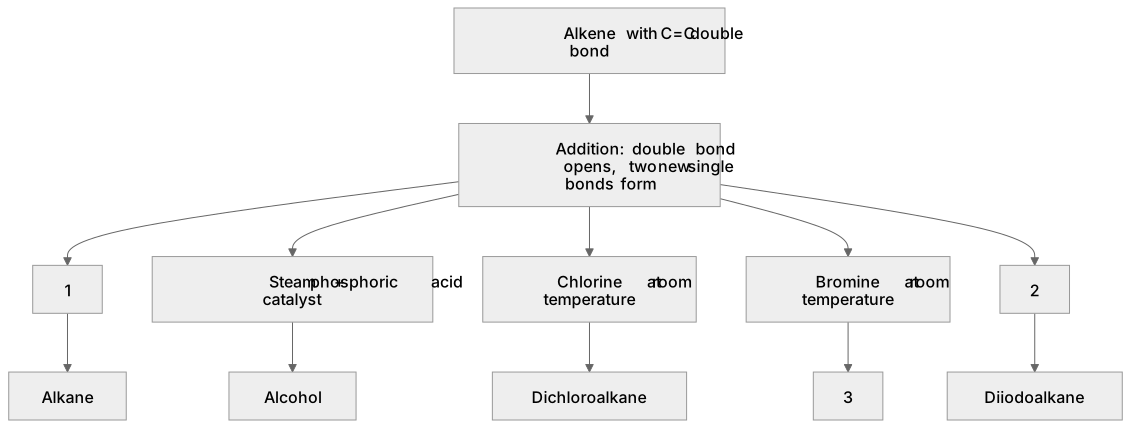
1Box 1
2Box 2
3Box 3
There is more to this lesson
The full lesson goes on to check your understanding and help you earn the marks. Create a free account to carry on, with your progress saved.
A week of Premium from your first lesson · Then the free plan continues · No card, no charge
Test your understanding of Reactions of alkenes: Students should be able to: describe the reactions and conditions for the addition of hydrogen, water and halogens to alkenes draw fully displayed structural formulae of the first four members of the alkenes and the products of their addition reactions with hydrogen, water, chlorine, bromine and iodine.
Active recall beats re-reading. Take an instant quiz now to test what you’ve learned and lock it into long-term memory.
A week of Premium from your first lesson · Then the free plan continues · No card, no charge