AQA · GCSE · Chemistry
Course version: 8462 · Version from Sept 2018
-10 Atoms are very small, having a radius of about 0.1 nm (1 x 10 m).
Full specification wording
Size and mass of atoms: -10 Atoms are very small, having a radius of about 0.1 nm (1 x 10 m).
Atoms are the fundamental building blocks of matter, but they are incredibly small.
Checked against the AQA 8462 specification (opens in a new tab) on .
- Point 1 of 6
- 4 key terms
Study notes
From the checked teaching notes for this specification point.
The idea
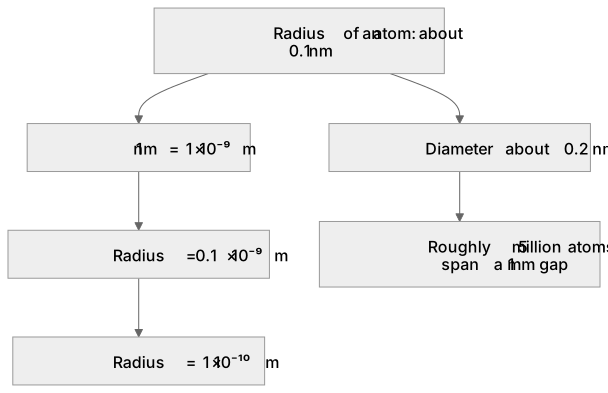
Atoms are the fundamental building blocks of matter, but they are incredibly small. The typical radius of an atom is about 0.1 nanometres (nm). Since 1 nm = 1 × 10⁻⁹ m, this means an atomic radius is about 1 × 10⁻¹⁰ m. To visualise this, imagine lining up atoms across a 1 mm gap: because the diameter is about 0.2 nm, you would need roughly 5 million atoms to span the distance. This scale explains why we use standard form and nanometres when discussing atomic dimensions. Understanding the size of atoms is essential for appreciating why they cannot be seen with ordinary microscopes and why models are used to represent them. It also underpins concepts like atomic structure and the scale of the nucleus compared to the whole atom.
What earns the marks
- State that the typical radius of an atom is approximately 0.1 nm.
- Convert 0.1 nm to metres: 0.1 nm = 1 × 10⁻¹⁰ m.
- Recognise that atoms are extremely small, with diameters around 0.2 nm.
- Use standard form to express atomic dimensions, e.g., 1 × 10⁻¹⁰ m.
- Compare the size of an atom to everyday objects to appreciate its scale.
Common mistakes and how to put them right
Writing the radius as 0.1 m instead of 0.1 nm.
Put it right by remembering that nm stands for nanometre, which is 10⁻⁹ m.
Confusing the exponent when converting.
Put it right by multiplying 0.1 by 10⁻⁹.
Forgetting to include units when stating the radius.
Put it right: Include nm or m as appropriate.
Exam tips
- Memorise the approximate atomic radius in both nanometres and metres to save time in exams.
- When converting between nm and m, remember that 1 nm = 1 × 10⁻⁹ m, so multiply the number of nm by 10⁻⁹.
- Practise writing very small numbers in standard form to avoid errors with exponents.
Try the lesson
The start of the Size and mass of atoms: -10 Atoms are very small, having a radius of about 0.1 nm (1 x 10 m). lesson, made from checked teaching notes for this specification point.
Have a go first
What is the approximate radius of an atom?
Listen
Atoms are the fundamental building blocks of matter, but they are incredibly small. The typical radius of an atom is about 0.1 nanometres (nm). Since 1 nm = 1 × 10⁻⁹ m, this means an atomic radius is about 1 × 10⁻¹⁰ m. To visualise this, imagine lining up atoms across a 1 mm gap: because the diameter is about 0.2 nm, you would need roughly 5 million atoms to span the distance. This scale explains why we use standard form and nanometres when discussing atomic dimensions. Understanding the size of atoms is essential for appreciating why they cannot be seen with ordinary microscopes and why models are used to represent them. It also underpins concepts like atomic structure and the scale of the nucleus compared to the whole atom. A strong answer earns marks for these points. State that the typical radius of an atom is approximately 0.1 nm. Convert 0.1 nm to metres: 0.1 nm = 1 × 10⁻¹⁰ m. Recognise that atoms are extremely small, with diameters around 0.2 nm. Use standard form to express atomic dimensions, e.g., 1 × 10⁻¹⁰ m. A common slip: Writing the radius as 0.1 m instead of 0.1 nm. Instead, remembering that nm stands for nanometre, which is 10⁻⁹ m. Exam tip: Memorise the approximate atomic radius in both nanometres and metres to save time in exams.
See it
Key words
Say what each word means before you turn the card.
Nanometres as a unit of length
Try answering aloud or in your head before turning the card.
Standard form and unit conversion
Try answering aloud or in your head before turning the card.
Atomic dimensions in metres
Try answering aloud or in your head before turning the card.
Scale and size of atoms
Try answering aloud or in your head before turning the card.
See every definition
- Nanometres as a unit of length
- A unit of length in which 1 nm = 1 × 10⁻⁹ m, used when discussing atomic dimensions.
- Standard form and unit conversion
- A way of writing very small numbers and converting between units, used to express atomic dimensions such as 1 × 10⁻¹⁰ m.
- Atomic dimensions in metres
- The typical radius of an atom is about 0.1 nm, which is 1 × 10⁻¹⁰ m.
- Scale and size of atoms
- Atoms are extremely small, with a radius of about 0.1 nm and diameters around 0.2 nm.
Label the diagram
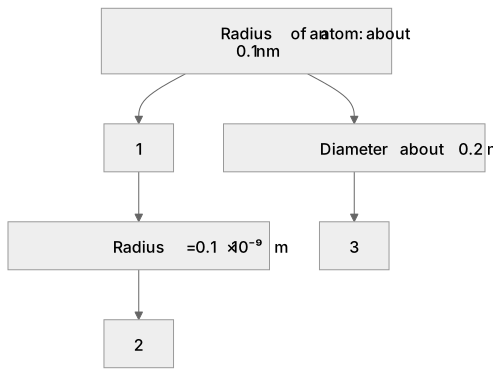
Some boxes have lost their names. Pick the right name for each number.
1Box 1
2Box 2
3Box 3
There is more to this lesson
The full lesson goes on to check your understanding and help you earn the marks. Create a free account to carry on, with your progress saved.
A week of Premium from your first lesson · Then the free plan continues · No card, no charge
Test your understanding of Size and mass of atoms: -10 Atoms are very small, having a radius of about 0.1 nm (1 x 10 m).
Active recall beats re-reading. Take an instant quiz now to test what you’ve learned and lock it into long-term memory.
A week of Premium from your first lesson · Then the free plan continues · No card, no charge