AQA · GCSE · Chemistry
Course version: 8462 · Version from Sept 2018
It may also mean that smaller quantities are needed to be effective than…
Full specification wording
Sizes of particles and their properties: It may also mean that smaller quantities are needed to be effective than for materials with normal particle sizes.
Nanoparticles have a very large surface area to volume ratio because a high proportion of their atoms lie at the surface.
Checked against the AQA 8462 specification (opens in a new tab) on .
- Point 5 of 6
- 4 key terms
Study notes
From the checked teaching notes for this specification point.
The idea
Nanoparticles have a very large surface area to volume ratio because a high proportion of their atoms lie at the surface. This means a given mass of nanoparticulate material exposes far more reactive surface than the same mass of a coarse powder, so less material is often needed to achieve the same effect. For example, a thin layer of nano-sized titanium dioxide can give effective sun protection using a fraction of the mass of larger pigment particles, and nano-sized catalysts can speed up a reaction with a smaller mass of catalyst. The statement is a consequence of particle size, not a separate property: reducing particle size increases surface area for the same mass, which can make the material more effective per gram.
What earns the marks
- Nanoparticles have a high proportion of their atoms at the surface, giving a very large surface area to volume ratio.
- For the same mass, nanoparticulate material exposes much more surface area than material with normal particle sizes.
- A larger exposed surface area allows more contact with surrounding reactants or surfaces, so the effect can be achieved with a smaller quantity.
- The statement applies to effectiveness per unit mass, not to the intrinsic reactivity of the substance, which is unchanged.
Common mistakes and how to put them right
Thinking nanoparticles are a different chemical substance with new chemical properties.
Put it right: The substance is the same and the change is in surface area to volume ratio and related behaviour.
Assuming smaller particles always mean a faster or stronger effect in every context.
Put it right: The effect depends on the application, such as catalysis, sun cream or medicine.
Confusing surface area with total volume.
Put it right: For the same mass the volume is unchanged but the exposed surface area increases as particle size decreases.
Exam tips
- Link the answer explicitly to surface area to volume ratio, then explain how that leads to a smaller effective quantity.
- Use a named context such as sun cream or a catalyst to show the idea applied rather than stated.
- Compare nano-sized particles with normal-sized particles of the same substance in the same sentence to make the contrast clear.
Try the lesson
The start of the Sizes of particles and their properties: It may also mean that smaller quantities are needed to be effective than for materials with normal particle sizes. lesson, made from checked teaching notes for this specification point.
Have a go first
A manufacturer replaces a normal-sized silver powder with silver nanoparticles in a wound dressing. Why might a smaller quantity of silver nanoparticles be needed to be effective?
Listen
Nanoparticles have a very large surface area to volume ratio because a high proportion of their atoms lie at the surface. This means a given mass of nanoparticulate material exposes far more reactive surface than the same mass of a coarse powder, so less material is often needed to achieve the same effect. For example, a thin layer of nano-sized titanium dioxide can give effective sun protection using a fraction of the mass of larger pigment particles, and nano-sized catalysts can speed up a reaction with a smaller mass of catalyst. The statement is a consequence of particle size, not a separate property: reducing particle size increases surface area for the same mass, which can make the material more effective per gram. A strong answer earns marks for these points. Nanoparticles have a high proportion of their atoms at the surface, giving a very large surface area to volume ratio. For the same mass, nanoparticulate material exposes much more surface area than material with normal particle sizes. A larger exposed surface area allows more contact with surrounding reactants or surfaces, so the effect can be achieved with a smaller quantity. The statement applies to effectiveness per unit mass, not to the intrinsic reactivity of the substance, which is unchanged. A common slip: Thinking nanoparticles are a different chemical substance with new chemical properties. Instead, the substance is the same and the change is in surface area to volume ratio and related behaviour. Exam tip: Link the answer explicitly to surface area to volume ratio, then explain how that leads to a smaller effective quantity.
See it
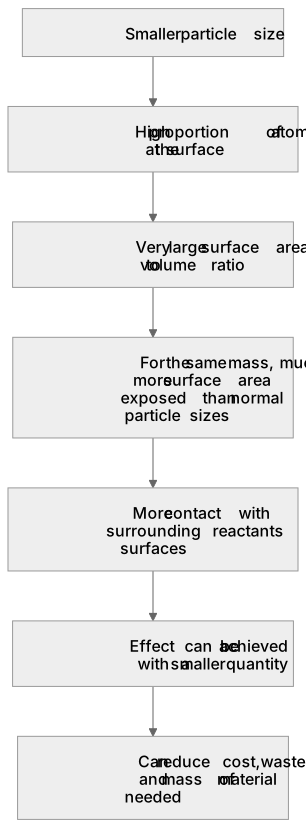
Put it in order
Put these steps in the order they happen.
- 1. Can reduce cost, waste and mass of material needed
- 2. Effect can be achieved with a smaller quantity
- 3. Very large surface area to volume ratio
- 4. More contact with surrounding reactants or surfaces
- 5. Smaller particle size
- 6. High proportion of atoms at the surface
- 7. For the same mass, much more surface area exposed than normal particle sizes
Key words
Say what each word means before you turn the card.
Surface area to volume ratio
Try answering aloud or in your head before turning the card.
Particle size and properties
Try answering aloud or in your head before turning the card.
Efficiency of materials
Try answering aloud or in your head before turning the card.
Applications of nanoparticles
Try answering aloud or in your head before turning the card.
See every definition
- Surface area to volume ratio
- Nanoparticles have a very large one of these because a high proportion of their atoms lie at the surface.
- Particle size and properties
- Reducing particle size increases surface area for the same mass, which can make the material more effective per gram.
- Efficiency of materials
- A larger exposed surface area allows the effect to be achieved with a smaller quantity, which can reduce cost, waste and the mass of material needed.
- Applications of nanoparticles
- The effect depends on the application, such as catalysis, sun cream or medicine, where a smaller quantity may be effective.
Label the diagram
Some boxes have lost their names. Pick the right name for each number.
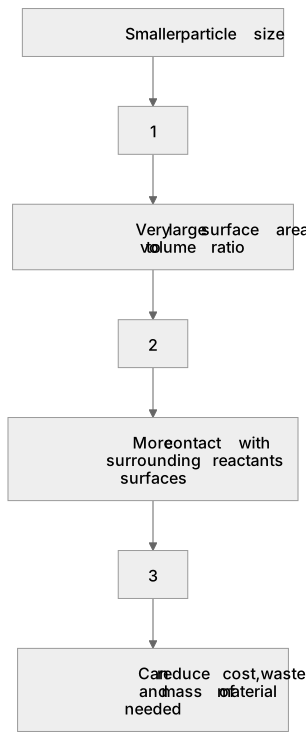
1Box 1
2Box 2
3Box 3
There is more to this lesson
The full lesson goes on to check your understanding and help you earn the marks. Create a free account to carry on, with your progress saved.
A week of Premium from your first lesson · Then the free plan continues · No card, no charge
Test your understanding of Sizes of particles and their properties: It may also mean that smaller quantities are needed to be effective than for materials with normal particle sizes.
Active recall beats re-reading. Take an instant quiz now to test what you’ve learned and lock it into long-term memory.
A week of Premium from your first lesson · Then the free plan continues · No card, no charge