AQA · GCSE · Chemistry
Course version: 8462 · Version from Sept 2018
Required practical 1: preparation of a pure, dry sample of a soluble salt…
Full specification wording
Soluble salts: Required practical 1: preparation of a pure, dry sample of a soluble salt from an insoluble oxide or carbonate using a Bunsen burner to heat dilute acid and a water bath or electric heater to evaporate the solution.
In this required practical, warm dilute acid using a Bunsen burner, then add the insoluble oxide or carbonate a little at a time until it is in excess and no more dissolves.
Checked against the AQA 8462 specification (opens in a new tab) on .
- Point 5 of 5
- 4 key terms
Study notes
From the checked teaching notes for this specification point.
The idea
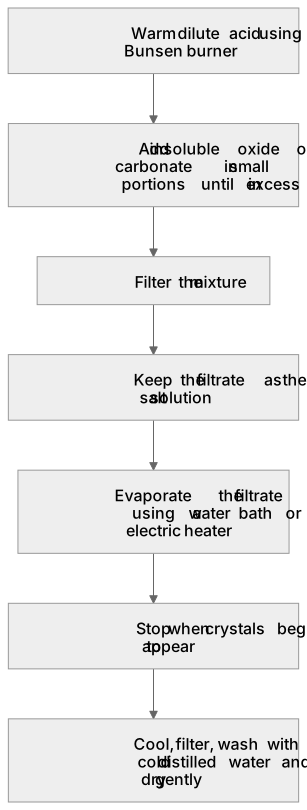
In this required practical, warm dilute acid using a Bunsen burner, then add the insoluble oxide or carbonate a little at a time until it is in excess and no more dissolves. Filter the mixture to remove the excess solid, keeping the filtrate, which contains the soluble salt. Evaporate the filtrate using a water bath or electric heater rather than a direct flame, because gentle heating avoids spitting and decomposition. Stop when crystals begin to appear, then cool, filter, wash with a little cold distilled water and dry gently. The practical develops safe heating, filtration and crystallisation skills while producing a pure, dry named salt such as copper(II) sulfate or magnesium sulfate.
What earns the marks
- Warm the dilute acid using a Bunsen burner before adding the insoluble oxide or carbonate.
- Add the solid in small portions until it is in excess and no more dissolves.
- Filter the mixture and retain the filtrate as the salt solution.
- Evaporate the filtrate using a water bath or electric heater, not a direct Bunsen flame.
- Stop evaporation when crystals begin to appear, then cool, filter, wash and dry the crystals.
- Use the named salt and its reactants correctly, for example copper(II) oxide with dilute sulfuric acid.
Common mistakes and how to put them right
Heating the evaporating basin directly with a roaring Bunsen flame.
Put it right: This can spit or decompose the salt, so a water bath or electric heater should be used.
Discarding the filtrate and keeping the residue.
Put it right: The soluble salt is in the filtrate, so the filtrate must be kept.
Adding all the solid at once and assuming it has reacted.
Put it right: Excess solid must remain undissolved to show the acid is used up, so it should be added gradually.
Exam tips
- Learn the order: warm acid, add solid to excess, filter, evaporate gently, cool, filter, wash, dry.
- Name the equipment used for gentle evaporation and explain why a direct flame is unsuitable.
- Link each step to its purpose, such as excess solid ensuring complete neutralisation.
Try the lesson
The start of the Soluble salts: Required practical 1: preparation of a pure, dry sample of a soluble salt from an insoluble oxide or carbonate using a Bunsen burner to heat dilute acid and a water bath or electric heater to evaporate the solution. lesson, made from checked teaching notes for this specification point.
Have a go first
In Required practical 1, which piece of apparatus is specified to evaporate the salt solution gently?
Listen
In this required practical, warm dilute acid using a Bunsen burner, then add the insoluble oxide or carbonate a little at a time until it is in excess and no more dissolves. Filter the mixture to remove the excess solid, keeping the filtrate, which contains the soluble salt. Evaporate the filtrate using a water bath or electric heater rather than a direct flame, because gentle heating avoids spitting and decomposition. Stop when crystals begin to appear, then cool, filter, wash with a little cold distilled water and dry gently. The practical develops safe heating, filtration and crystallisation skills while producing a pure, dry named salt such as copper(II) sulfate or magnesium sulfate. A strong answer earns marks for these points. Warm the dilute acid using a Bunsen burner before adding the insoluble oxide or carbonate. Add the solid in small portions until it is in excess and no more dissolves. Filter the mixture and retain the filtrate as the salt solution. Evaporate the filtrate using a water bath or electric heater, not a direct Bunsen flame. Exam tip: Learn the order: warm acid, add solid to excess, filter, evaporate gently, cool, filter, wash, dry.
See it
Put it in order
Put these steps in the order they happen.
- 1. Cool, filter, wash with cold distilled water and dry gently
- 2. Stop when crystals begin to appear
- 3. Filter the mixture
- 4. Evaporate the filtrate using a water bath or electric heater
- 5. Warm dilute acid using a Bunsen burner
- 6. Add insoluble oxide or carbonate in small portions until in excess
- 7. Keep the filtrate as the salt solution
Key words
Say what each word means before you turn the card.
Required practical skills
Try answering aloud or in your head before turning the card.
Neutralisation and salt formation
Try answering aloud or in your head before turning the card.
Filtration and crystallisation
Try answering aloud or in your head before turning the card.
Hazard control and apparatus choice
Try answering aloud or in your head before turning the card.
See every definition
- Required practical skills
- Skills developed by warming dilute acid with a Bunsen burner, filtering the mixture and evaporating the filtrate to produce a pure, dry salt.
- Neutralisation and salt formation
- Adding the insoluble oxide or carbonate a little at a time until it is in excess and no more dissolves, so the acid is used up and a soluble salt forms.
- Filtration and crystallisation
- Filtering the mixture to remove the excess solid and keep the filtrate, then evaporating the filtrate until crystals begin to appear, before cooling, filtering, washing and drying them.
- Hazard control and apparatus choice
- Evaporating the filtrate using a water bath or electric heater rather than a direct flame, because gentle heating avoids spitting and decomposition.
Label the diagram
Some boxes have lost their names. Pick the right name for each number.
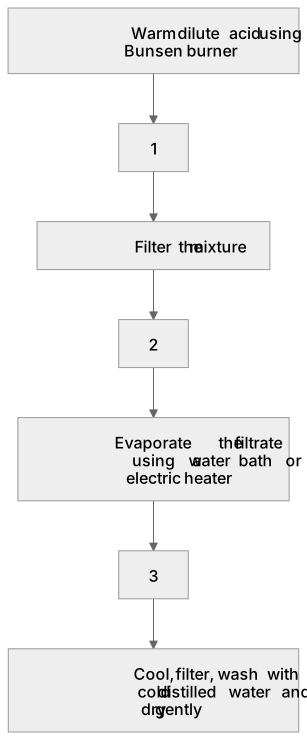
1Box 1
2Box 2
3Box 3
There is more to this lesson
The full lesson goes on to check your understanding and help you earn the marks. Create a free account to carry on, with your progress saved.
A week of Premium from your first lesson · Then the free plan continues · No card, no charge
Test your understanding of Soluble salts: Required practical 1: preparation of a pure, dry sample of a soluble salt from an insoluble oxide or carbonate using a Bunsen burner to heat dilute acid and a water bath or electric heater to evaporate the solution.
Active recall beats re-reading. Take an instant quiz now to test what you’ve learned and lock it into long-term memory.
A week of Premium from your first lesson · Then the free plan continues · No card, no charge