AQA · GCSE · Chemistry
Course version: 8462 · Version from Sept 2018
The solid is added to the acid until no more reacts and the excess solid…
Full specification wording
Soluble salts: The solid is added to the acid until no more reacts and the excess solid is filtered off to produce a solution of the salt.
In this preparation, the insoluble solid is added gradually to the acid.
Checked against the AQA 8462 specification (opens in a new tab) on .
- Point 2 of 5
- 4 key terms
Study notes
From the checked teaching notes for this specification point.
The idea
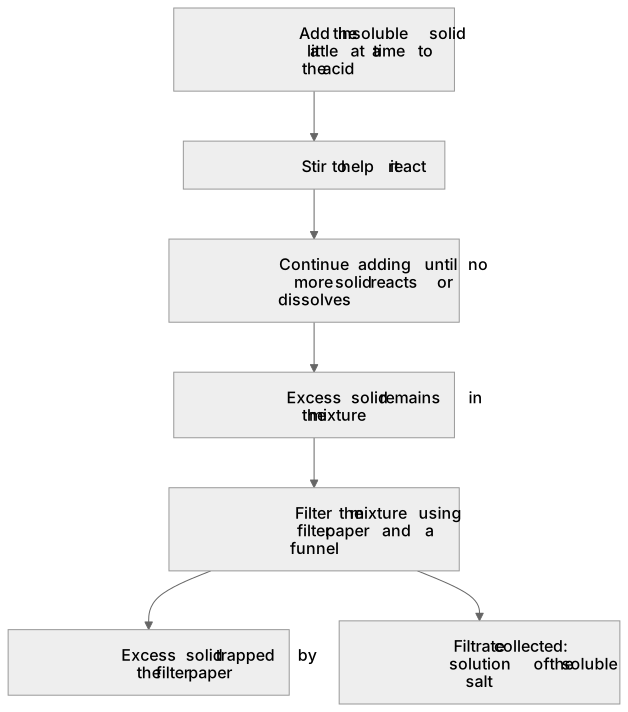
In this preparation, the insoluble solid is added gradually to the acid. The solid reacts and dissolves as the salt forms. You keep adding the solid until no more will react, which shows that all the acid has been used up. At this point there is excess solid sitting at the bottom of the mixture. The mixture is then filtered. The filter paper traps the unreacted excess solid, while the solution of the soluble salt passes through as the filtrate. This gives a clean salt solution without leftover acid. The solution can then be evaporated or left to crystallise to obtain the solid salt.
For example: Adding copper oxide to warm sulfuric acid until no more dissolves, then filtering, gives copper sulfate solution.
What earns the marks
- Add the insoluble solid a little at a time to the acid, stirring to help it react.
- Continue adding until no more solid reacts or dissolves, indicating that the acid has been neutralised.
- Observe that excess solid remains in the mixture after the reaction is complete.
- Filter the mixture using filter paper and a funnel to separate the excess solid from the salt solution.
- Collect the filtrate, which is the solution of the soluble salt.
- Explain that filtration removes the excess insoluble solid but keeps the soluble salt in solution.
Common mistakes and how to put them right
Stopping the addition of solid too early, which leaves unreacted acid in the solution.
Put it right: Add until no more reacts.
Filtering the mixture before the reaction is complete, which wastes reactants and leaves acid.
Put it right: Wait until no further reaction occurs.
Using filter paper that is too coarse or torn, which lets solid through.
Put it right: Use a clean, correctly folded filter paper.
Evaporating the filtrate to dryness too quickly, which can decompose the salt or cause spitting.
Put it right: Evaporate slowly or crystallise.
Exam tips
- Use the phrase 'until no more reacts' or 'until in excess' to show you know when to stop adding solid.
- State that the excess solid is filtered off and the filtrate is the salt solution.
- Explain that filtration works because the excess solid is insoluble while the salt is soluble.
- Mention that the salt solution can be crystallised to obtain the solid salt.
Try the lesson
The start of the Soluble salts: The solid is added to the acid until no more reacts and the excess solid is filtered off to produce a solution of the salt. lesson, made from checked teaching notes for this specification point.
Have a go first
Why is the solid added to the acid until no more reacts?
Listen
In this preparation, the insoluble solid is added gradually to the acid. The solid reacts and dissolves as the salt forms. You keep adding the solid until no more will react, which shows that all the acid has been used up. At this point there is excess solid sitting at the bottom of the mixture. The mixture is then filtered. The filter paper traps the unreacted excess solid, while the solution of the soluble salt passes through as the filtrate. This gives a clean salt solution without leftover acid. The solution can then be evaporated or left to crystallise to obtain the solid salt. For example, adding copper oxide to warm sulfuric acid until no more dissolves, then filtering, gives copper sulfate solution. A strong answer earns marks for these points. Add the insoluble solid a little at a time to the acid, stirring to help it react. Continue adding until no more solid reacts or dissolves, indicating that the acid has been neutralised. Observe that excess solid remains in the mixture after the reaction is complete. Filter the mixture using filter paper and a funnel to separate the excess solid from the salt solution. A common slip: Stopping the addition of solid too early, which leaves unreacted acid in the solution. Instead, add until no more reacts. Exam tip: Use the phrase 'until no more reacts' or 'until in excess' to show you know when to stop adding solid.
See it
Key words
Say what each word means before you turn the card.
Excess solid method
Try answering aloud or in your head before turning the card.
Filtration
Try answering aloud or in your head before turning the card.
Soluble salt solution
Try answering aloud or in your head before turning the card.
Neutralisation endpoint
Try answering aloud or in your head before turning the card.
See every definition
- Excess solid method
- Adding the insoluble solid gradually to the acid until no more reacts, so that all the acid has been used up.
- Filtration
- Separating the excess solid from the salt solution, with the filter paper trapping the unreacted solid while the solution passes through.
- Soluble salt solution
- The filtrate that passes through the filter paper, giving a clean salt solution without leftover acid.
- Neutralisation endpoint
- The point at which no more solid reacts or dissolves, showing that all the acid has been used up and excess solid remains.
Label the diagram
Some boxes have lost their names. Pick the right name for each number.
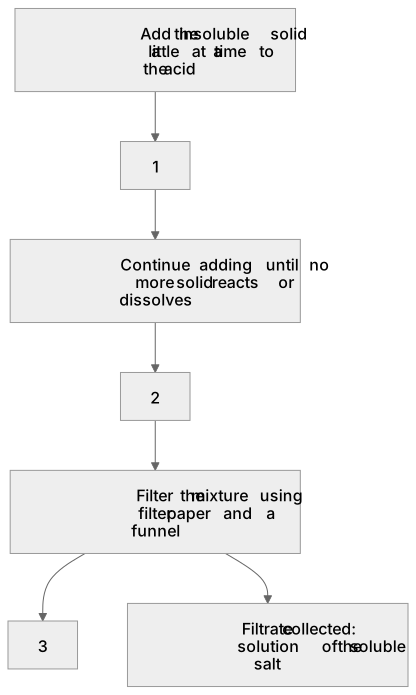
1Box 1
2Box 2
3Box 3
There is more to this lesson
The full lesson goes on to check your understanding and help you earn the marks. Create a free account to carry on, with your progress saved.
A week of Premium from your first lesson · Then the free plan continues · No card, no charge
Test your understanding of Soluble salts: The solid is added to the acid until no more reacts and the excess solid is filtered off to produce a solution of the salt.
Active recall beats re-reading. Take an instant quiz now to test what you’ve learned and lock it into long-term memory.
A week of Premium from your first lesson · Then the free plan continues · No card, no charge