AQA · GCSE · Chemistry
Course version: 8462 · Version from Sept 2018
For a given concentration of aqueous solutions, the stronger an acid, the…
Full specification wording
Strong and weak acids (HT only): For a given concentration of aqueous solutions, the stronger an acid, the lower the pH.
Acid strength depends on the degree of ionisation, not on how much acid is dissolved.
Checked against the AQA 8462 specification (opens in a new tab) on .
- Point 3 of 5
- 4 key terms
Study notes
From the checked teaching notes for this specification point.
The idea
Acid strength depends on the degree of ionisation, not on how much acid is dissolved. If two aqueous solutions have the same concentration, the stronger acid ionises more completely, so it releases a greater concentration of hydrogen ions, H⁺. Since pH is a measure of H⁺ concentration, a higher H⁺ concentration gives a lower pH value. For example, 0.1 mol/dm³ hydrochloric acid (a strong acid) has a lower pH than 0.1 mol/dm³ ethanoic acid (a weak acid). The comparison is only valid at equal concentration: a very dilute strong acid can have a higher pH than a concentrated weak acid. Always state that concentration is fixed before comparing strength.
What earns the marks
- At the same concentration, a stronger acid ionises more completely and so produces a higher concentration of H⁺ ions.
- A higher concentration of H⁺ ions corresponds to a lower pH value.
- Therefore, for equal concentrations, the stronger acid has the lower pH.
- The comparison must specify a given concentration, because changing concentration also changes pH.
- Strong acids such as hydrochloric acid ionise completely, whereas weak acids such as ethanoic acid ionise only partially.
- pH is a measure of hydrogen ion concentration, so it links directly to the degree of ionisation.
Common mistakes and how to put them right
Comparing a strong acid and a weak acid without fixing the concentration.
Put it right: The statement only holds for a given concentration.
Thinking that a stronger acid always has a lower pH regardless of concentration.
Put it right: A dilute strong acid may have a higher pH than a concentrated weak acid.
Confusing acid strength with concentration.
Put it right: Strength is about degree of ionisation, concentration is about amount of substance per unit volume.
Exam tips
- Begin comparison answers with the phrase 'for the same concentration' to show you understand the condition.
- Link the lower pH to a higher H⁺ concentration, not simply to the label 'strong acid'.
- Use a named pair such as hydrochloric acid and ethanoic acid to make the comparison concrete.
Try the lesson
The start of the Strong and weak acids (HT only): For a given concentration of aqueous solutions, the stronger an acid, the lower the pH. lesson, made from checked teaching notes for this specification point.
Have a go first
Two solutions of the same concentration are tested. One contains a strong acid and the other contains a weak acid. Which solution has the lower pH?
Listen
Acid strength depends on the degree of ionisation, not on how much acid is dissolved. If two aqueous solutions have the same concentration, the stronger acid ionises more completely, so it releases a greater concentration of hydrogen ions, H⁺. Since pH is a measure of H⁺ concentration, a higher H⁺ concentration gives a lower pH value. For example, 0.1 mol/dm³ hydrochloric acid (a strong acid) has a lower pH than 0.1 mol/dm³ ethanoic acid (a weak acid). The comparison is only valid at equal concentration: a very dilute strong acid can have a higher pH than a concentrated weak acid. Always state that concentration is fixed before comparing strength. A strong answer earns marks for these points. At the same concentration, a stronger acid ionises more completely and so produces a higher concentration of H⁺ ions. A higher concentration of H⁺ ions corresponds to a lower pH value. Therefore, for equal concentrations, the stronger acid has the lower pH. The comparison must specify a given concentration, because changing concentration also changes pH. Exam tip: Begin comparison answers with the phrase 'for the same concentration' to show you understand the condition.
See it
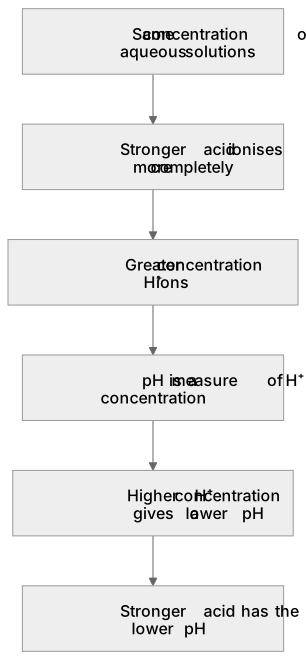
Put it in order
Put these steps in the order they happen.
- 1. Greater concentration of H⁺ ions
- 2. Stronger acid ionises more completely
- 3. Same concentration of aqueous solutions
- 4. Stronger acid has the lower pH
- 5. Higher H⁺ concentration gives a lower pH
- 6. pH is a measure of H⁺ concentration
Key words
Say what each word means before you turn the card.
Degree of ionisation and acid strength
Try answering aloud or in your head before turning the card.
Hydrogen ion concentration and pH
Try answering aloud or in your head before turning the card.
Concentration versus strength
Try answering aloud or in your head before turning the card.
Quantitative comparison of acids
Try answering aloud or in your head before turning the card.
See every definition
- Degree of ionisation and acid strength
- Acid strength depends on how completely an acid ionises, not on how much acid is dissolved.
- Hydrogen ion concentration and pH
- pH is a measure of hydrogen ion concentration, so a higher concentration of H⁺ ions gives a lower pH value.
- Concentration versus strength
- Strength is about degree of ionisation, whereas concentration is about the amount of substance per unit volume.
- Quantitative comparison of acids
- For a given concentration, the stronger acid ionises more completely and so produces a higher concentration of H⁺ ions, giving a lower pH.
Label the diagram
Some boxes have lost their names. Pick the right name for each number.
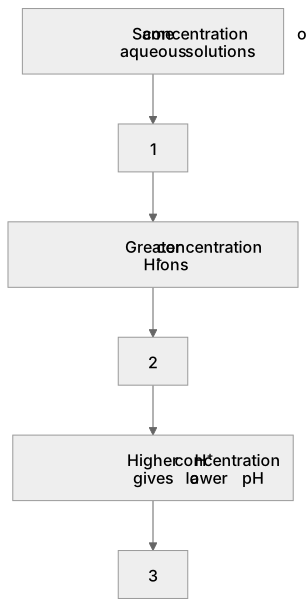
1Box 1
2Box 2
3Box 3
There is more to this lesson
The full lesson goes on to check your understanding and help you earn the marks. Create a free account to carry on, with your progress saved.
A week of Premium from your first lesson · Then the free plan continues · No card, no charge
Test your understanding of Strong and weak acids (HT only): For a given concentration of aqueous solutions, the stronger an acid, the lower the pH.
Active recall beats re-reading. Take an instant quiz now to test what you’ve learned and lock it into long-term memory.
A week of Premium from your first lesson · Then the free plan continues · No card, no charge