AQA · GCSE · Chemistry
Course version: 8462 · Version from Sept 2018
Required practical 7: use of chemical tests to identify the ions in…
Full specification wording
Sulfates: Required practical 7: use of chemical tests to identify the ions in unknown single ionic compounds covering the ions from sections Flame tests (page 73) to Sulfates (page 74).
This required practical brings together the qualitative tests for positive and negative ions in single ionic compounds.
Checked against the AQA 8462 specification (opens in a new tab) on .
- Point 2 of 2
- 4 key terms
Study notes
From the checked teaching notes for this specification point.
The idea
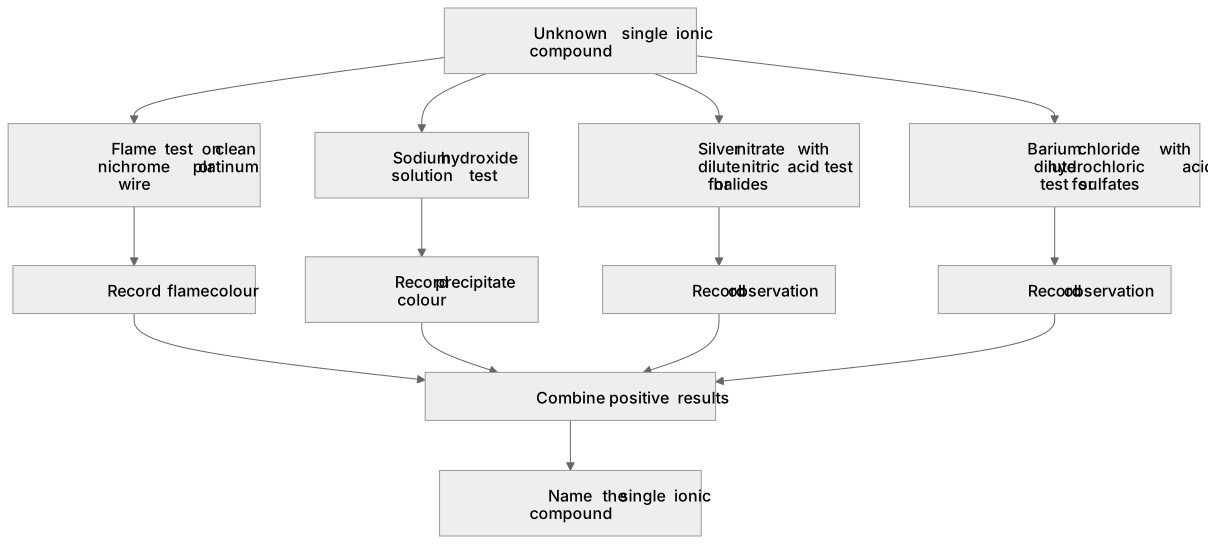
This required practical brings together the qualitative tests for positive and negative ions in single ionic compounds. You dissolve or moisten the unknown compound, then select tests that reveal its ions: flame tests for metal cations such as lithium, sodium, potassium, calcium and copper; sodium hydroxide solution for metal cations that form coloured or white precipitates; dilute acid with silver nitrate for halide ions; and dilute hydrochloric acid with barium chloride for sulfate ions. By combining results, you identify the compound. For example, a compound giving a lilac flame and a white precipitate with barium chloride contains potassium and sulfate ions, so it is potassium sulfate. The compound is single, so one cation and one anion are present.
What earns the marks
- Carry out tests on a clean nichrome or platinum wire or in clean test tubes to avoid contamination between samples.
- Record observations precisely, including flame colours and precipitate colours, before drawing a conclusion.
- Combine the positive results to name the single ionic compound, for example a lilac flame plus a white barium sulfate precipitate indicates potassium sulfate.
- Recognise that a negative result is also evidence and that several tests may be needed to identify one compound.
Common mistakes and how to put them right
Using the same wire or test tube for different samples without cleaning.
Put it right: Clean the wire in concentrated hydrochloric acid and use fresh test tubes to prevent cross-contamination.
Recording a conclusion instead of an observation, such as writing that the compound contains copper rather than recording a blue-green flame or blue precipitate.
Adding silver nitrate without dilute nitric acid when testing for halides.
Put it right: Acidify first so carbonate ions do not produce a misleading precipitate.
Exam tips
- Plan a sequence of tests that identifies both the cation and the anion before naming the compound.
- Write observations in a table with separate columns for the test, the observation and the conclusion.
- Use the exact colour names for flames and precipitates, because vague descriptions lose credit.
Try the lesson
The start of the Sulfates: Required practical 7: use of chemical tests to identify the ions in unknown single ionic compounds covering the ions from sections Flame tests (page 73) to Sulfates (page 74). lesson, made from checked teaching notes for this specification point.
Have a go first
In Required practical 7, a student uses a flame test on an unknown compound and sees a lilac flame. Which metal ion is present?
Listen
This required practical brings together the qualitative tests for positive and negative ions in single ionic compounds. You dissolve or moisten the unknown compound, then select tests that reveal its ions: flame tests for metal cations such as lithium, sodium, potassium, calcium and copper; sodium hydroxide solution for metal cations that form coloured or white precipitates; dilute acid with silver nitrate for halide ions; and dilute hydrochloric acid with barium chloride for sulfate ions. By combining results, you identify the compound. For example, a compound giving a lilac flame and a white precipitate with barium chloride contains potassium and sulfate ions, so it is potassium sulfate. The compound is single, so one cation and one anion are present. A strong answer earns marks for these points. Select the correct test for each ion: flame tests for metal cations, sodium hydroxide solution for some metal cations, silver nitrate with dilute nitric acid for halides, and barium chloride with dilute hydrochloric acid for sulfates. Carry out tests on a clean nichrome or platinum wire or in clean test tubes to avoid contamination between samples. Record observations precisely, including flame colours and precipitate colours, before drawing a conclusion. Combine the positive results to name the single ionic compound, for example a lilac flame plus a white barium sulfate precipitate indicates potassium sulfate. A common slip: Using the same wire or test tube for different samples without cleaning. Instead, clean the wire in concentrated hydrochloric acid and use fresh test tubes to prevent cross-contamination. Exam tip: Plan a sequence of tests that identifies both the cation and the anion before naming the compound.
See it
Key words
Say what each word means before you turn the card.
Flame tests
Try answering aloud or in your head before turning the card.
Sodium hydroxide solution
Try answering aloud or in your head before turning the card.
Barium chloride with dilute hydrochloric acid
Try answering aloud or in your head before turning the card.
Silver nitrate with dilute nitric acid
Try answering aloud or in your head before turning the card.
See every definition
- Flame tests
- Tests used for metal cations such as lithium, sodium, potassium, calcium and copper, in which the flame colour is observed.
- Sodium hydroxide solution
- A test used for metal cations that form coloured or white precipitates.
- Barium chloride with dilute hydrochloric acid
- A test used for sulfate ions, giving a white precipitate.
- Silver nitrate with dilute nitric acid
- A test used for halide ions, acidified first so carbonate ions do not produce a misleading precipitate.
There is more to this lesson
The full lesson goes on to check your understanding and help you earn the marks. Create a free account to carry on, with your progress saved.
A week of Premium from your first lesson · Then the free plan continues · No card, no charge
Test your understanding of Sulfates: Required practical 7: use of chemical tests to identify the ions in unknown single ionic compounds covering the ions from sections Flame tests (page 73) to Sulfates (page 74).
Active recall beats re-reading. Take an instant quiz now to test what you’ve learned and lock it into long-term memory.
A week of Premium from your first lesson · Then the free plan continues · No card, no charge