AQA · GCSE · Chemistry
Course version: 8462 · Version from Sept 2018
The test for chlorine uses litmus paper. When damp litmus paper is put…
Full specification wording
Test for chlorine: The test for chlorine uses litmus paper. When damp litmus paper is put into chlorine gas the litmus paper is bleached and turns white.
Chlorine is a pale yellow-green toxic gas, so it must never be smelled directly or prepared in open laboratory conditions without suitable ventilation.
Checked against the AQA 8462 specification (opens in a new tab) on .
- 4 key terms
Study notes
From the checked teaching notes for this specification point.
The idea
Chlorine is a pale yellow-green toxic gas, so it must never be smelled directly or prepared in open laboratory conditions without suitable ventilation. To test for it, damp a piece of litmus paper with distilled water, hold it in the gas with forceps, and observe. Chlorine dissolves in the water film to form an acidic solution, so the paper first turns red; the chlorine then bleaches the dye, so the colour is removed and the paper turns white. The dampness is essential because dry litmus does not respond. The bleaching effect distinguishes chlorine from acidic gases such as hydrogen chloride, which redden damp litmus but do not bleach it.
What earns the marks
- States that the litmus paper must be damp, for example moistened with distilled water, before exposure to the gas.
- Describes holding the damp litmus paper in the chlorine gas, for example using forceps, and observing the colour change.
- Explains that the litmus first turns red because chlorine dissolves to form an acidic solution.
- Explains that the dye is then bleached, so the paper loses its colour and turns white.
- Distinguishes chlorine from an acidic gas that only reddens damp litmus, because only chlorine bleaches it.
- Links the observation to the conclusion that the gas is chlorine, rather than to a named product.
Common mistakes and how to put them right
Using dry litmus paper.
Put it right: The error is that no colour change is seen, and the correction is to damp the paper with distilled water first.
Reporting only that the paper turns white.
Put it right: The error is that the initial reddening is omitted, and the correction is to record both the red colour and the subsequent bleaching.
Confusing bleaching with a colour change to blue or another colour.
Put it right: The error is a wrong final colour, and the correction is to state that the paper turns white because the dye is destroyed.
Exam tips
- Write the observation as a sequence: damp litmus turns red, then is bleached to white.
- Name the safety precaution of not inhaling chlorine and testing in a fume cupboard or well-ventilated area.
- If asked to identify an unknown gas, quote the bleaching of damp litmus as the specific evidence for chlorine.
Try the lesson
The start of the Test for chlorine: The test for chlorine uses litmus paper. When damp litmus paper is put into chlorine gas the litmus paper is bleached and turns white. lesson, made from checked teaching notes for this specification point.
Have a go first
A piece of damp litmus paper is placed in a gas and the paper turns white. Which gas is present?
Listen
Chlorine is a pale yellow-green toxic gas, so it must never be smelled directly or prepared in open laboratory conditions without suitable ventilation. To test for it, damp a piece of litmus paper with distilled water, hold it in the gas with forceps, and observe. Chlorine dissolves in the water film to form an acidic solution, so the paper first turns red; the chlorine then bleaches the dye, so the colour is removed and the paper turns white. The dampness is essential because dry litmus does not respond. The bleaching effect distinguishes chlorine from acidic gases such as hydrogen chloride, which redden damp litmus but do not bleach it. A strong answer earns marks for these points. States that the litmus paper must be damp, for example moistened with distilled water, before exposure to the gas. Describes holding the damp litmus paper in the chlorine gas, for example using forceps, and observing the colour change. Explains that the litmus first turns red because chlorine dissolves to form an acidic solution. Explains that the dye is then bleached, so the paper loses its colour and turns white. Exam tip: Write the observation as a sequence: damp litmus turns red, then is bleached to white.
See it
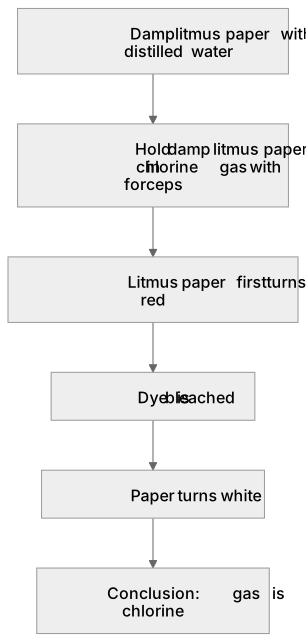
Put it in order
Put these steps in the order they happen.
- 1. Litmus paper first turns red
- 2. Hold damp litmus paper in chlorine gas with forceps
- 3. Damp litmus paper with distilled water
- 4. Conclusion: gas is chlorine
- 5. Paper turns white
- 6. Dye is bleached
Key words
Say what each word means before you turn the card.
Bleaching
Try answering aloud or in your head before turning the card.
Damp litmus paper
Try answering aloud or in your head before turning the card.
Acidic solution
Try answering aloud or in your head before turning the card.
Toxic gas
Try answering aloud or in your head before turning the card.
See every definition
- Bleaching
- The removal of colour from damp litmus paper by chlorine, so that the paper turns white because the dye is destroyed.
- Damp litmus paper
- Litmus paper moistened with distilled water, which is essential because dry litmus does not respond to chlorine gas.
- Acidic solution
- What forms when chlorine dissolves in the water film on the litmus paper, causing the paper first to turn red.
- Toxic gas
- A gas such as chlorine that must never be smelled directly or prepared in open laboratory conditions without suitable ventilation.
Label the diagram
Some boxes have lost their names. Pick the right name for each number.
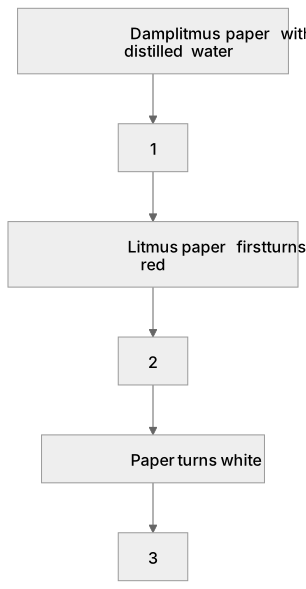
1Box 1
2Box 2
3Box 3
There is more to this lesson
The full lesson goes on to check your understanding and help you earn the marks. Create a free account to carry on, with your progress saved.
A week of Premium from your first lesson · Then the free plan continues · No card, no charge
Test your understanding of Test for chlorine: The test for chlorine uses litmus paper. When damp litmus paper is put into chlorine gas the litmus paper is bleached and turns white.
Active recall beats re-reading. Take an instant quiz now to test what you’ve learned and lock it into long-term memory.
A week of Premium from your first lesson · Then the free plan continues · No card, no charge