AQA · GCSE · Chemistry
Course version: 8462 · Version from Sept 2018
The test for oxygen uses a glowing splint inserted into a test tube of the…
Full specification wording
Test for oxygen: The test for oxygen uses a glowing splint inserted into a test tube of the gas. The splint relights in oxygen.
Oxygen is identified by its ability to relight a glowing splint.
Checked against the AQA 8462 specification (opens in a new tab) on .
- 4 key terms
Study notes
From the checked teaching notes for this specification point.
The idea
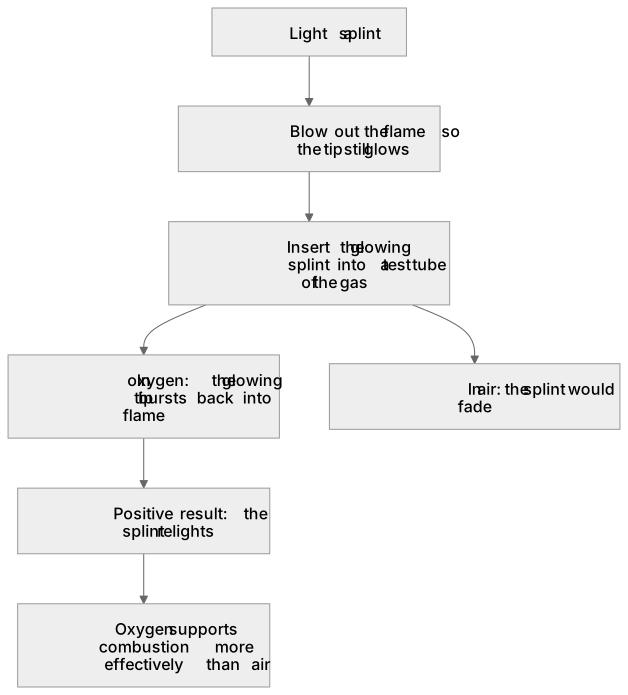
Oxygen is identified by its ability to relight a glowing splint. A splint is lit, then blown out so that it still glows at the tip. This glowing splint is inserted into a test tube containing the gas. In air, the splint would fade, but in oxygen the glowing tip bursts back into flame because oxygen supports combustion more effectively than air. The key observation is relighting, not a pop. The splint must be glowing, not flaming, before insertion, and it should be lowered into the tube so the gas surrounds the tip. A burning splint popping would indicate hydrogen instead.
What earns the marks
- State that a glowing splint is inserted into a test tube containing the gas.
- Describe the positive result as the splint relighting.
- Explain that oxygen supports combustion, so the glowing splint bursts into flame.
- Distinguish this from the hydrogen test, where a burning splint gives a pop rather than a glowing splint relighting.
- Note that the splint must be glowing, not still flaming, before it is inserted.
Common mistakes and how to put them right
Using a burning splint for oxygen.
Put it right: The correct test uses a glowing splint, while a burning splint is used for hydrogen.
Saying the splint 'burns brighter' instead of relighting.
Put it right: The correct observation is that the glowing splint relights.
Leaving the splint flaming before insertion.
Put it right: The correct method extinguishes the flame so the splint is only glowing.
Exam tips
- State the splint condition clearly: glowing, not burning, before insertion.
- Use the exact observation 'relights' rather than vague descriptions such as 'it reacts'.
- When comparing gases, link the oxygen test to supporting combustion and the hydrogen test to a pop sound.
Try the lesson
The start of the Test for oxygen: The test for oxygen uses a glowing splint inserted into a test tube of the gas. The splint relights in oxygen. lesson, made from checked teaching notes for this specification point.
Have a go first
Which gas causes a glowing splint to relight when the splint is inserted into a test tube of the gas?
Listen
Oxygen is identified by its ability to relight a glowing splint. A splint is lit, then blown out so that it still glows at the tip. This glowing splint is inserted into a test tube containing the gas. In air, the splint would fade, but in oxygen the glowing tip bursts back into flame because oxygen supports combustion more effectively than air. The key observation is relighting, not a pop. The splint must be glowing, not flaming, before insertion, and it should be lowered into the tube so the gas surrounds the tip. A burning splint popping would indicate hydrogen instead. A strong answer earns marks for these points. State that a glowing splint is inserted into a test tube containing the gas. Describe the positive result as the splint relighting. Explain that oxygen supports combustion, so the glowing splint bursts into flame. Distinguish this from the hydrogen test, where a burning splint gives a pop rather than a glowing splint relighting. Exam tip: State the splint condition clearly: glowing, not burning, before insertion.
See it
Key words
Say what each word means before you turn the card.
Gas identification
Try answering aloud or in your head before turning the card.
Combustion and oxidation
Try answering aloud or in your head before turning the card.
Experimental technique
Try answering aloud or in your head before turning the card.
Contrasting gas tests
Try answering aloud or in your head before turning the card.
See every definition
- Gas identification
- Oxygen is identified by its ability to relight a glowing splint inserted into a test tube of the gas.
- Combustion and oxidation
- Oxygen supports combustion more effectively than air, so the glowing tip bursts back into flame.
- Experimental technique
- A splint is lit, then blown out so that it still glows at the tip, and lowered into the tube so the gas surrounds the tip.
- Contrasting gas tests
- A burning splint popping would indicate hydrogen instead, rather than a glowing splint relighting.
Label the diagram
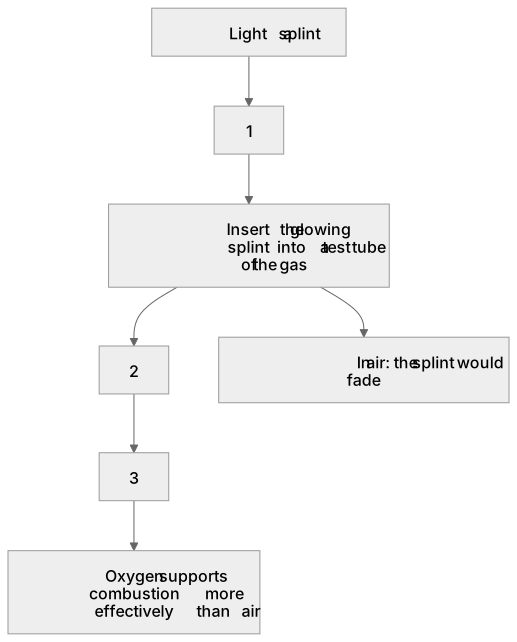
Some boxes have lost their names. Pick the right name for each number.
1Box 1
2Box 2
3Box 3
There is more to this lesson
The full lesson goes on to check your understanding and help you earn the marks. Create a free account to carry on, with your progress saved.
A week of Premium from your first lesson · Then the free plan continues · No card, no charge
Test your understanding of Test for oxygen: The test for oxygen uses a glowing splint inserted into a test tube of the gas. The splint relights in oxygen.
Active recall beats re-reading. Take an instant quiz now to test what you’ve learned and lock it into long-term memory.
A week of Premium from your first lesson · Then the free plan continues · No card, no charge