AQA · GCSE · Chemistry
Course version: 8462 · Version from Sept 2018
The carbon footprint is the total amount of carbon dioxide and other…
Full specification wording
The carbon footprint and its reduction: The carbon footprint is the total amount of carbon dioxide and other greenhouse gases emitted over the full life cycle of a product, service or event.
A carbon footprint measures the total greenhouse gases released across the whole life cycle of a product, service or event.
Checked against the AQA 8462 specification (opens in a new tab) on .
- Point 1 of 3
- 4 key terms
Study notes
From the checked teaching notes for this specification point.
The idea
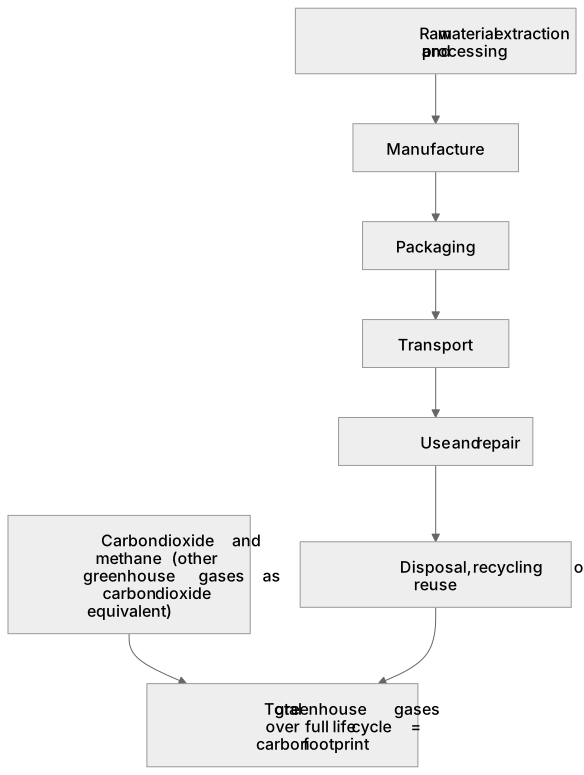
A carbon footprint measures the total greenhouse gases released across the whole life cycle of a product, service or event. The life cycle begins with extracting raw materials and processing them, continues through manufacture, packaging, transport, use and repair, and ends with disposal, recycling or reuse. Carbon dioxide and methane are the main gases counted, and other greenhouse gases may be included by converting them to a carbon dioxide equivalent. For example, a cotton T-shirt carries emissions from growing and irrigating the crop, making and dyeing the fabric, shipping it, washing and drying it during use, and finally discarding it. Because the footprint covers every stage, changing one stage alone may not reduce the total much.
What earns the marks
- Defines the carbon footprint as the total greenhouse gases emitted, not just carbon dioxide.
- States that the whole life cycle is included, from raw material extraction to disposal or recycling.
- Names carbon dioxide and methane as greenhouse gases that contribute to the footprint.
- Applies the idea to a product, service or event, for example tracing stages of a T-shirt or a concert.
- Recognises that transport, manufacture, use and waste disposal can each add emissions.
- Explains that a full life-cycle view is needed before claiming a product is low carbon.
Common mistakes and how to put them right
Counting only carbon dioxide.
Put it right: Methane and other greenhouse gases are also included.
Considering only one stage, such as transport.
Put it right: The full life cycle from extraction to disposal must be counted.
Confusing carbon footprint with the mass of the product.
Put it right: It is a mass of greenhouse gases emitted, not the product's own mass.
Exam tips
- Quote the definition precisely, including the words total, greenhouse gases and full life cycle.
- When applying the idea, name at least three life-cycle stages to show the full scope.
- Use a familiar product as a worked example so the abstract definition becomes concrete.
Try the lesson
The start of the The carbon footprint and its reduction: The carbon footprint is the total amount of carbon dioxide and other greenhouse gases emitted over the full life cycle of a product, service or event. lesson, made from checked teaching notes for this specification point.
Have a go first
Which of these is included when working out the carbon footprint of a product?
Listen
A carbon footprint measures the total greenhouse gases released across the whole life cycle of a product, service or event. The life cycle begins with extracting raw materials and processing them, continues through manufacture, packaging, transport, use and repair, and ends with disposal, recycling or reuse. Carbon dioxide and methane are the main gases counted, and other greenhouse gases may be included by converting them to a carbon dioxide equivalent. For example, a cotton T-shirt carries emissions from growing and irrigating the crop, making and dyeing the fabric, shipping it, washing and drying it during use, and finally discarding it. Because the footprint covers every stage, changing one stage alone may not reduce the total much. A strong answer earns marks for these points. Defines the carbon footprint as the total greenhouse gases emitted, not just carbon dioxide. States that the whole life cycle is included, from raw material extraction to disposal or recycling. Names carbon dioxide and methane as greenhouse gases that contribute to the footprint. Applies the idea to a product, service or event, for example tracing stages of a T-shirt or a concert. A common slip: Counting only carbon dioxide. Instead, methane and other greenhouse gases are also included. Exam tip: Quote the definition precisely, including the words total, greenhouse gases and full life cycle.
See it
Key words
Say what each word means before you turn the card.
Carbon footprint
Try answering aloud or in your head before turning the card.
Life-cycle thinking
Try answering aloud or in your head before turning the card.
Greenhouse gas emissions
Try answering aloud or in your head before turning the card.
Product, service and event impacts
Try answering aloud or in your head before turning the card.
See every definition
- Carbon footprint
- The total amount of carbon dioxide and other greenhouse gases emitted over the full life cycle of a product, service or event.
- Life-cycle thinking
- Considering every stage from raw material extraction through manufacture, packaging, transport, use and repair to disposal, recycling or reuse.
- Greenhouse gas emissions
- Gases released across the life cycle, with carbon dioxide and methane the main gases counted and others included by converting them to a carbon dioxide equivalent.
- Product, service and event impacts
- Emissions added at each stage, since transport, manufacture, use and waste disposal can each add emissions.
Label the diagram
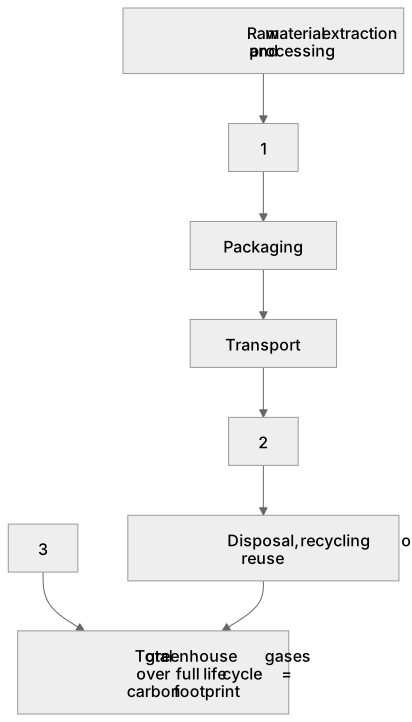
Some boxes have lost their names. Pick the right name for each number.
1Box 1
2Box 2
3Box 3
There is more to this lesson
The full lesson goes on to check your understanding and help you earn the marks. Create a free account to carry on, with your progress saved.
A week of Premium from your first lesson · Then the free plan continues · No card, no charge
Test your understanding of The carbon footprint and its reduction: The carbon footprint is the total amount of carbon dioxide and other greenhouse gases emitted over the full life cycle of a product, service or event.
Active recall beats re-reading. Take an instant quiz now to test what you’ve learned and lock it into long-term memory.
A week of Premium from your first lesson · Then the free plan continues · No card, no charge