AQA · GCSE · Chemistry
Course version: 8462 · Version from Sept 2018
New experimental evidence may lead to a scientific model being changed or…
Full specification wording
The development of the model of the atom (common content with physics): New experimental evidence may lead to a scientific model being changed or replaced.
Scientific models are explanations of observations, and they can change when new experimental evidence does not fit.
Checked against the AQA 8462 specification (opens in a new tab) on .
- Point 1 of 14
- 4 key terms
Study notes
From the checked teaching notes for this specification point.
The idea
Scientific models are explanations of observations, and they can change when new experimental evidence does not fit. The atomic model developed over time: Dalton described atoms as solid spheres; Thomson's discovery of the electron led to the plum pudding model; Rutherford's alpha-particle scattering experiment showed that most alpha particles passed through gold foil but some were deflected, so the model changed to a nuclear atom with a positive nucleus; Bohr later proposed electron shells; further evidence led to the modern model. A model is replaced when new evidence cannot be explained by the old model, not simply because someone disagrees.
What earns the marks
- A scientific model is a representation or explanation used to describe observations and make predictions.
- New experimental evidence can show that an existing model cannot explain observations, so the model is changed or replaced.
- Rutherford's alpha-particle scattering experiment provided evidence that the atom has a small, dense, positive nucleus, replacing the plum pudding model.
- The discovery of the electron by Thomson changed the model from Dalton's solid sphere to a model containing negative electrons.
- Bohr's model introduced electron shells to explain evidence that was not accounted for by earlier models.
- Scientific models are provisional and may be modified as further evidence is collected.
Common mistakes and how to put them right
Thinking a model changes because a scientist prefers a new idea.
Put it right: New experimental evidence drives the change.
Believing the plum pudding model included a nucleus.
Put it right: The nuclear model came after Rutherford's evidence.
Saying the atomic model has never changed.
Put it right: It developed through several stages as evidence accumulated.
Exam tips
- Link each model change to the specific evidence that caused it, such as alpha-particle scattering for the nuclear model.
- Use the phrase new experimental evidence when explaining why a model is replaced.
- Describe what was observed, such as most alpha particles passing through, and what that suggested about the atom.
Try the lesson
The start of the The development of the model of the atom (common content with physics): New experimental evidence may lead to a scientific model being changed or replaced. lesson, made from checked teaching notes for this specification point.
Have a go first
What happens to a scientific model when new experimental evidence cannot be explained by it?
Listen
Scientific models are explanations of observations, and they can change when new experimental evidence does not fit. The atomic model developed over time: Dalton described atoms as solid spheres; Thomson's discovery of the electron led to the plum pudding model; Rutherford's alpha-particle scattering experiment showed that most alpha particles passed through gold foil but some were deflected, so the model changed to a nuclear atom with a positive nucleus; Bohr later proposed electron shells; further evidence led to the modern model. A model is replaced when new evidence cannot be explained by the old model, not simply because someone disagrees. A strong answer earns marks for these points. A scientific model is a representation or explanation used to describe observations and make predictions. New experimental evidence can show that an existing model cannot explain observations, so the model is changed or replaced. Rutherford's alpha-particle scattering experiment provided evidence that the atom has a small, dense, positive nucleus, replacing the plum pudding model. The discovery of the electron by Thomson changed the model from Dalton's solid sphere to a model containing negative electrons. A common slip: Thinking a model changes because a scientist prefers a new idea. Instead, new experimental evidence drives the change. Exam tip: Link each model change to the specific evidence that caused it, such as alpha-particle scattering for the nuclear model.
See it
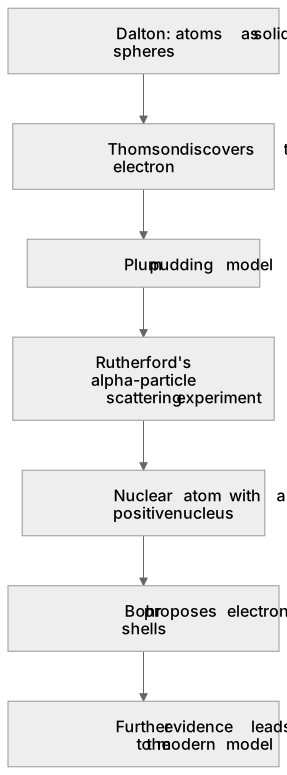
Put it in order
Put these steps in the order they happen.
- 1. Further evidence leads to the modern model
- 2. Bohr proposes electron shells
- 3. Plum pudding model
- 4. Nuclear atom with a positive nucleus
- 5. Dalton: atoms as solid spheres
- 6. Thomson discovers the electron
- 7. Rutherford's alpha-particle scattering experiment
Key words
Say what each word means before you turn the card.
Development of the atomic model
Try answering aloud or in your head before turning the card.
Evidence and scientific explanation
Try answering aloud or in your head before turning the card.
Provisional nature of scientific models
Try answering aloud or in your head before turning the card.
Key experiments in atomic history
Try answering aloud or in your head before turning the card.
See every definition
- Development of the atomic model
- The atomic model changed over time as new experimental evidence emerged, moving from Dalton's solid spheres through Thomson's plum pudding model and Rutherford's nuclear atom to Bohr's electron shells and the modern model.
- Evidence and scientific explanation
- New experimental evidence can show that an existing model cannot explain observations, so the model is changed or replaced.
- Provisional nature of scientific models
- Scientific models are provisional and may be modified as further evidence is collected.
- Key experiments in atomic history
- Thomson's discovery of the electron and Rutherford's alpha-particle scattering experiment provided evidence that changed the atomic model.
Label the diagram
Some boxes have lost their names. Pick the right name for each number.
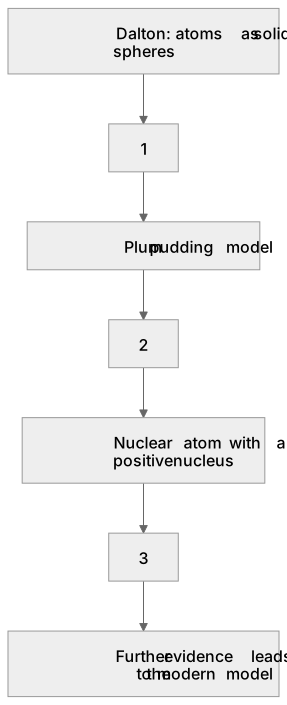
1Box 1
2Box 2
3Box 3
There is more to this lesson
The full lesson goes on to check your understanding and help you earn the marks. Create a free account to carry on, with your progress saved.
A week of Premium from your first lesson · Then the free plan continues · No card, no charge
Test your understanding of The development of the model of the atom (common content with physics): New experimental evidence may lead to a scientific model being changed or replaced.
Active recall beats re-reading. Take an instant quiz now to test what you’ve learned and lock it into long-term memory.
A week of Premium from your first lesson · Then the free plan continues · No card, no charge