AQA · GCSE · Chemistry
Course version: 8462 · Version from Sept 2018
Niels Bohr adapted the nuclear model by suggesting that electrons orbit…
Full specification wording
The development of the model of the atom (common content with physics): Niels Bohr adapted the nuclear model by suggesting that electrons orbit the nucleus at specific distances.
Rutherford's nuclear model placed a tiny positive nucleus at the centre of the atom but did not explain how electrons behaved.
Checked against the AQA 8462 specification (opens in a new tab) on .
- Point 7 of 14
Study notes
From the checked teaching notes for this specification point.
The idea
Rutherford's nuclear model placed a tiny positive nucleus at the centre of the atom but did not explain how electrons behaved. Niels Bohr adapted the model by proposing that electrons orbit the nucleus only at specific distances, now called energy levels or shells. Electrons can move between these levels by absorbing or emitting energy, but they cannot exist between them. This idea explained patterns in the light emitted and absorbed by atoms, which earlier models could not. Bohr's adaptation shows how a model is refined rather than discarded when new evidence emerges: the nucleus stays, but the arrangement of electrons is described more precisely.
What earns the marks
- State that Bohr adapted the nuclear model rather than replacing it completely.
- Describe electrons as orbiting the nucleus at specific distances, called energy levels or shells.
- Explain that electrons can move between energy levels by absorbing or emitting energy.
- Link Bohr's suggestion to its purpose: explaining experimental observations such as light emitted or absorbed by atoms.
- Recognise that the nuclear model was refined over time as new evidence emerged.
Common mistakes and how to put them right
Saying electrons orbit at any distance.
Put it right by stating that orbits are at specific, fixed distances from the nucleus.
Confusing Bohr's change with the discovery of the nucleus.
Put it right by explaining that Rutherford proposed the nucleus and Bohr adapted the model to describe electron orbits.
Describing electrons as stationary in shells.
Put it right by stating that electrons orbit the nucleus within specific energy levels.
Exam tips
- Use the phrase specific distances or energy levels when describing Bohr's suggestion.
- Make clear that Bohr adapted the nuclear model rather than replacing it.
- Link the model to evidence, such as patterns in light emitted by atoms, to show why the adaptation was needed.
Try the lesson
The start of the The development of the model of the atom (common content with physics): Niels Bohr adapted the nuclear model by suggesting that electrons orbit the nucleus at specific distances. lesson, made from checked teaching notes for this specification point.
Have a go first
According to Bohr's adaptation of the nuclear model, where are electrons found?
Listen
Rutherford's nuclear model placed a tiny positive nucleus at the centre of the atom but did not explain how electrons behaved. Niels Bohr adapted the model by proposing that electrons orbit the nucleus only at specific distances, now called energy levels or shells. Electrons can move between these levels by absorbing or emitting energy, but they cannot exist between them. This idea explained patterns in the light emitted and absorbed by atoms, which earlier models could not. Bohr's adaptation shows how a model is refined rather than discarded when new evidence emerges: the nucleus stays, but the arrangement of electrons is described more precisely. A strong answer earns marks for these points. State that Bohr adapted the nuclear model rather than replacing it completely. Describe electrons as orbiting the nucleus at specific distances, called energy levels or shells. Explain that electrons can move between energy levels by absorbing or emitting energy. Link Bohr's suggestion to its purpose: explaining experimental observations such as light emitted or absorbed by atoms. A common slip: Saying electrons orbit at any distance. Instead, stating that orbits are at specific, fixed distances from the nucleus. Exam tip: Use the phrase specific distances or energy levels when describing Bohr's suggestion.
See it
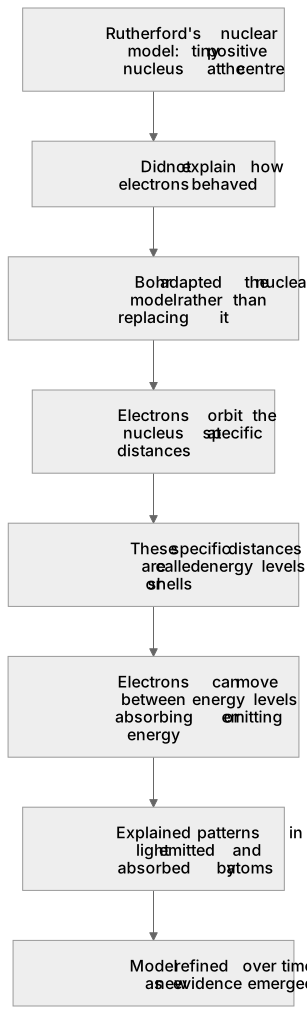
Put it in order
Put these steps in the order they happen.
- 1. These specific distances are called energy levels or shells
- 2. Model refined over time as new evidence emerged
- 3. Electrons can move between energy levels by absorbing or emitting energy
- 4. Rutherford's nuclear model: tiny positive nucleus at the centre
- 5. Did not explain how electrons behaved
- 6. Explained patterns in light emitted and absorbed by atoms
- 7. Bohr adapted the nuclear model rather than replacing it
- 8. Electrons orbit the nucleus at specific distances
Label the diagram
Some boxes have lost their names. Pick the right name for each number.
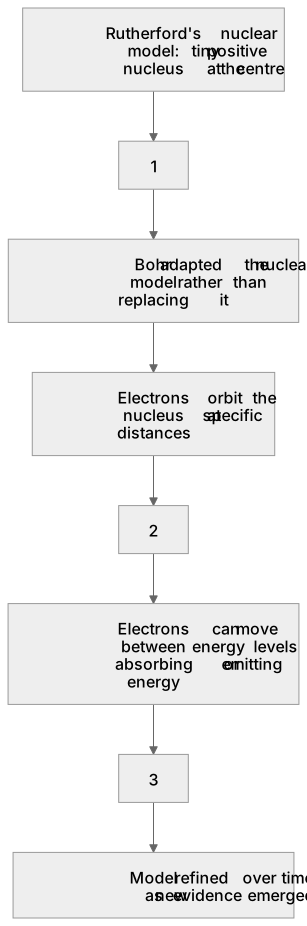
1Box 1
2Box 2
3Box 3
There is more to this lesson
The full lesson goes on to check your understanding and help you earn the marks. Create a free account to carry on, with your progress saved.
A week of Premium from your first lesson · Then the free plan continues · No card, no charge
Test your understanding of The development of the model of the atom (common content with physics): Niels Bohr adapted the nuclear model by suggesting that electrons orbit the nucleus at specific distances.
Active recall beats re-reading. Take an instant quiz now to test what you’ve learned and lock it into long-term memory.
A week of Premium from your first lesson · Then the free plan continues · No card, no charge