AQA · GCSE · Chemistry
Course version: 8462 · Version from Sept 2018
The plum pudding model suggested that the atom is a ball of positive…
Full specification wording
The development of the model of the atom (common content with physics): The plum pudding model suggested that the atom is a ball of positive charge with negative electrons embedded in it.
The plum pudding model, proposed by J. J. Thomson, pictures the atom as a sphere of positive charge with negative electrons dotted through it.
Checked against the AQA 8462 specification (opens in a new tab) on .
- Point 4 of 14
- 4 key terms
Study notes
From the checked teaching notes for this specification point.
The idea
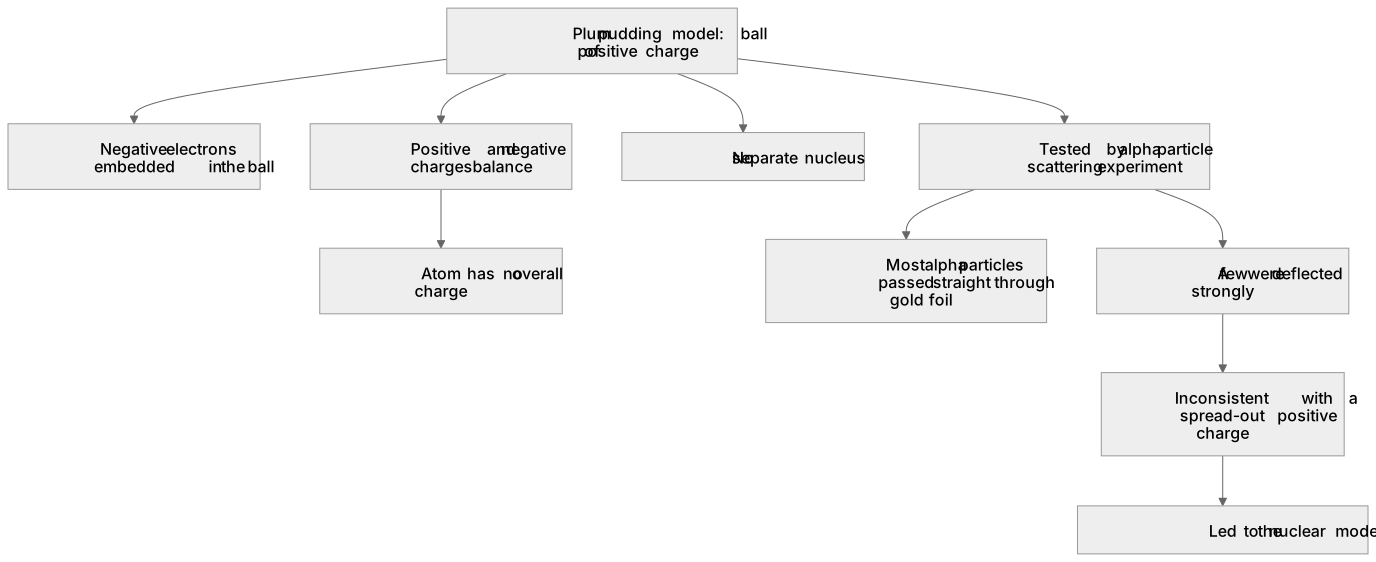
The plum pudding model, proposed by J. J. Thomson, pictures the atom as a sphere of positive charge with negative electrons dotted through it. The positive and negative charges balance, so the atom has no overall charge. This arrangement explained how atoms could form ions by losing or gaining electrons, and why matter is normally neutral. It also fitted the evidence available at the time, because electrons had been detected but no positive particles had been identified individually. The model does not include a nucleus, protons or neutrons. It was later tested by the alpha particle scattering experiment, in which most alpha particles passed straight through gold foil but a few were deflected strongly. That result was inconsistent with a spread-out positive charge and led to the nuclear model.
What earns the marks
- Describe the atom as a ball of positive charge in this model.
- State that negative electrons are embedded in the positive ball.
- Explain that the charges balance so the atom is neutral overall.
- Recognise that the model has no separate nucleus.
- Link the model to its inability to explain large-angle alpha particle deflections.
Common mistakes and how to put them right
Describing the positive charge as concentrated in a centre.
Put it right by saying it is spread throughout the ball.
Forgetting the electrons are negative.
Put it right by stating their charge explicitly.
Saying the model explains the alpha scattering results.
Put it right by noting it failed to explain them.
Exam tips
- Sketch a simple labelled diagram if asked to show the model, with plus signs spread through the sphere and minus signs inside.
- Use the word embedded rather than floating or orbiting.
- State clearly that the atom is neutral overall because charges balance.
Try the lesson
The start of the The development of the model of the atom (common content with physics): The plum pudding model suggested that the atom is a ball of positive charge with negative electrons embedded in it. lesson, made from checked teaching notes for this specification point.
Have a go first
In the plum pudding model, how were the electrons arranged?
Listen
The plum pudding model, proposed by J. J. Thomson, pictures the atom as a sphere of positive charge with negative electrons dotted through it. The positive and negative charges balance, so the atom has no overall charge. This arrangement explained how atoms could form ions by losing or gaining electrons, and why matter is normally neutral. It also fitted the evidence available at the time, because electrons had been detected but no positive particles had been identified individually. The model does not include a nucleus, protons or neutrons. It was later tested by the alpha particle scattering experiment, in which most alpha particles passed straight through gold foil but a few were deflected strongly. That result was inconsistent with a spread-out positive charge and led to the nuclear model. A strong answer earns marks for these points. Describe the atom as a ball of positive charge in this model. State that negative electrons are embedded in the positive ball. Explain that the charges balance so the atom is neutral overall. Recognise that the model has no separate nucleus. A common slip: Describing the positive charge as concentrated in a centre. Instead, saying it is spread throughout the ball. Exam tip: Sketch a simple labelled diagram if asked to show the model, with plus signs spread through the sphere and minus signs inside.
See it
Key words
Say what each word means before you turn the card.
Charge balance in atoms
Try answering aloud or in your head before turning the card.
Embedded electrons
Try answering aloud or in your head before turning the card.
Limitations of early models
Try answering aloud or in your head before turning the card.
Experimental testing of models
Try answering aloud or in your head before turning the card.
See every definition
- Charge balance in atoms
- The positive and negative charges balance, so the atom has no overall charge.
- Embedded electrons
- Negative electrons are embedded in a ball of positive charge.
- Limitations of early models
- The model does not include a nucleus, protons or neutrons, and was inconsistent with large-angle alpha particle deflections.
- Experimental testing of models
- The model was later tested by the alpha particle scattering experiment, in which most alpha particles passed straight through gold foil but a few were deflected strongly.
Label the diagram
Some boxes have lost their names. Pick the right name for each number.
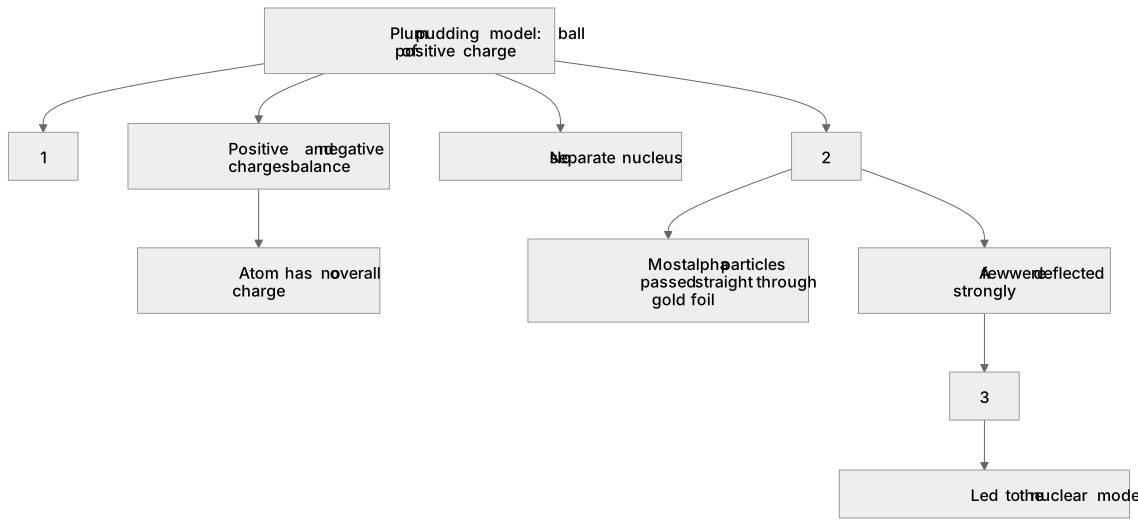
1Box 1
2Box 2
3Box 3
There is more to this lesson
The full lesson goes on to check your understanding and help you earn the marks. Create a free account to carry on, with your progress saved.
A week of Premium from your first lesson · Then the free plan continues · No card, no charge
Test your understanding of The development of the model of the atom (common content with physics): The plum pudding model suggested that the atom is a ball of positive charge with negative electrons embedded in it.
Active recall beats re-reading. Take an instant quiz now to test what you’ve learned and lock it into long-term memory.
A week of Premium from your first lesson · Then the free plan continues · No card, no charge