AQA · GCSE · Chemistry
Course version: 8462 · Version from Sept 2018
This was about 20 years after the nucleus became an accepted scientific…
Full specification wording
The development of the model of the atom (common content with physics): This was about 20 years after the nucleus became an accepted scientific idea.
Scientific models are accepted only when evidence supports them, and acceptance can take time.
Checked against the AQA 8462 specification (opens in a new tab) on .
- Point 12 of 14
- 4 key terms
Study notes
From the checked teaching notes for this specification point.
The idea
Scientific models are accepted only when evidence supports them, and acceptance can take time. Rutherford's nuclear model, based on the alpha-particle scattering experiments published around 1911, proposed that the atom has a tiny, dense, positively charged nucleus. This idea became widely accepted over the following years. Chadwick's evidence for the neutron came in 1932, roughly two decades later. The gap shows that the nucleus was an established scientific idea well before the neutron was identified. It also shows how one discovery raises new questions: if the nucleus contained only protons, the mass and charge of many nuclei did not add up, and the neutron resolved that problem.
What earns the marks
- Place the acceptance of the nuclear model in the early twentieth century, following Rutherford's alpha-particle scattering evidence.
- Place Chadwick's discovery of the neutron around 1932, approximately 20 years after the nuclear model was accepted.
- Explain that scientific ideas become accepted when repeated experimental evidence supports them.
- Recognise that the neutron was proposed to explain mass that could not be accounted for by protons alone.
- Describe the development of the atomic model as a sequence of evidence-led changes rather than a single event.
Common mistakes and how to put them right
Treating the nuclear model and the neutron as discovered at the same time.
Put it right by separating them by about 20 years.
Assuming that a model is accepted immediately after one experiment.
Put it right by noting that acceptance requires supporting evidence over time.
Confusing the order of discoveries by placing the neutron before the nucleus.
Put it right by stating that the nucleus was accepted first.
Exam tips
- Use approximate dates or a sequence rather than exact dates unless they are given in the question.
- When describing a timeline, name the model or discovery and the evidence that supported it.
- Explain why a new particle was needed by referring to unexplained mass or charge in the nucleus.
Try the lesson
The start of the The development of the model of the atom (common content with physics): This was about 20 years after the nucleus became an accepted scientific idea. lesson, made from checked teaching notes for this specification point.
Have a go first
James Chadwick provided evidence for the existence of neutrons in the nucleus. When did this occur in relation to the acceptance of the nuclear model?
Listen
Scientific models are accepted only when evidence supports them, and acceptance can take time. Rutherford's nuclear model, based on the alpha-particle scattering experiments published around 1911, proposed that the atom has a tiny, dense, positively charged nucleus. This idea became widely accepted over the following years. Chadwick's evidence for the neutron came in 1932, roughly two decades later. The gap shows that the nucleus was an established scientific idea well before the neutron was identified. It also shows how one discovery raises new questions: if the nucleus contained only protons, the mass and charge of many nuclei did not add up, and the neutron resolved that problem. A strong answer earns marks for these points. Place the acceptance of the nuclear model in the early twentieth century, following Rutherford's alpha-particle scattering evidence. Place Chadwick's discovery of the neutron around 1932, approximately 20 years after the nuclear model was accepted. Explain that scientific ideas become accepted when repeated experimental evidence supports them. Recognise that the neutron was proposed to explain mass that could not be accounted for by protons alone. A common slip: Treating the nuclear model and the neutron as discovered at the same time. Instead, separating them by about 20 years. Exam tip: Use approximate dates or a sequence rather than exact dates unless they are given in the question.
See it
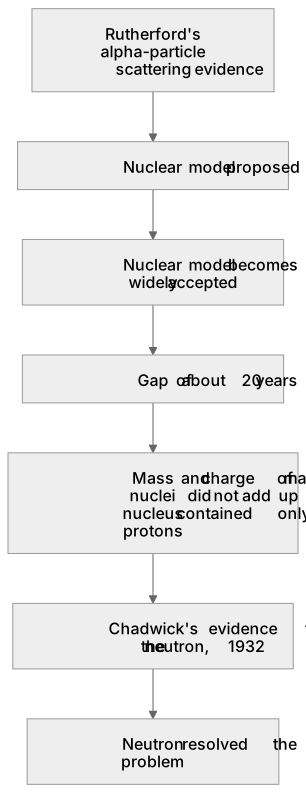
Put it in order
Put these steps in the order they happen.
- 1. Neutron resolved the problem
- 2. Chadwick's evidence for the neutron, 1932
- 3. Nuclear model becomes widely accepted
- 4. Mass and charge of many nuclei did not add up if nucleus contained only protons
- 5. Rutherford's alpha-particle scattering evidence
- 6. Nuclear model proposed
- 7. Gap of about 20 years
Key words
Say what each word means before you turn the card.
Role of evidence in accepting models
Try answering aloud or in your head before turning the card.
Time scale of scientific discovery
Try answering aloud or in your head before turning the card.
Progression from nuclear model to modern atom
Try answering aloud or in your head before turning the card.
Historical development of atomic theory
Try answering aloud or in your head before turning the card.
See every definition
- Role of evidence in accepting models
- Scientific models are accepted only when evidence supports them, and acceptance can take time.
- Time scale of scientific discovery
- The neutron was identified roughly two decades after the nucleus became an accepted scientific idea.
- Progression from nuclear model to modern atom
- The atomic model develops as a sequence of evidence-led changes rather than a single event.
- Historical development of atomic theory
- The nucleus was an established scientific idea well before the neutron was identified.
Label the diagram
Some boxes have lost their names. Pick the right name for each number.
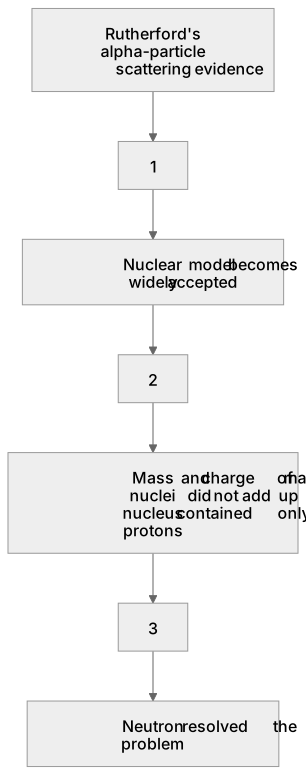
1Box 1
2Box 2
3Box 3
There is more to this lesson
The full lesson goes on to check your understanding and help you earn the marks. Create a free account to carry on, with your progress saved.
A week of Premium from your first lesson · Then the free plan continues · No card, no charge
Test your understanding of The development of the model of the atom (common content with physics): This was about 20 years after the nucleus became an accepted scientific idea.
Active recall beats re-reading. Take an instant quiz now to test what you’ve learned and lock it into long-term memory.
A week of Premium from your first lesson · Then the free plan continues · No card, no charge