AQA · GCSE · Chemistry
Course version: 8462 · Version from Sept 2018
Students should be able to make qualitative predictions about the effect…
Full specification wording
The effect of changing conditions on equilibrium (HT only): Students should be able to make qualitative predictions about the effect of changes on systems at equilibrium when given appropriate information.
Qualitative predictions describe the direction in which an equilibrium shifts and whether the yield of a product increases or decreases, without calculating numerical equilibrium constants.
Checked against the AQA 8462 specification (opens in a new tab) on .
- Point 4 of 4
- 3 key terms
Study notes
From the checked teaching notes for this specification point.
The idea
Qualitative predictions describe the direction in which an equilibrium shifts and whether the yield of a product increases or decreases, without calculating numerical equilibrium constants. Given a balanced equation and information about a change, you apply Le Chatelier’s Principle. For example, for the equilibrium 2SO₂(g) + O₂(g) ⇌ 2SO₃(g), increasing pressure shifts equilibrium to the right because there are three gas molecules on the left and two on the right, so the yield of SO₃ increases. Increasing temperature shifts equilibrium in the endothermic direction; if the forward reaction is exothermic, the yield of SO₃ decreases. Predictions must be justified by reference to the change and the opposing shift, and should state the effect on the amount of a named substance.
What earns the marks
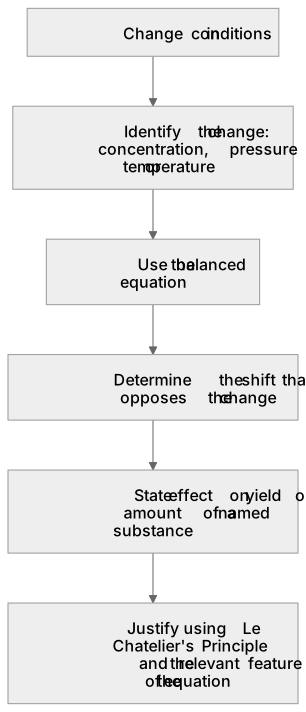
- Identify the change described, such as an increase in concentration, pressure or temperature.
- Use the balanced equation to determine the direction of the equilibrium shift that opposes the change.
- State whether the yield or amount of a specified reactant or product increases or decreases.
- Justify the prediction by referring to Le Chatelier’s Principle and the relevant feature of the equation, such as gas molecule numbers or exothermic/endothermic direction.
- Recognise that qualitative predictions do not require numerical calculation of equilibrium concentrations or constants.
Common mistakes and how to put them right
Giving only the direction of shift without stating the effect on the yield of a named substance.
Put it right: The prediction should include both.
Assuming that increasing pressure always increases yield.
Put it right: The correct prediction depends on the number of gas molecules on each side.
Treating a temperature change as affecting the rate only.
Put it right: Temperature also changes the position of equilibrium according to the exothermic or endothermic direction.
Exam tips
- Read the given information carefully and identify exactly which condition is changed.
- Write the balanced equation and annotate the number of gas molecules on each side before making a pressure prediction.
- Use comparative language such as increases, decreases or shifts to the right, and avoid vague statements such as it changes.
Try the lesson
The start of the The effect of changing conditions on equilibrium (HT only): Students should be able to make qualitative predictions about the effect of changes on systems at equilibrium when given appropriate information. lesson, made from checked teaching notes for this specification point.
Have a go first
For the equilibrium 2SO₂(g) + O₂(g) ⇌ 2SO₃(g), predict the effect on the position of equilibrium of increasing the pressure.
Listen
Qualitative predictions describe the direction in which an equilibrium shifts and whether the yield of a product increases or decreases, without calculating numerical equilibrium constants. Given a balanced equation and information about a change, you apply Le Chatelier’s Principle. For example, for the equilibrium 2SO₂(g) + O₂(g) ⇌ 2SO₃(g), increasing pressure shifts equilibrium to the right because there are three gas molecules on the left and two on the right, so the yield of SO₃ increases. Increasing temperature shifts equilibrium in the endothermic direction; if the forward reaction is exothermic, the yield of SO₃ decreases. Predictions must be justified by reference to the change and the opposing shift, and should state the effect on the amount of a named substance. A strong answer earns marks for these points. Identify the change described, such as an increase in concentration, pressure or temperature. Use the balanced equation to determine the direction of the equilibrium shift that opposes the change. State whether the yield or amount of a specified reactant or product increases or decreases. Justify the prediction by referring to Le Chatelier’s Principle and the relevant feature of the equation, such as gas molecule numbers or exothermic/endothermic direction. Exam tip: Read the given information carefully and identify exactly which condition is changed.
See it
Put it in order
Put these steps in the order they happen.
- 1. Use the balanced equation
- 2. Identify the change: concentration, pressure or temperature
- 3. Change in conditions
- 4. Justify using Le Chatelier's Principle and the relevant feature of the equation
- 5. State effect on yield or amount of a named substance
- 6. Determine the shift that opposes the change
Key words
Say what each word means before you turn the card.
Qualitative prediction
Try answering aloud or in your head before turning the card.
Equilibrium shift
Try answering aloud or in your head before turning the card.
Justification using equations
Try answering aloud or in your head before turning the card.
See every definition
- Qualitative prediction
- A description of the direction in which an equilibrium shifts and whether the yield of a product increases or decreases, without calculating numerical equilibrium constants.
- Equilibrium shift
- The direction in which an equilibrium moves, determined by using the balanced equation to oppose the change described.
- Justification using equations
- Explaining a prediction by referring to Le Chatelier's Principle and the relevant feature of the equation, such as gas molecule numbers or exothermic/endothermic direction.
Label the diagram
Some boxes have lost their names. Pick the right name for each number.
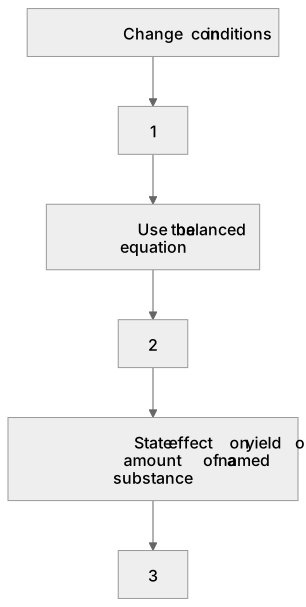
1Box 1
2Box 2
3Box 3
There is more to this lesson
The full lesson goes on to check your understanding and help you earn the marks. Create a free account to carry on, with your progress saved.
A week of Premium from your first lesson · Then the free plan continues · No card, no charge
Test your understanding of The effect of changing conditions on equilibrium (HT only): Students should be able to make qualitative predictions about the effect of changes on systems at equilibrium when given appropriate information.
Active recall beats re-reading. Take an instant quiz now to test what you’ve learned and lock it into long-term memory.
A week of Premium from your first lesson · Then the free plan continues · No card, no charge