AQA · GCSE · Chemistry
Course version: 8462 · Version from Sept 2018
If the temperature of a system at equilibrium is decreased: the relative…
Full specification wording
The effect of temperature changes on equilibrium (HT only): If the temperature of a system at equilibrium is decreased: the relative amount of products at equilibrium decreases for an endothermic reaction the relative amount of products at equilibrium increases for an exothermic reaction.
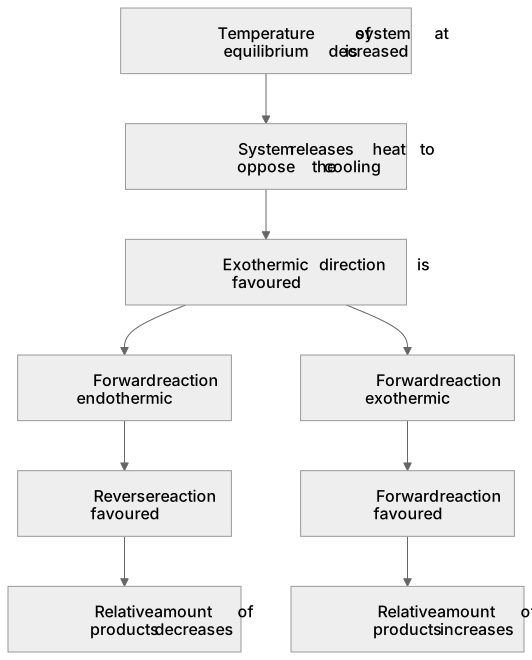
Decreasing the temperature of a system at equilibrium favours the exothermic direction, because the system releases heat to oppose the cooling.
Checked against the AQA 8462 specification (opens in a new tab) on .
- Point 2 of 3
Study notes
From the checked teaching notes for this specification point.
The idea
Decreasing the temperature of a system at equilibrium favours the exothermic direction, because the system releases heat to oppose the cooling. If the forward reaction is endothermic, the reverse reaction is exothermic and is favoured, so the relative amount of products at equilibrium decreases. If the forward reaction is exothermic, the forward reaction is favoured, so the relative amount of products at equilibrium increases. For example, in the exothermic forward reaction N₂(g) + 3H₂(g) ⇌ 2NH₃(g), lowering the temperature shifts equilibrium to the right, producing more ammonia. This principle is used in the Haber process to increase ammonia yield, although lower temperatures also slow the rate of reaction.
What earns the marks
- Decreasing temperature favours the exothermic direction.
- For an endothermic forward reaction, the reverse reaction is favoured and the relative amount of products decreases.
- For an exothermic forward reaction, the forward reaction is favoured and the relative amount of products increases.
- The system releases heat to oppose the decrease in temperature.
- The new equilibrium has a different composition from the original equilibrium.
- The explanation should refer to the relative amounts of products at equilibrium.
Common mistakes and how to put them right
Assuming that decreasing temperature always decreases the amount of product.
Put it right: This is only true for an endothermic forward reaction.
Confusing the favoured direction.
Put it right: Decreasing temperature favours the exothermic direction, not the endothermic direction.
Forgetting that a lower temperature also slows down the rate at which equilibrium is reached, even though the yield may be higher.
Exam tips
- Identify whether the forward reaction is endothermic or exothermic before predicting the effect.
- Use the phrase 'the equilibrium shifts in the exothermic direction' to make your reasoning clear.
- Mention the effect on the relative amount of products, not just the direction of the shift.
Try the lesson
The start of the The effect of temperature changes on equilibrium (HT only): If the temperature of a system at equilibrium is decreased: the relative amount of products at equilibrium decreases for an endothermic reaction the relative amount of products at equilibrium increases for an exothermic reaction. lesson, made from checked teaching notes for this specification point.
Have a go first
A reversible reaction reaches equilibrium. The forward reaction is exothermic. The temperature of the system is then decreased. What happens to the relative amount of products at equilibrium?
Listen
Decreasing the temperature of a system at equilibrium favours the exothermic direction, because the system releases heat to oppose the cooling. If the forward reaction is endothermic, the reverse reaction is exothermic and is favoured, so the relative amount of products at equilibrium decreases. If the forward reaction is exothermic, the forward reaction is favoured, so the relative amount of products at equilibrium increases. For example, in the exothermic forward reaction N₂(g) + 3H₂(g) ⇌ 2NH₃(g), lowering the temperature shifts equilibrium to the right, producing more ammonia. This principle is used in the Haber process to increase ammonia yield, although lower temperatures also slow the rate of reaction. A strong answer earns marks for these points. Decreasing temperature favours the exothermic direction. For an endothermic forward reaction, the reverse reaction is favoured and the relative amount of products decreases. For an exothermic forward reaction, the forward reaction is favoured and the relative amount of products increases. The system releases heat to oppose the decrease in temperature. Exam tip: Identify whether the forward reaction is endothermic or exothermic before predicting the effect.
See it
Label the diagram
Some boxes have lost their names. Pick the right name for each number.
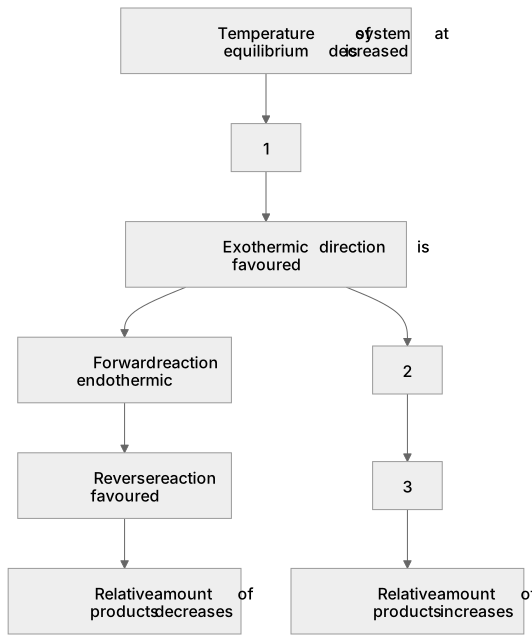
1Box 1
2Box 2
3Box 3
There is more to this lesson
The full lesson goes on to check your understanding and help you earn the marks. Create a free account to carry on, with your progress saved.
A week of Premium from your first lesson · Then the free plan continues · No card, no charge
Test your understanding of The effect of temperature changes on equilibrium (HT only): If the temperature of a system at equilibrium is decreased: the relative amount of products at equilibrium decreases for an endothermic reaction the relative amount of products at equilibrium increases for an exothermic reaction.
Active recall beats re-reading. Take an instant quiz now to test what you’ve learned and lock it into long-term memory.
A week of Premium from your first lesson · Then the free plan continues · No card, no charge