AQA · GCSE · Chemistry
Course version: 8462 · Version from Sept 2018
The energy needed to break bonds and the energy released when bonds are…
Full specification wording
The energy change of reactions (HT only): The energy needed to break bonds and the energy released when bonds are formed can be calculated from bond energies.
Bond energies are average values, usually quoted in kJ/mol, for breaking one mole of a given bond in the gaseous state.
Checked against the AQA 8462 specification (opens in a new tab) on .
- Point 2 of 6
- 3 key terms
Study notes
From the checked teaching notes for this specification point.
The idea
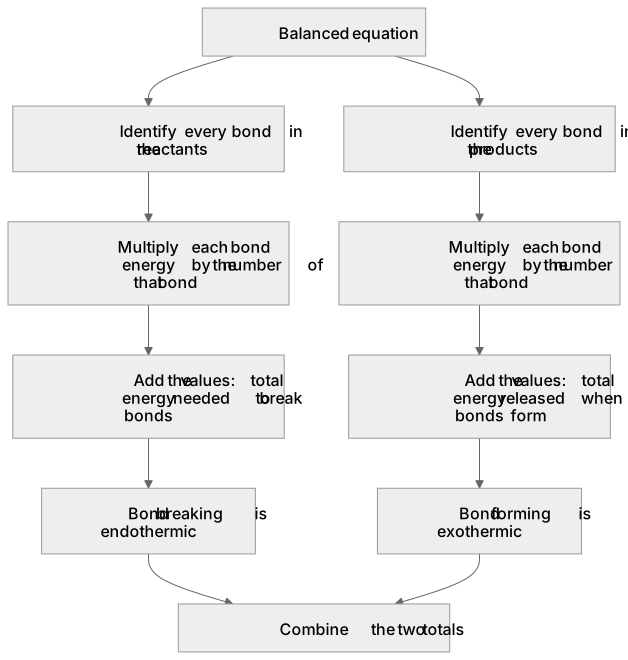
Bond energies are average values, usually quoted in kJ/mol, for breaking one mole of a given bond in the gaseous state. To calculate the energy needed to break bonds in the reactants, identify every bond in the reactant molecules, multiply each bond energy by the number of that bond present, and add the values. To calculate the energy released when bonds form in the products, do the same for the product molecules. For example, in H₂ + Cl₂ → 2HCl, breaking H–H and Cl–Cl requires 436 + 243 = 679 kJ/mol, while forming two H–Cl bonds releases 2 × 431 = 862 kJ/mol. Bond breaking is endothermic and bond forming is exothermic, so the two totals are calculated separately before being combined.
What earns the marks
- State that bond breaking is endothermic because energy must be supplied to overcome the attraction holding the atoms together.
- State that bond formation is exothermic because energy is released as new bonds form and the system becomes more stable.
- Use bond energies in kJ/mol as average values for breaking one mole of a specified bond in the gaseous state.
- Calculate the total energy needed to break bonds by multiplying each bond energy by the number of that bond in the reactants and adding the values.
- Calculate the total energy released when bonds form by multiplying each bond energy by the number of that bond in the products and adding the values.
- Show clear working that distinguishes the breaking total from the forming total before any subtraction is carried out.
Common mistakes and how to put them right
Adding bond energies for bonds that are not present in the equation.
Put it right by drawing displayed formulae for every reactant and product and counting each bond carefully.
Using the number of molecules rather than the number of bonds.
Put it right by multiplying the bond energy by the number of that specific bond in the balanced equation.
Treating bond formation as endothermic.
Put it right by remembering that forming bonds releases energy and only breaking bonds requires energy input.
Exam tips
- Draw displayed formulae for all reactants and products before selecting bond energies, so no bond is missed or double-counted.
- Write the breaking total and the forming total on separate lines with units of kJ/mol, then combine them in a clearly labelled final step.
- Check that the equation is balanced before counting bonds, because coefficients change the number of bonds present.
Try the lesson
The start of the The energy change of reactions (HT only): The energy needed to break bonds and the energy released when bonds are formed can be calculated from bond energies. lesson, made from checked teaching notes for this specification point.
Have a go first
A molecule of ammonia (NH₃) contains three N–H bonds. The bond energy of an N–H bond is 391 kJ/mol. What is the total energy needed to break all the bonds in one mole of ammonia?
Listen
Bond energies are average values, usually quoted in kJ/mol, for breaking one mole of a given bond in the gaseous state. To calculate the energy needed to break bonds in the reactants, identify every bond in the reactant molecules, multiply each bond energy by the number of that bond present, and add the values. To calculate the energy released when bonds form in the products, do the same for the product molecules. For example, in H₂ + Cl₂ → 2HCl, breaking H–H and Cl–Cl requires 436 + 243 = 679 kJ/mol, while forming two H–Cl bonds releases 2 × 431 = 862 kJ/mol. Bond breaking is endothermic and bond forming is exothermic, so the two totals are calculated separately before being combined. A strong answer earns marks for these points. State that bond breaking is endothermic because energy must be supplied to overcome the attraction holding the atoms together. State that bond formation is exothermic because energy is released as new bonds form and the system becomes more stable. Use bond energies in kJ/mol as average values for breaking one mole of a specified bond in the gaseous state. Calculate the total energy needed to break bonds by multiplying each bond energy by the number of that bond in the reactants and adding the values. A common slip: Adding bond energies for bonds that are not present in the equation. Instead, drawing displayed formulae for every reactant and product and counting each bond carefully. Exam tip: Draw displayed formulae for all reactants and products before selecting bond energies, so no bond is missed or double-counted.
See it
Key words
Say what each word means before you turn the card.
Bond breaking
Try answering aloud or in your head before turning the card.
Bond formation
Try answering aloud or in your head before turning the card.
Bond energies
Try answering aloud or in your head before turning the card.
See every definition
- Bond breaking
- Endothermic, because energy must be supplied to overcome the attraction holding the atoms together.
- Bond formation
- Exothermic, because energy is released as new bonds form and the system becomes more stable.
- Bond energies
- Average values, usually quoted in kJ/mol, for breaking one mole of a given bond in the gaseous state.
There is more to this lesson
The full lesson goes on to check your understanding and help you earn the marks. Create a free account to carry on, with your progress saved.
A week of Premium from your first lesson · Then the free plan continues · No card, no charge
Test your understanding of The energy change of reactions (HT only): The energy needed to break bonds and the energy released when bonds are formed can be calculated from bond energies.
Active recall beats re-reading. Take an instant quiz now to test what you’ve learned and lock it into long-term memory.
A week of Premium from your first lesson · Then the free plan continues · No card, no charge