AQA · GCSE · Chemistry
Course version: 8462 · Version from Sept 2018
(HT only) Students should be able to: interpret graphs of reaction…
Full specification wording
The Haber process: (HT only) Students should be able to: interpret graphs of reaction conditions versus rate apply the principles of dynamic equilibrium in Reversible reactions and dynamic equilibrium (page 59) to the Haber process explain the trade-off between rate of production and position of equilibrium explain how the commercially used conditions for the Haber process are related to the availability and cost of raw materials and energy supplies, control of equilibrium position and rate. AQA GCSE Chemistry 8462. GCSE ex
Raising temperature increases rate but shifts the exothermic forward reaction backwards, lowering yield, so about 450°C is a compromise.
Checked against the AQA 8462 specification (opens in a new tab) on .
- Point 5 of 5
Study notes
From the checked teaching notes for this specification point.
The idea
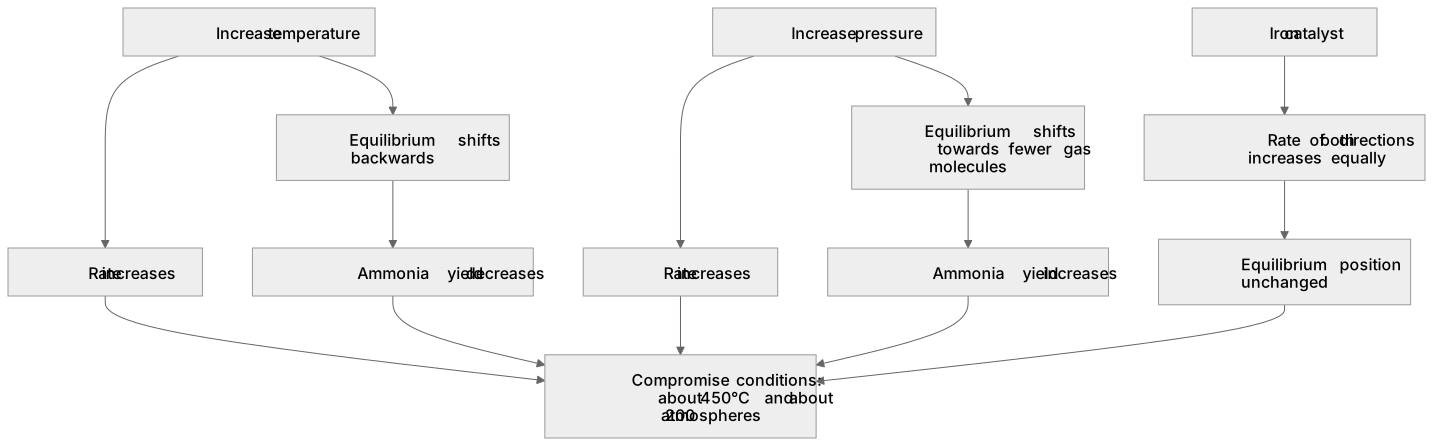
Raising temperature increases rate but shifts the exothermic forward reaction backwards, lowering yield, so about 450°C is a compromise. Raising pressure increases rate and shifts equilibrium towards fewer gas molecules, favouring ammonia, but very high pressure is expensive and hazardous, so about 200 atmospheres is used. The iron catalyst raises rate without changing equilibrium position. Graphs of rate against temperature or pressure show rate rising, while yield graphs show the equilibrium trade-off. Commercial choices also depend on the cost and availability of raw materials and energy, so the conditions balance yield, speed and expense.
What earns the marks
- Increasing temperature increases rate but shifts the exothermic equilibrium backwards, reducing ammonia yield.
- Increasing pressure increases rate and shifts equilibrium towards the side with fewer gas molecules, increasing ammonia yield.
- A catalyst increases the rate of both forward and reverse reactions equally and does not change the position of equilibrium.
- The chosen conditions are a compromise between rate of production, equilibrium yield, safety and cost.
- Graphs of rate against temperature or pressure show rate increasing as the variable increases.
- Graphs of yield against temperature show yield decreasing as temperature rises for this exothermic reaction.
- Raw material and energy costs influence the commercial conditions chosen.
- The Haber process uses about 450°C and about 200 atmospheres with an iron catalyst.
Common mistakes and how to put them right
Claiming a catalyst increases yield.
Put it right: A catalyst speeds up both directions equally and leaves the equilibrium position unchanged.
Saying higher temperature always gives more ammonia.
Put it right: Higher temperature lowers ammonia yield at equilibrium.
Stating that pressure has no effect on equilibrium.
Put it right: Increasing pressure favours the side with fewer gas molecules, which is the ammonia side.
Exam tips
- Use Le Chatelier reasoning explicitly: state the change, then the direction the equilibrium shifts, then the effect on yield.
- When interpreting a graph, read the axes first and quote a trend, for example rate rises with temperature while yield falls.
- Link each commercial condition to a reason involving rate, equilibrium, cost or safety to reach the higher tariff.
Try the lesson
The start of the The Haber process: (HT only) Students should be able to: interpret graphs of reaction conditions versus rate apply the principles of dynamic equilibrium in Reversible reactions and dynamic equilibrium (page 59) to the Haber process explain the trade-off between rate of production and position of equilibrium explain how the commercially used conditions for the Haber process are related to the availability and cost of raw materials and energy supplies, control of equilibrium position and rate. AQA GCSE Chemistry 8462. GCSE ex lesson, made from checked teaching notes for this specification point.
Have a go first
In the Haber process, the forward reaction to produce ammonia is exothermic. Why is a moderate temperature of 450 °C used rather than a much lower temperature?
Listen
Raising temperature increases rate but shifts the exothermic forward reaction backwards, lowering yield, so about 450°C is a compromise. Raising pressure increases rate and shifts equilibrium towards fewer gas molecules, favouring ammonia, but very high pressure is expensive and hazardous, so about 200 atmospheres is used. The iron catalyst raises rate without changing equilibrium position. Graphs of rate against temperature or pressure show rate rising, while yield graphs show the equilibrium trade-off. Commercial choices also depend on the cost and availability of raw materials and energy, so the conditions balance yield, speed and expense. A strong answer earns marks for these points. Increasing temperature increases rate but shifts the exothermic equilibrium backwards, reducing ammonia yield. Increasing pressure increases rate and shifts equilibrium towards the side with fewer gas molecules, increasing ammonia yield. A catalyst increases the rate of both forward and reverse reactions equally and does not change the position of equilibrium. The chosen conditions are a compromise between rate of production, equilibrium yield, safety and cost. A common slip: Claiming a catalyst increases yield: the error is confusing rate with equilibrium position. Instead, a catalyst speeds up both directions equally and leaves the equilibrium position unchanged. Exam tip: Use Le Chatelier reasoning explicitly: state the change, then the direction the equilibrium shifts, then the effect on yield.
See it
There is more to this lesson
The full lesson goes on to check your understanding and help you earn the marks. Create a free account to carry on, with your progress saved.
A week of Premium from your first lesson · Then the free plan continues · No card, no charge
Test your understanding of The Haber process: (HT only) Students should be able to: interpret graphs of reaction conditions versus rate apply the principles of dynamic equilibrium in Reversible reactions and dynamic equilibrium (page 59) to the Haber process explain the trade-off between rate of production and position of equilibrium explain how the commercially used conditions for the Haber process are related to the availability and cost of raw materials and energy supplies, control of equilibrium position and rate. AQA GCSE Chemistry 8462. GCSE ex
Active recall beats re-reading. Take an instant quiz now to test what you’ve learned and lock it into long-term memory.
A week of Premium from your first lesson · Then the free plan continues · No card, no charge