AQA · GCSE · Chemistry
Course version: 8462 · Version from Sept 2018
Passing an electric current through electrolytes causes the ions to move…
Full specification wording
The process of electrolysis: Passing an electric current through electrolytes causes the ions to move to the electrodes.
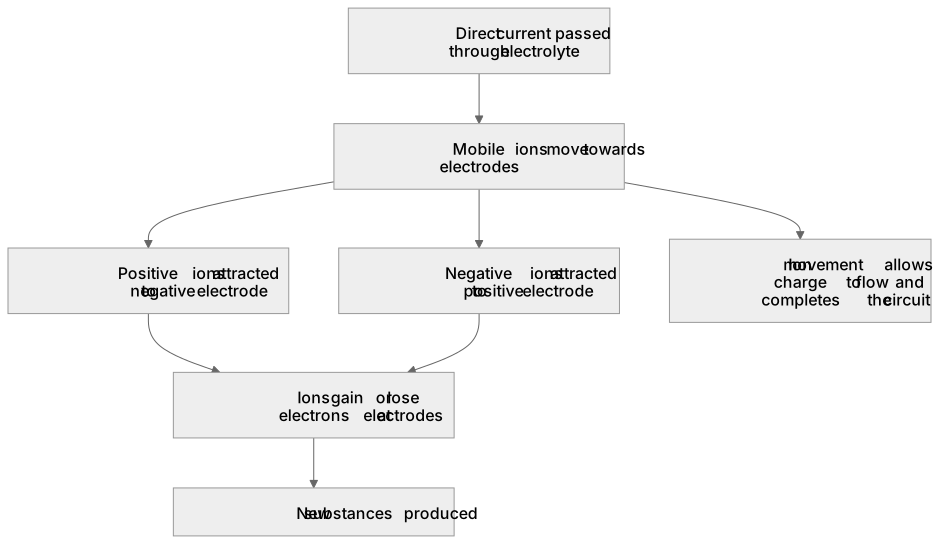
When a direct current is passed through an electrolyte, the mobile ions move towards the electrodes.
Checked against the AQA 8462 specification (opens in a new tab) on .
- Point 3 of 7
- 4 key terms
Study notes
From the checked teaching notes for this specification point.
The idea
When a direct current is passed through an electrolyte, the mobile ions move towards the electrodes. Positively charged ions are attracted to the negative electrode, and negatively charged ions are attracted to the positive electrode. This movement of ions through the electrolyte completes the circuit and allows charge to flow. For example, in molten sodium chloride, Na⁺ ions move towards the negative electrode and Cl⁻ ions move towards the positive electrode. The ions then gain or lose electrons at the electrodes, producing new substances. This process is electrolysis, and it requires a direct current supply and mobile ions.
What earns the marks
- Passing a direct current through an electrolyte causes ions to move towards the electrodes.
- The movement of ions through the electrolyte allows charge to flow and completes the circuit.
- Ions are discharged at the electrodes, where they gain or lose electrons.
- Electrolysis requires mobile ions and a direct current supply.
- A named example such as molten sodium chloride can be used to show Na⁺ and Cl⁻ ions moving to opposite electrodes.
Common mistakes and how to put them right
Thinking that ions move only when the current is switched on but not before.
Put it right: Ions are already mobile in the electrolyte and the current causes their directed movement.
Believing that electrons flow through the electrolyte.
Put it right: Ions carry charge through the electrolyte while electrons flow in the external circuit.
Assuming that alternating current is used.
Put it right: Electrolysis uses a direct current so that the electrodes keep fixed polarities.
Exam tips
- State that a direct current is needed and explain that it causes directed ion movement.
- Describe the movement of both positive and negative ions to show a complete picture.
- Link ion movement to discharge at the electrodes and the formation of new substances.
Try the lesson
The start of the The process of electrolysis: Passing an electric current through electrolytes causes the ions to move to the electrodes. lesson, made from checked teaching notes for this specification point.
Have a go first
What happens to the ions in an electrolyte when an electric current is passed through it?
Listen
When a direct current is passed through an electrolyte, the mobile ions move towards the electrodes. Positively charged ions are attracted to the negative electrode, and negatively charged ions are attracted to the positive electrode. This movement of ions through the electrolyte completes the circuit and allows charge to flow. For example, in molten sodium chloride, Na⁺ ions move towards the negative electrode and Cl⁻ ions move towards the positive electrode. The ions then gain or lose electrons at the electrodes, producing new substances. This process is electrolysis, and it requires a direct current supply and mobile ions. A strong answer earns marks for these points. Passing a direct current through an electrolyte causes ions to move towards the electrodes. The movement of ions through the electrolyte allows charge to flow and completes the circuit. Ions are discharged at the electrodes, where they gain or lose electrons. Electrolysis requires mobile ions and a direct current supply. A common slip: Thinking that ions move only when the current is switched on but not before. Instead, ions are already mobile in the electrolyte and the current causes their directed movement. Exam tip: State that a direct current is needed and explain that it causes directed ion movement.
See it
Key words
Say what each word means before you turn the card.
Electrolysis and direct current
Try answering aloud or in your head before turning the card.
Ion migration in electrolytes
Try answering aloud or in your head before turning the card.
Charge flow in circuits
Try answering aloud or in your head before turning the card.
Discharge at electrodes
Try answering aloud or in your head before turning the card.
See every definition
- Electrolysis and direct current
- Passing a direct current through an electrolyte causes the mobile ions to move towards the electrodes, and this process is electrolysis.
- Ion migration in electrolytes
- Positively charged ions are attracted to the negative electrode and negatively charged ions are attracted to the positive electrode.
- Charge flow in circuits
- The movement of ions through the electrolyte allows charge to flow and completes the circuit.
- Discharge at electrodes
- The ions gain or lose electrons at the electrodes, producing new substances.
Label the diagram
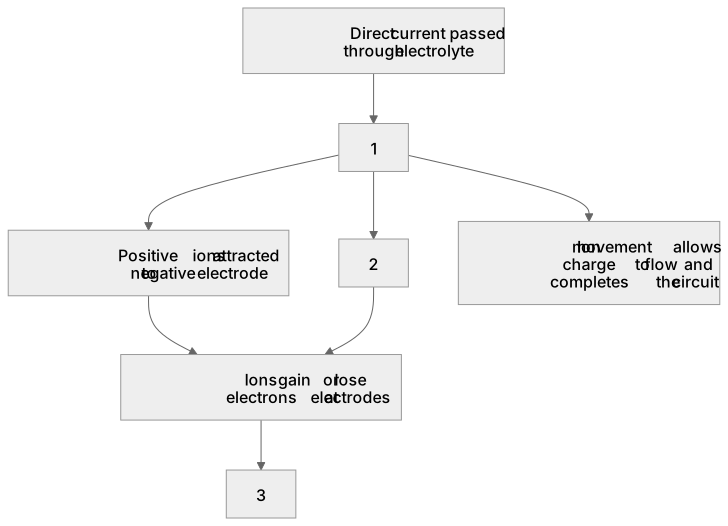
Some boxes have lost their names. Pick the right name for each number.
1Box 1
2Box 2
3Box 3
There is more to this lesson
The full lesson goes on to check your understanding and help you earn the marks. Create a free account to carry on, with your progress saved.
A week of Premium from your first lesson · Then the free plan continues · No card, no charge
Test your understanding of The process of electrolysis: Passing an electric current through electrolytes causes the ions to move to the electrodes.
Active recall beats re-reading. Take an instant quiz now to test what you’ve learned and lock it into long-term memory.
A week of Premium from your first lesson · Then the free plan continues · No card, no charge