AQA · GCSE · Chemistry
Course version: 8462 · Version from Sept 2018
When an ionic compound is melted or dissolved in water, the ions are free…
Full specification wording
The process of electrolysis: When an ionic compound is melted or dissolved in water, the ions are free to move about within the liquid or solution.
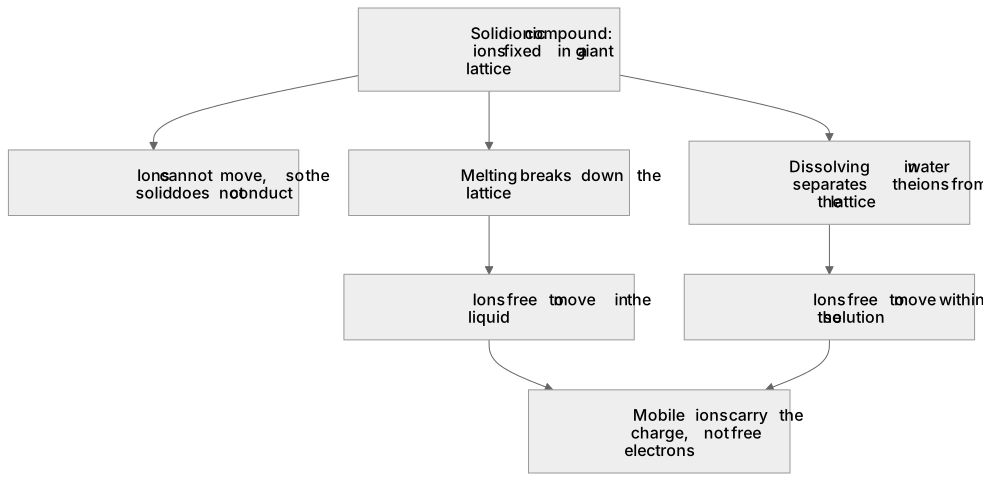
In a solid ionic compound, the ions are held in a giant lattice and cannot move, so it does not conduct.
Checked against the AQA 8462 specification (opens in a new tab) on .
- Point 1 of 7
Study notes
From the checked teaching notes for this specification point.
The idea
In a solid ionic compound, the ions are held in a giant lattice and cannot move, so it does not conduct. Melting or dissolving in water breaks down this lattice and releases the ions. Once released, the ions are free to move about within the liquid or solution. For example, solid sodium chloride does not conduct, but molten sodium chloride and sodium chloride solution both contain mobile Na⁺ and Cl⁻ ions. The key idea is that mobile ions, not electrons, carry charge in these liquids and solutions. This explains why an ionic compound must be molten or dissolved before it can be electrolysed.
What earns the marks
- Solid ionic compounds contain ions fixed in a giant lattice, so the ions cannot move and the solid does not conduct.
- Melting provides energy to break down the lattice, releasing ions that are free to move in the liquid.
- Dissolving in water separates the ions from the lattice and allows them to move about within the solution.
- Mobile ions are the charge carriers in molten and dissolved ionic compounds, not free electrons.
- A named example such as molten sodium chloride or sodium chloride solution can be used to illustrate mobile Na⁺ and Cl⁻ ions.
Common mistakes and how to put them right
Thinking that solid ionic compounds conduct because they contain charged ions.
Put it right: The ions are fixed in the lattice and cannot move.
Believing that electrons carry charge through molten or dissolved ionic compounds.
Put it right: Mobile ions carry the charge.
Assuming that dissolving always produces mobile ions for every compound.
Put it right: This applies to ionic compounds that dissolve and release their ions.
Exam tips
- Link the state of the compound directly to ion mobility: solid means fixed ions, molten or dissolved means mobile ions.
- Use a named ionic compound and identify the ions present, such as Na⁺ and Cl⁻, to make the explanation concrete.
- When asked why a solid does not conduct, refer to the lattice and the inability of ions to move rather than saying there are no ions.
Try the lesson
The start of the The process of electrolysis: When an ionic compound is melted or dissolved in water, the ions are free to move about within the liquid or solution. lesson, made from checked teaching notes for this specification point.
Have a go first
Why can a molten ionic compound conduct electricity?
Listen
In a solid ionic compound, the ions are held in a giant lattice and cannot move, so it does not conduct. Melting or dissolving in water breaks down this lattice and releases the ions. Once released, the ions are free to move about within the liquid or solution. For example, solid sodium chloride does not conduct, but molten sodium chloride and sodium chloride solution both contain mobile Na⁺ and Cl⁻ ions. The key idea is that mobile ions, not electrons, carry charge in these liquids and solutions. This explains why an ionic compound must be molten or dissolved before it can be electrolysed. A strong answer earns marks for these points. Solid ionic compounds contain ions fixed in a giant lattice, so the ions cannot move and the solid does not conduct. Melting provides energy to break down the lattice, releasing ions that are free to move in the liquid. Dissolving in water separates the ions from the lattice and allows them to move about within the solution. Mobile ions are the charge carriers in molten and dissolved ionic compounds, not free electrons. A common slip: Thinking that solid ionic compounds conduct because they contain charged ions. Instead, the ions are fixed in the lattice and cannot move. Exam tip: Link the state of the compound directly to ion mobility: solid means fixed ions, molten or dissolved means mobile ions.
See it
Label the diagram
Some boxes have lost their names. Pick the right name for each number.
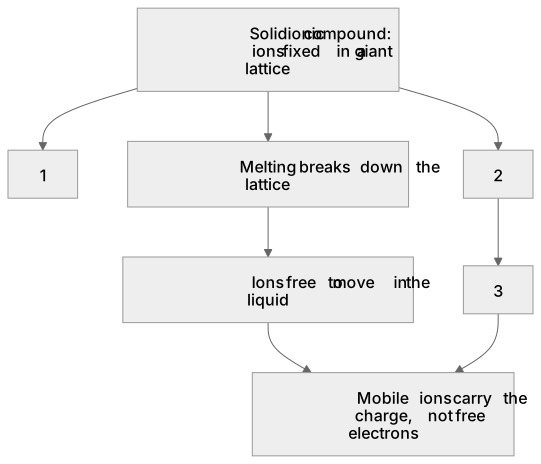
1Box 1
2Box 2
3Box 3
There is more to this lesson
The full lesson goes on to check your understanding and help you earn the marks. Create a free account to carry on, with your progress saved.
A week of Premium from your first lesson · Then the free plan continues · No card, no charge
Test your understanding of The process of electrolysis: When an ionic compound is melted or dissolved in water, the ions are free to move about within the liquid or solution.
Active recall beats re-reading. Take an instant quiz now to test what you’ve learned and lock it into long-term memory.
A week of Premium from your first lesson · Then the free plan continues · No card, no charge