AQA · GCSE · Chemistry
Course version: 8462 · Version from Sept 2018
For 200 million years, the proportions of different gases in the…
Full specification wording
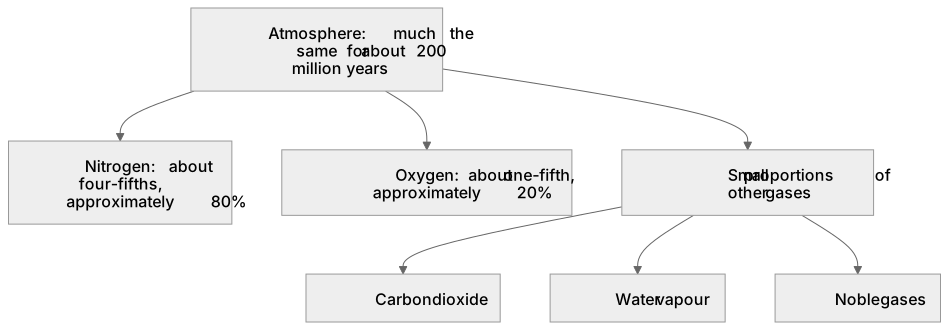
The proportions of different gases in the atmosphere: For 200 million years, the proportions of different gases in the atmosphere have been much the same as they are today: about four-fifths (approximately 80%) nitrogen about one-fifth (approximately 20%) oxygen small proportions of various other gases, including carbon dioxide, water vapour and noble gases.
The atmosphere has been stable in composition for about 200 million years.
Checked against the AQA 8462 specification (opens in a new tab) on .
- 3 key terms
Study notes
From the checked teaching notes for this specification point.
The idea
The atmosphere has been stable in composition for about 200 million years. Today it is roughly four-fifths nitrogen, about 80%, and one-fifth oxygen, about 20%. The remaining small proportion contains other gases, including carbon dioxide, water vapour and noble gases such as argon. These fractions describe dry air; water vapour varies with location and weather. For example, in 100 cm³ of dry air, about 80 cm³ is nitrogen and about 20 cm³ is oxygen, leaving only a small volume for carbon dioxide, water vapour and noble gases. The phrase 'much the same' means the proportions have not changed significantly over that period, even though human activities now add carbon dioxide.
What earns the marks
- State that the atmosphere has had much the same proportions of gases for about 200 million years.
- Give nitrogen as about four-fifths, approximately 80%, of the atmosphere.
- Give oxygen as about one-fifth, approximately 20%, of the atmosphere.
- Name carbon dioxide, water vapour and noble gases as small proportions of the remaining gases.
- Use the fractions four-fifths and one-fifth correctly when describing the main gases.
- Recognise that the percentages describe dry air and that water vapour is variable.
Common mistakes and how to put them right
Reversing the proportions and stating 80% oxygen.
Put it right: Nitrogen is about 80% and oxygen about 20%.
Treating carbon dioxide as a major component.
Put it right: It is a small proportion, along with water vapour and noble gases.
Assuming the composition has never changed.
Put it right: It has been much the same for about 200 million years, but the early atmosphere was different.
Exam tips
- Learn the two main fractions as four-fifths nitrogen and one-fifth oxygen, with the percentages.
- When asked for other gases, name carbon dioxide, water vapour and noble gases rather than giving a single example.
- Use the phrase 'much the same' to show stability over 200 million years, not exact constancy.
Try the lesson
The start of the The proportions of different gases in the atmosphere: For 200 million years, the proportions of different gases in the atmosphere have been much the same as they are today: about four-fifths (approximately 80%) nitrogen about one-fifth (approximately 20%) oxygen small proportions of various other gases, including carbon dioxide, water vapour and noble gases. lesson, made from checked teaching notes for this specification point.
Have a go first
Which gas makes up about four-fifths of the atmosphere today?
Listen
The atmosphere has been stable in composition for about 200 million years. Today it is roughly four-fifths nitrogen, about 80%, and one-fifth oxygen, about 20%. The remaining small proportion contains other gases, including carbon dioxide, water vapour and noble gases such as argon. These fractions describe dry air; water vapour varies with location and weather. For example, in 100 cm³ of dry air, about 80 cm³ is nitrogen and about 20 cm³ is oxygen, leaving only a small volume for carbon dioxide, water vapour and noble gases. The phrase 'much the same' means the proportions have not changed significantly over that period, even though human activities now add carbon dioxide. A strong answer earns marks for these points. State that the atmosphere has had much the same proportions of gases for about 200 million years. Give nitrogen as about four-fifths, approximately 80%, of the atmosphere. Give oxygen as about one-fifth, approximately 20%, of the atmosphere. Name carbon dioxide, water vapour and noble gases as small proportions of the remaining gases. A common slip: Reversing the proportions and stating 80% oxygen. Instead, nitrogen is about 80% and oxygen about 20%. Exam tip: Learn the two main fractions as four-fifths nitrogen and one-fifth oxygen, with the percentages.
See it
Key words
Say what each word means before you turn the card.
Proportions of gases
Try answering aloud or in your head before turning the card.
Stability over geological time
Try answering aloud or in your head before turning the card.
Small proportions of other gases
Try answering aloud or in your head before turning the card.
See every definition
- Proportions of gases
- The fractions of different gases in the atmosphere, which have been much the same as they are today for 200 million years.
- Stability over geological time
- The atmosphere has had much the same proportions of gases for about 200 million years, meaning they have not changed significantly over that period.
- Small proportions of other gases
- The remaining part of the atmosphere contains various other gases, including carbon dioxide, water vapour and noble gases.
Label the diagram
Some boxes have lost their names. Pick the right name for each number.
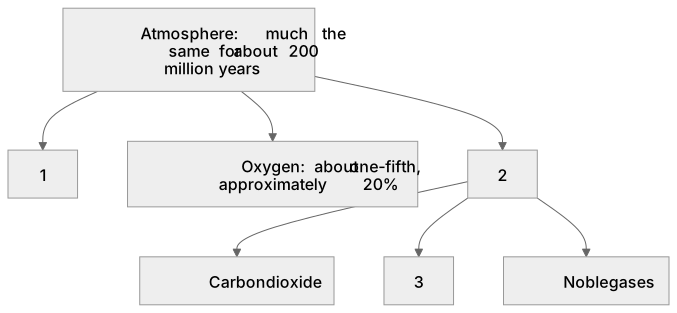
1Box 1
2Box 2
3Box 3
There is more to this lesson
The full lesson goes on to check your understanding and help you earn the marks. Create a free account to carry on, with your progress saved.
A week of Premium from your first lesson · Then the free plan continues · No card, no charge
Test your understanding of The proportions of different gases in the atmosphere: For 200 million years, the proportions of different gases in the atmosphere have been much the same as they are today: about four-fifths (approximately 80%) nitrogen about one-fifth (approximately 20%) oxygen small proportions of various other gases, including carbon dioxide, water vapour and noble gases.
Active recall beats re-reading. Take an instant quiz now to test what you’ve learned and lock it into long-term memory.
A week of Premium from your first lesson · Then the free plan continues · No card, no charge