AQA · GCSE · Chemistry
Course version: 8462 · Version from Sept 2018
The non-metals hydrogen and carbon are often included in the reactivity…
Full specification wording
The reactivity series: The non-metals hydrogen and carbon are often included in the reactivity series.
The reactivity series is not limited to metals.
Checked against the AQA 8462 specification (opens in a new tab) on .
- Point 5 of 7
- 4 key terms
Study notes
From the checked teaching notes for this specification point.
The idea
The reactivity series is not limited to metals. Hydrogen and carbon are non-metals placed among the metals to predict displacement and extraction. Hydrogen sits between lead and copper in the usual order, so metals above hydrogen displace it from dilute acids, while copper and metals below it do not. Carbon sits between aluminium and zinc, so metals below carbon, such as zinc and iron, can be extracted from their oxides by heating with carbon, whereas metals above carbon, such as aluminium, cannot be extracted this way. Including these non-metals turns the series into a ranking of tendency to form positive ions or, for carbon, tendency to take oxygen from a metal oxide.
What earns the marks
- Hydrogen is placed between lead and copper in the reactivity series.
- Metals above hydrogen displace hydrogen from dilute acids; metals below hydrogen, such as copper, do not.
- Carbon is placed between aluminium and zinc in the reactivity series.
- Metals below carbon can be extracted from their oxides by heating with carbon; metals above carbon cannot be extracted this way.
- The position of a non-metal in the series allows predictions about displacement and extraction.
Common mistakes and how to put them right
Treating hydrogen and carbon as metals.
Put it right by stating that they are non-metals included in the series for prediction.
Placing carbon above aluminium.
Put it right by placing carbon between aluminium and zinc.
Claiming copper displaces hydrogen from dilute acid.
Put it right by stating that copper is below hydrogen and does not displace it.
Exam tips
- State the position of hydrogen or carbon relative to named metals when explaining a prediction.
- Link the position of carbon to extraction: metals below carbon can be reduced by carbon, metals above cannot.
- Use the series to justify a prediction rather than simply naming the more reactive substance.
Try the lesson
The start of the The reactivity series: The non-metals hydrogen and carbon are often included in the reactivity series. lesson, made from checked teaching notes for this specification point.
Have a go first
Which two non-metals are often included in the reactivity series to help predict how metals can be extracted and how they react with acids?
Listen
The reactivity series is not limited to metals. Hydrogen and carbon are non-metals placed among the metals to predict displacement and extraction. Hydrogen sits between lead and copper in the usual order, so metals above hydrogen displace it from dilute acids, while copper and metals below it do not. Carbon sits between aluminium and zinc, so metals below carbon, such as zinc and iron, can be extracted from their oxides by heating with carbon, whereas metals above carbon, such as aluminium, cannot be extracted this way. Including these non-metals turns the series into a ranking of tendency to form positive ions or, for carbon, tendency to take oxygen from a metal oxide. A strong answer earns marks for these points. Hydrogen is placed between lead and copper in the reactivity series. Metals above hydrogen displace hydrogen from dilute acids; metals below hydrogen, such as copper, do not. Carbon is placed between aluminium and zinc in the reactivity series. Metals below carbon can be extracted from their oxides by heating with carbon; metals above carbon cannot be extracted this way. A common slip: Treating hydrogen and carbon as metals. Instead, stating that they are non-metals included in the series for prediction. Exam tip: State the position of hydrogen or carbon relative to named metals when explaining a prediction.
See it
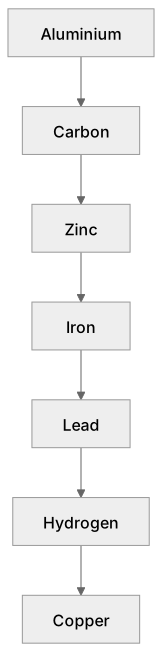
Put it in order
Put these steps in the order they happen.
- 1. Copper
- 2. Hydrogen
- 3. Zinc
- 4. Lead
- 5. Aluminium
- 6. Carbon
- 7. Iron
Key words
Say what each word means before you turn the card.
Reactivity series
Try answering aloud or in your head before turning the card.
Non-metals in the series
Try answering aloud or in your head before turning the card.
Displacement of hydrogen
Try answering aloud or in your head before turning the card.
Extraction of metals with carbon
Try answering aloud or in your head before turning the card.
See every definition
- Reactivity series
- A ranking that includes the non-metals hydrogen and carbon as well as metals, used to predict displacement and extraction.
- Non-metals in the series
- Hydrogen and carbon are included among the metals in the series for prediction.
- Displacement of hydrogen
- Metals above hydrogen displace it from dilute acids, while metals below hydrogen, such as copper, do not.
- Extraction of metals with carbon
- Metals below carbon can be extracted from their oxides by heating with carbon, whereas metals above carbon cannot be extracted this way.
Label the diagram
Some boxes have lost their names. Pick the right name for each number.
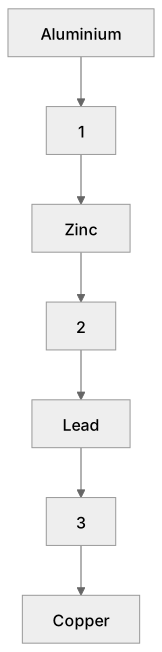
1Box 1
2Box 2
3Box 3
There is more to this lesson
The full lesson goes on to check your understanding and help you earn the marks. Create a free account to carry on, with your progress saved.
A week of Premium from your first lesson · Then the free plan continues · No card, no charge
Test your understanding of The reactivity series: The non-metals hydrogen and carbon are often included in the reactivity series.
Active recall beats re-reading. Take an instant quiz now to test what you’ve learned and lock it into long-term memory.
A week of Premium from your first lesson · Then the free plan continues · No card, no charge