AQA · GCSE · Chemistry
Course version: 8462 · Version from Sept 2018
Melting and freezing take place at the melting point, boiling and…
Full specification wording
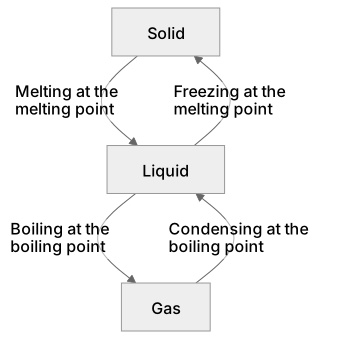
The three states of matter: Melting and freezing take place at the melting point, boiling and condensing take place at the boiling point.
Each pure substance changes state at fixed temperatures.
Checked against the AQA 8462 specification (opens in a new tab) on .
- Point 2 of 9
- 3 key terms
Study notes
From the checked teaching notes for this specification point.
The idea
Each pure substance changes state at fixed temperatures. Melting is the change from solid to liquid and freezing is the reverse, liquid to solid; both occur at the melting point. Boiling is the change from liquid to gas and condensing is the reverse, gas to liquid; both occur at the boiling point. For a pure substance, the melting point and freezing point are the same temperature, and the boiling point and condensation point are the same temperature. For example, pure water melts and freezes at 0 °C and boils and condenses at 100 °C at normal atmospheric pressure. During a change of state, energy is transferred but the temperature stays constant until the change is complete. Impurities usually lower the melting point and raise the boiling point, which is why melting and boiling points can be used to check purity.
What earns the marks
- States that melting and freezing occur at the melting point.
- States that boiling and condensing occur at the boiling point.
- Identifies melting and boiling as changes requiring energy input, and freezing and condensing as changes releasing energy.
- Explains that temperature remains constant during a change of state.
- Uses melting and boiling points to identify a pure substance or detect impurities.
Common mistakes and how to put them right
Saying that boiling can occur at any temperature.
Put it right by stating that boiling occurs at the boiling point.
Confusing evaporation with boiling.
Put it right by noting that evaporation occurs below the boiling point from the surface of a liquid.
Stating that temperature rises during melting.
Put it right by explaining that the temperature stays constant while the state changes.
Exam tips
- Label the flat sections of a heating or cooling curve as changes of state.
- Quote the melting point and boiling point of water as 0 °C and 100 °C when needed.
- When comparing pure and impure samples, refer to changes in melting and boiling points.
Try the lesson
The start of the The three states of matter: Melting and freezing take place at the melting point, boiling and condensing take place at the boiling point. lesson, made from checked teaching notes for this specification point.
Have a go first
Which two changes of state take place at the melting point of a substance?
Listen
Each pure substance changes state at fixed temperatures. Melting is the change from solid to liquid and freezing is the reverse, liquid to solid; both occur at the melting point. Boiling is the change from liquid to gas and condensing is the reverse, gas to liquid; both occur at the boiling point. For a pure substance, the melting point and freezing point are the same temperature, and the boiling point and condensation point are the same temperature. For example, pure water melts and freezes at 0 °C and boils and condenses at 100 °C at normal atmospheric pressure. During a change of state, energy is transferred but the temperature stays constant until the change is complete. Impurities usually lower the melting point and raise the boiling point, which is why melting and boiling points can be used to check purity. A strong answer earns marks for these points. States that melting and freezing occur at the melting point. States that boiling and condensing occur at the boiling point. Identifies melting and boiling as changes requiring energy input, and freezing and condensing as changes releasing energy. Explains that temperature remains constant during a change of state. A common slip: Saying that boiling can occur at any temperature. Instead, stating that boiling occurs at the boiling point. Exam tip: Label the flat sections of a heating or cooling curve as changes of state.
See it
Key words
Say what each word means before you turn the card.
Changes of state
Try answering aloud or in your head before turning the card.
Melting and boiling points
Try answering aloud or in your head before turning the card.
Purity and impurities
Try answering aloud or in your head before turning the card.
See every definition
- Changes of state
- Energy is transferred during a change of state, but the temperature stays constant until the change is complete.
- Melting and boiling points
- Melting and freezing occur at the melting point, and boiling and condensing occur at the boiling point.
- Purity and impurities
- Impurities usually lower the melting point and raise the boiling point, so melting and boiling points can be used to check purity.
Label the diagram
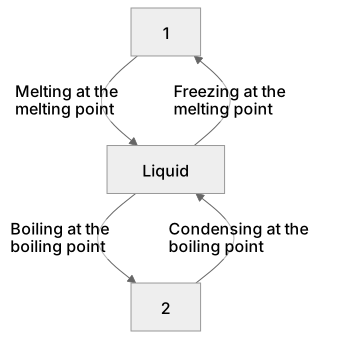
Some boxes have lost their names. Pick the right name for each number.
1Box 1
2Box 2
There is more to this lesson
The full lesson goes on to check your understanding and help you earn the marks. Create a free account to carry on, with your progress saved.
A week of Premium from your first lesson · Then the free plan continues · No card, no charge
Test your understanding of The three states of matter: Melting and freezing take place at the melting point, boiling and condensing take place at the boiling point.
Active recall beats re-reading. Take an instant quiz now to test what you’ve learned and lock it into long-term memory.
A week of Premium from your first lesson · Then the free plan continues · No card, no charge