AQA · GCSE · Chemistry
Course version: 8462 · Version from Sept 2018
Particle theory can help to explain melting, boiling, freezing and…
Full specification wording
The three states of matter: Particle theory can help to explain melting, boiling, freezing and condensing.
Particle theory explains changes of state by tracking energy, spacing and motion.
Checked against the AQA 8462 specification (opens in a new tab) on .
- Point 4 of 9
- 4 key terms
Study notes
From the checked teaching notes for this specification point.
The idea
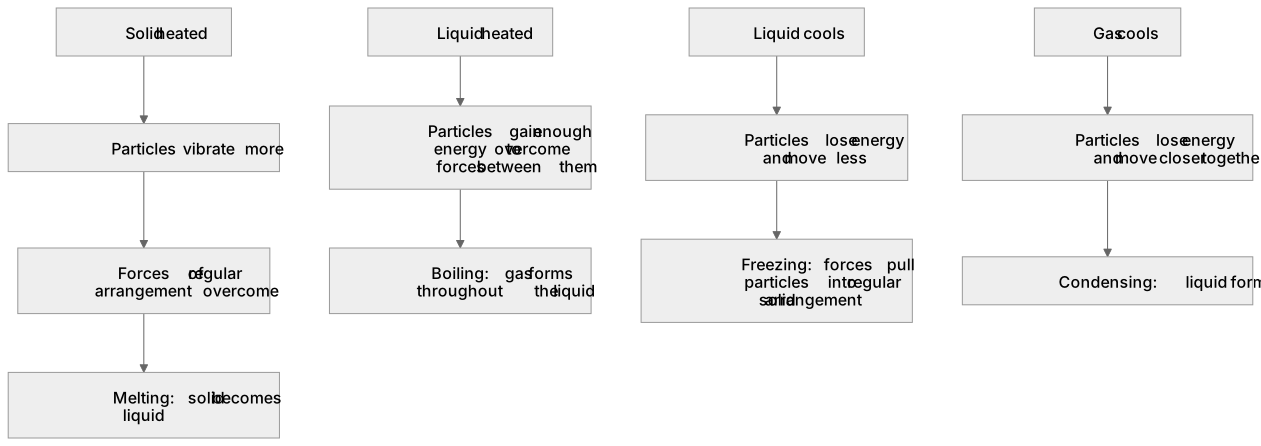
Particle theory explains changes of state by tracking energy, spacing and motion. Melting: a solid is heated, particles vibrate more until the forces holding the regular arrangement are overcome, and the solid becomes a liquid. Boiling: a liquid is heated, particles gain enough energy to overcome the forces between them and escape as a gas throughout the liquid. Freezing: a liquid cools, particles lose energy and move less, so forces pull them into a regular solid arrangement. Condensing: a gas cools, particles lose energy and move closer together, forming a liquid. In each change the particles themselves are unchanged; only their energy, spacing and arrangement alter.
For example: Steam condensing on a cold window forms liquid water droplets.
What earns the marks
- Explains melting as heating a solid so particles vibrate more until the regular arrangement breaks down and the solid becomes a liquid.
- Explains boiling as heating a liquid so particles gain enough energy to overcome the forces between them and form a gas throughout the liquid.
- Explains freezing as cooling a liquid so particles lose energy, move less and become locked into a regular solid arrangement.
- Explains condensing as cooling a gas so particles lose energy, move closer together and form a liquid.
- States that the particles themselves are unchanged during a change of state; only their energy, spacing and arrangement change.
- Uses particle theory to link each change of state to the energy transferred to or from the substance.
Common mistakes and how to put them right
Saying that boiling and evaporation are the same process.
Put it right by stating that boiling occurs throughout a liquid at a specific temperature, while evaporation occurs at the surface over a range of temperatures.
Saying that particles expand when heated.
Put it right by stating that the particles themselves do not expand; they move further apart or vibrate more.
Saying that energy is destroyed when a gas condenses.
Put it right by stating that energy is transferred to the surroundings as the gas cools.
Exam tips
- Name the change of state, state whether energy is gained or lost, then describe the effect on particle motion and arrangement.
- Use the terms vibrate, overcome forces, move freely and regular arrangement to show precise particle-theory reasoning.
- Check that your answer keeps the particles themselves unchanged; only their energy and spacing should alter.
Try the lesson
The start of the The three states of matter: Particle theory can help to explain melting, boiling, freezing and condensing. lesson, made from checked teaching notes for this specification point.
Have a go first
According to particle theory, what happens to the particles in a solid when it melts?
Listen
Particle theory explains changes of state by tracking energy, spacing and motion. Melting: a solid is heated, particles vibrate more until the forces holding the regular arrangement are overcome, and the solid becomes a liquid. Boiling: a liquid is heated, particles gain enough energy to overcome the forces between them and escape as a gas throughout the liquid. Freezing: a liquid cools, particles lose energy and move less, so forces pull them into a regular solid arrangement. Condensing: a gas cools, particles lose energy and move closer together, forming a liquid. In each change the particles themselves are unchanged; only their energy, spacing and arrangement alter. For example, steam condensing on a cold window forms liquid water droplets. A strong answer earns marks for these points. Explains melting as heating a solid so particles vibrate more until the regular arrangement breaks down and the solid becomes a liquid. Explains boiling as heating a liquid so particles gain enough energy to overcome the forces between them and form a gas throughout the liquid. Explains freezing as cooling a liquid so particles lose energy, move less and become locked into a regular solid arrangement. Explains condensing as cooling a gas so particles lose energy, move closer together and form a liquid. A common slip: Saying that boiling and evaporation are the same process. Instead, stating that boiling occurs throughout a liquid at a specific temperature, while evaporation occurs at the surface over a range of temperatures. Exam tip: Name the change of state, state whether energy is gained or lost, then describe the effect on particle motion and arrangement.
See it
Key words
Say what each word means before you turn the card.
Melting
Try answering aloud or in your head before turning the card.
Boiling
Try answering aloud or in your head before turning the card.
Freezing
Try answering aloud or in your head before turning the card.
Condensing
Try answering aloud or in your head before turning the card.
See every definition
- Melting
- Heating a solid so particles vibrate more until the forces holding the regular arrangement are overcome and the solid becomes a liquid.
- Boiling
- Heating a liquid so particles gain enough energy to overcome the forces between them and escape as a gas throughout the liquid.
- Freezing
- Cooling a liquid so particles lose energy and move less, so forces pull them into a regular solid arrangement.
- Condensing
- Cooling a gas so particles lose energy and move closer together, forming a liquid.
Label the diagram
Some boxes have lost their names. Pick the right name for each number.
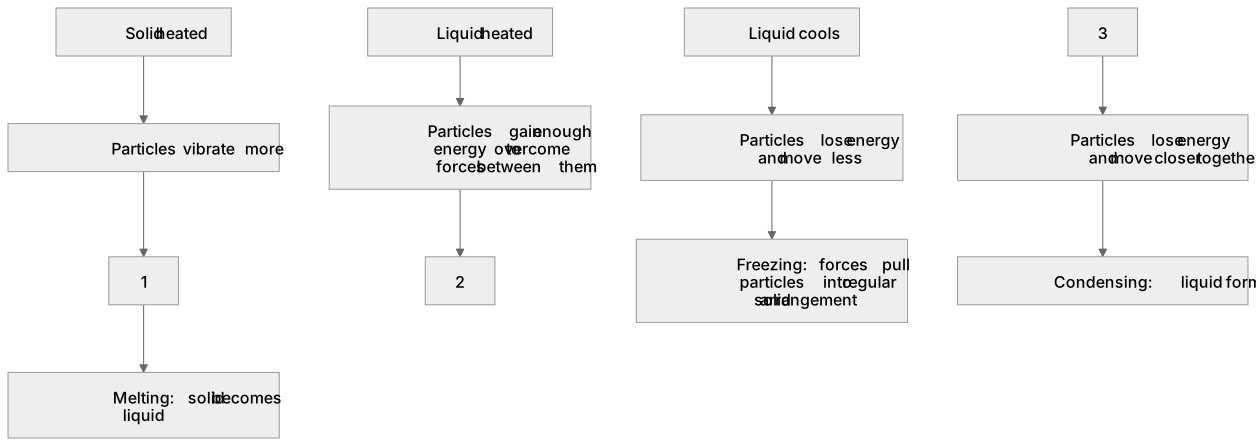
1Box 1
2Box 2
3Box 3
There is more to this lesson
The full lesson goes on to check your understanding and help you earn the marks. Create a free account to carry on, with your progress saved.
A week of Premium from your first lesson · Then the free plan continues · No card, no charge
Test your understanding of The three states of matter: Particle theory can help to explain melting, boiling, freezing and condensing.
Active recall beats re-reading. Take an instant quiz now to test what you’ve learned and lock it into long-term memory.
A week of Premium from your first lesson · Then the free plan continues · No card, no charge